
Photo: Miya Mizuno/Sony Pictures/Everett Collection
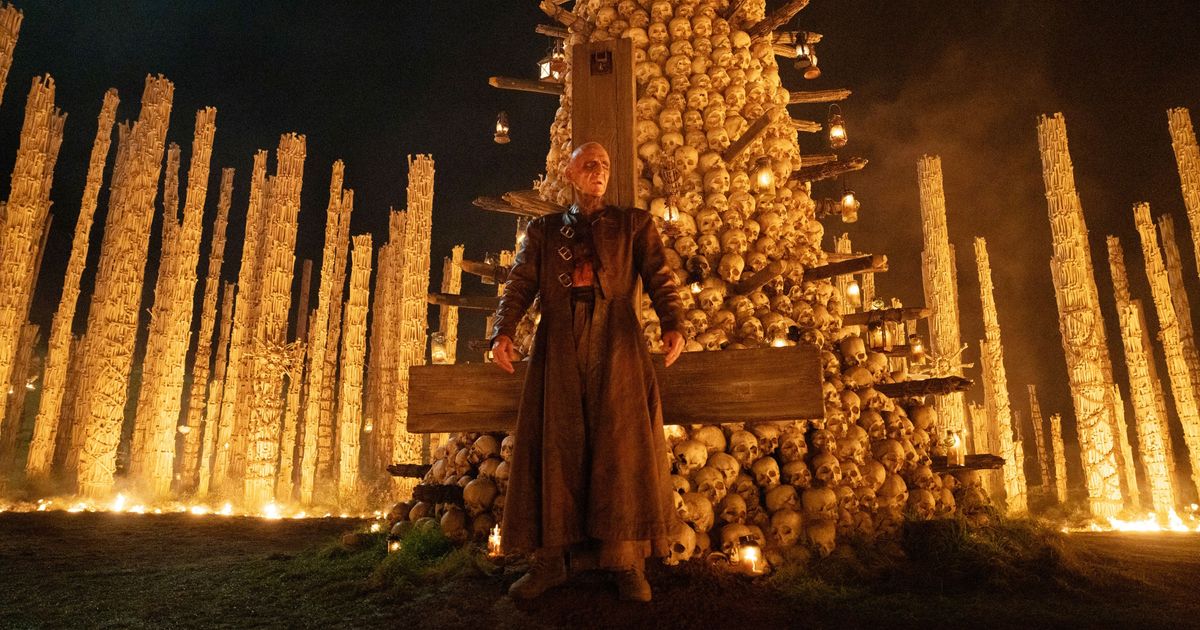
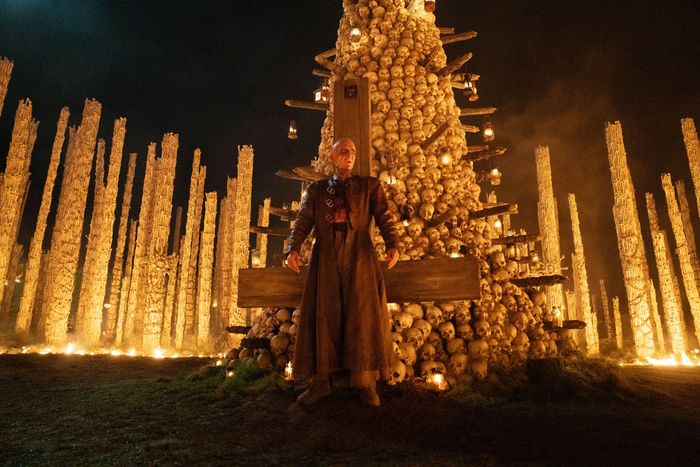
I know it sounds hyperbolic and as though I have the memory of a mayfly when I say Ralph Fiennes’s performance in The Bone Temple may just be the best thing he’s ever done. But by the end of Nia DaCosta’s sequel to the Danny Boyle–directed 28 Year Later, I started to believe it. At the very least, it’s the most Ralph Fiennes turn possible, and not in the sense that he’s doing a ton of capital-A acting, though at one point — spoilers, and there are going to be a lot of them in this piece — he does a pyrotechnic-enhanced dance number to Iron Maiden while passing himself off as the Devil himself. Rather, it’s the performance that calls on the totality of Fiennes’s different strengths as an actor, from his effortless ease with playing sinister to his capacity for sentimentality to the willingness to get weird that he has leaned into more and more as he’s gotten older. Dr. Ian Kelson, GP turned installation artist constructing a monument to human mortality out of human bones, was a beguilingly strange character in 28 Years Later, which extended the 28 Days Later franchise into a near future when the British Isles have been quarantined from the rest of the world since the second Rage Virus outbreak. But he’s nothing less than the rueful soul of its sequel, a man aware that he has become a kind of memento mori himself, one of a dwindling few who remember what life was like before civilization imploded and can recall the values people presumed they shared, however unsteadily. After pulling arrows from one of the infected, he fondly informs the mindless man that there’s no charge for the service because Kelson’s part of the NHS.
Fiennes’s is not just a great performance but a load-bearing one. Alex Garland, who wrote both installments of the sequel franchise, has always led with ideas over characters, and The Bone Temple, while a much better movie than 28 Years Later, has to lug around some big ones about nihilism that threaten to make it an exercise in high-minded torture porn. Garland’s tendency is why the cordoned-off Great Britain of the films, which has been left to languish in postapocalyptic isolation while everyone else moves on, feels more conceptual than lived-in. I don’t know what it would be like to wallow in a state of jumpy desperation, knowing that you could at any time be transformed into a mindless monster and that others may behave that way whether they’re infected or not. But the scattered communities, some more fully sketched out than others, we encounter in the two films don’t convey that reality, either. (Mostly, the characters give you the sense that all these people should be long dead.) Kelson, singing Duran Duran while bopping around the verdant countryside collecting corpses, is the only one who feels convincingly like he’s bearing witness to the end of the world, or at least the part of the world still dealing with the virus. He exudes a loopy equanimity that looks like madness from afar but comes into focus, at closer range, as a mournful observation for what has become of humanity. In his hands, the movie becomes something funnier and more moving as it grapples with misery.
Being malevolent has always come easily to Fiennes. He was chilling as SS officer Amon Göth in Schindler’s List, the role that won him his first Oscar, and a natural fit for the noseless Lord Voldemort. There’s a reptilian slipperiness to his handsomeness that, in romantic roles, has made him better suited to questionably reliable leads like his mysterious Hungarian aristocrat in The English Patient than to straightforward love interests like the politician he plays in Maid in Manhattan. The joke that The Bone Temple gradually builds toward is that Sir Lord Jimmy Crystal (Jack O’Connell) and his followers, a satanic cult of Jimmy Savile–costumed killers, mistake Kelson for the Lord of Darkness when they first spot him at a distance. It’s not the wildest of assumptions given that Kelson lives in a palace made of human skulls, his skin is red from the iodine he slathers on to protect himself from the virus, and he communes with the local leader of the infected, whom he has named Samson (Chi Lewis-Parry). But Kelson is actually the closest thing this blighted landscape has to a patron saint, even if the only gift he has come to believe can offer is a peaceful death. When Samson starts coming round in search of more of the morphine darts Kelson has been using to subdue him — not even zombies are immune to the appeal of opiates — Kelson starts treating his wounds, then joining him in his doses, then dancing with him to fragments of ’80s songs.
These are the finest scenes in the movie — Kelson and a massive infected alpha getting blitzed out of their minds in the middle of an idyllic British countryside containing unimaginable horrors — even better than the highly meme-able spectacle of Kelson leaping around his skull tower howling the lyrics to “The Number of the Beast” for an audience of feral plague children who’ve never heard of heavy metal in their chaotic lives. When Kelson starts spending time with Samson, who’s capable of ripping a person into pieces with his bare hands, he’s courting mortality himself, waltzing up to a possibility he has long made peace with. But Fiennes approaches those scenes not as someone with a death wish but with an overwhelming tenderness that makes his pale eyes blaze with compassion against his iodine-splattered skin. Kelson sees the fragments of the individual left in this person the virus has turned into a brain-devouring behemoth and wonders at them. Despair is, in its own way, easy, which is why we talk about it as something to be surrendered to, and why Jimmy is able to maintain a brutal hold on his disciples by allowing them to embrace destruction rather than contend with the prospect of trying to build a life in such a hostile world. Fiennes, boogying in the late-afternoon sunlight next to his chosen member of the technically not undead, makes for an absurd, perfect counterpoint. Kelson isn’t going to do anything so momentous as save everyone from the virus, even if his last act as a doctor provides a sliver of hope in that regard. He is instead an avatar for how to hold on to your own humanity in the face of horrors, a feat that may not have the grandeur of heroism but feels just as significant.