
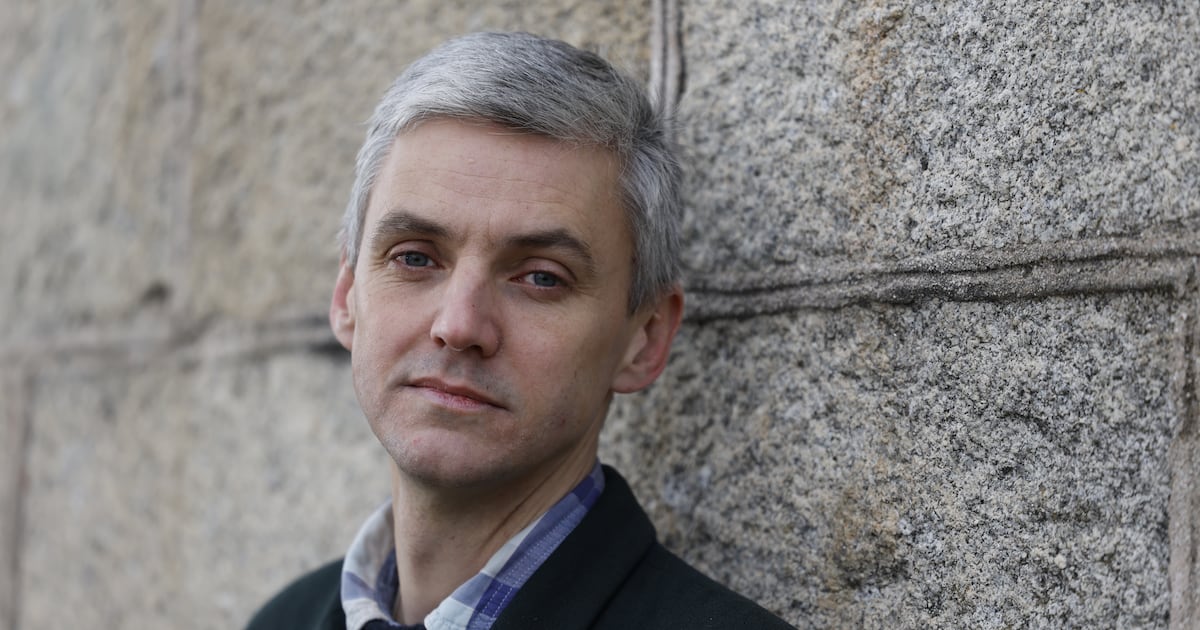
As writers’ gaffs go, a Martello tower in Dalkey, just around the headland from the one in Sandycove, where James Joyce’s novel Ulysses famously begins, is hard to beat. Unlike Buck Mulligan, however, Rob Doyle is far from plump. A stately 6ft 6in, he’s “the same height as Osama bin Laden”, he says, arrestingly.
Doyle and his partner, his fellow writer Roisin Kiberd, have lived in this part of south Co Dublin for several years, grateful beneficiaries of the tower’s New York-based owner, who is a patron of the arts. Doyle mostly wrote Cameo, his new novel, here. Lankum recorded an album while living here too.
The couple have to move soon, however, possibly to housesit in Coolock, in north Dublin, which would perhaps be more typical of the average contemporary writer’s circumstances, although Doyle has enjoyed more than average success.
The writer has previously played with author characters and blurred the lines between fiction and autobiography. Cameo takes it to another level. The life story of Ren Duka, an invented Irish novelist, who has runaway international success with a prolific series of autofictional novels, it is a satire on literary ambition and modern life that expands into a metafictional hall of mirrors.
Here Are the Young Men, Doyle’s debut novel, from 2014, about alienated adolescent Dubliners, was made into a film in 2020. He wasn’t born with a silver pen in his hand, however. The son of working-class parents, he grew up in Crumlin, in Dublin’s south inner city, and, as with the narrator of Cameo, major gangland figures lived nearby.
His background matters to him a lot, “but I’m maybe a bit proud that I’ve never made an identity spectacle of it.
“It did give me a bit of a chip on my shoulder at the height of the culture wars” – what Cameo’s narrator calls prissy campus totalitarianism. “If you came from a working-class background you saw through the supposedly left progressivism that was determined to put manners on the working class because they hadn’t kept up with the latest codes and jargon. To me it was reactionary bourgeois hysteria. We are in a different world now.”
Music was Doyle’s first love. His early schooling in writing was crafting the lyrics for the punk band he played guitar in. “Cult then, cult now,” he says. “The course was set. I was a very strange, troubled teenager, inward, dreamy, not macho, not a lad.”
He studied for a degree in philosophy at the Jesuit-run Milltown Institute of Theology and Philosophy and then a master’s at Trinity College Dublin. But for a time his thoughts turned dark.
“When I was 20 I had a catastrophic psychic collapse – a mental-health crisis in modern parlance – a three-year nightmare of severe depression caused by unprocessed trauma, exacerbated by drink and drugs.”
Therapy turned it around. He spent three years in psychoanalysis and ended up studying it.
[ Rob Doyle: ‘Frankly, a lot of my life has been disastrous’Opens in new window ]
After graduation he spent his 20s travelling in Asia, Europe and Latin America and took up blogging, writing was was essentially a travelogue, documenting his experiences, observations and thoughts on what he was reading as well as dabbling in fiction. “I wasn’t an influencer. It was just for a few mates and randomers.”
Doyle didn’t realise it then, but he was discovering his voice and distinctive style, which often blurs the line between fact and fiction. “It was the prototype.”
He spent four years writing Here Are the Young Men in London as a complete literary outsider, salvaging his teenage trauma. “Ten years later that experience took the form of a novel that I knew was going to rattle people and cause a stir. It was a struggle to get it published, but then people paid attention.
“The book was nihilistic, but the society around me seemed terrifyingly nihilistic, too. The psychologist James Hillman says ‘a depressed teenager is a healthy teenager’ – it’s an honest reaction to this world. It’s like people coming back from war with a 1,000-yard stare.”
What it depicted was often ugly and unsettling, but the writing was assured as well as fearlessly uncompromising, and the book won many admirers. Doyle has never held back. “I’m 43, but I’m still going into my own guts and exposing the weird and the shameful stuff, sexuality, inappropriate thoughts. That’s the living, vital stuff. That’s where the energy is.”
Writers’ first books are often semi-autobiographical before invention and imagination take over. Doyle doubled down instead, playing around with autofiction. His short stories, collected as This Is the Ritual in 2017, often featured troubled writers and characters called Rob. Next came Threshold, in 2020, “the book I wanted to write from the time of the blog. I just didn’t know how to write it back then.” Nominally a novel, it was actually “a strongly autobiographical, philosophical travelogue, an intensely personal summation of everything I had experienced.
“I would probably be happiest just calling it a read” – a nod to David Markson, author of This Is Not a Novel. “It had lots of fictional elements and lots of self-excavating autobiography. I wanted to find a voice that allowed me to talk about what I wanted to talk about, go straight to the heart of the matter. If you write like that” – dispensing with plot – “you never have to veer off. It was a great breakthrough for me.”
[ Old favourites: Rob Doyle on Reader’s Block by David MarksonOpens in new window ]
Threshold has 11 episodes, chapters or vignettes, all so condensed that they feel like novels. Doyle’s tone – brutally honest and intimate, sharply honed and often funny – is the binding element.
“I always go for readability, not that strain of avant-garde writing that is proudly reader-repellent. I’m a people-pleaser when it comes to literature. I want to give the reader a good time but also do my own thing without compromise. I go to books for ideas, astonishment, intimacy with the writer’s consciousness. I would imagine that’s what draws my readers in too.”
That Doyle is an experimental writer with mainstream appeal is backed up by his admirers, who range from John Boyne, Colm Tóibín and Sebastian Barry to Lisa McInerney, Kevin Barry, Mike McCormack, Geoff Dyer and Rachel Kushner.
He is formidably well-read. A year-long column in The Irish Times about his favourite books resulted in Autobibliography, in 2021, and he celebrated the experimental strain in Irish writing from Sterne and Swift to the present-day by editing an anthology, The Other Irish Tradition, which appeared in 2018.
[ The Irish novel isn’t dead. It just smells funnyOpens in new window ]
Having poured everything into Threshold and said everything he wanted to say, Doyle felt frazzled and exhausted. “Then the question arises: where do I go next? I need to be finding new horizons.”
One summer night in 2021 he was at a house party in Wexford with Kiberd, their fellow writer Geoff Dyer and other friends, and they were batting a joke around. “What they didn’t realise was that by the end of the night I had the kernel of the idea about this writer who flukes into vast success and then self-destructs.”
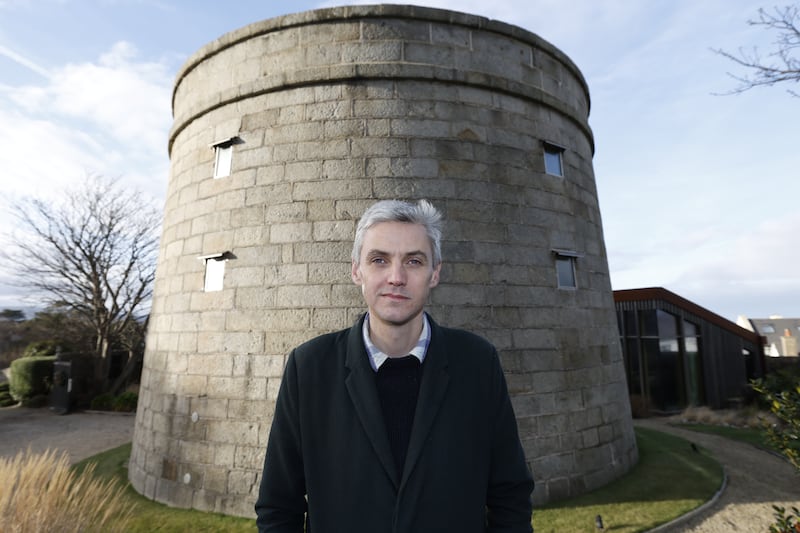 Rob Doyle at the Martello tower where he lives. Photograph: Nick Bradshaw
Doyle had recently moved into the Martello tower, and he thought he was embarking on a different, serious book, “then just for a laugh, in the margins, I was writing these sketches about a writer blundering through the chaos of the modern world. Initially I was just having fun, then gradually I realised the first book was just a weird pretext for this.”
The affair had become more fun and more meaningful than the relationship. “With writing you often have to catch yourself by surprise, come in the side gate.”
Ironically, Martello towers were built to keep out the French, whereas Doyle embraces that literary tradition. “French writers were always the ones who took it too far,” one of his characters says approvingly.
In a sense, Cameo is a book about failure that is disguised as a book about success, he says. “That is the fun paradox at the heart of it. Failure covers so much that is real in human experience. I’m always driven to figure myself out and go into whatever troubles, torments, hurts me. I find if I can honour that, and be as articulate and frank about that, it will resonate with people.
“We all have two selves, the one that faces the world and the suffering, private self. It’s the latter that generates the material that’s worth writing about. My way of doing that is to write with humour.”
Doyle’s writing had taken on a broad comic, almost cartoonish quality. “It was not my intention, but the unconscious guides you. I had hit this ecstatic wave, and I could take it anywhere, a giddy sense of having broken into a new room of my creative imagination. It soon became apparent, though, that it wasn’t a novel yet. After the ecstasy comes the moral terror: what is this?”
He moved to Singapore for six months and started to edit and develop.
“What I’m proudest of is the complex structure,” Doyle says. “I had the topsoil, the interlaced lives of the author and his creation Ren Duka, who is also an author, giving this mise-en-abyme effect, worlds within worlds, books within books.
“The next waves of creative ecstasy were discovering other layers underneath, a hyperdimensionality, merging the hardware of the stories with autobiographical literary concerns.”
The italicised excerpts from the life of author are reminiscent of italicised sections in Threshold and the “shadow half” of Autobibiliography.
“I’m most at home in the first person, so I needed the autobiographical sections,” he says. “Then the monologue sections from a variety of figures who exist in the extended Ren Duka universe. This is the originality of the book for me: the layers of truth and artifice.
“I love the chapter on Dina Tatangelo, the underground New York punk author, then the one about the actor who played Ren Duka, about cancel culture. Then the chapter on the manga artist, then Rob Doyle, like a signature, and Henry K Dillon, the taxi driver in a cyberpunk Dublin noir of the near future.”
Is it too unfathomable to be filmable? “Who knows?” he says. “Cloud Atlas got made. Never say never.”
Next summer will be five years since I drank alcohol. Alcohol had become a sickness. I saw I needed to get off this. I’d make an exception for magic mushrooms
One of the most powerful passages in Cameo is when Rob Doyle, at a low ebb, rings his sister Carol for support and instead gets handed some harsh home truths. Was that completely invented?
“Well, yeah, because I don’t have a sister. I loved writing that. In that Rob Doyle section set in Berlin, the fourth wall finally breaks down. The line gets blurred even in my head. There is truth in it and fiction. I knew I was on to something. She gives him hell, a brutal character assassination.
“I guess I have a masochistic streak. I tend to give myself a hard time in my autobiographical writing. It’s an instinct. Rather than flatter myself I look at my flaws. If I was to do that to someone else it would look vicious. I think my writing does have a strong moral compass. Writing viciously about real-life people isn’t something I would do.”
Why the title Cameo? “I don’t want to be too definitive,” Doyle says. “There are so many versions of the author, it’s a hall of mirrors, so whose cameo is it, mine?
“I realised while writing it that it went from being this fun, slightly absurdist encounter with the chaos of modern life to something more uncanny, metaphysical, mystical.
“It’s a book about the realisation of being authored, that you are in some sense a fiction. The question is: by who; by what? While it’s more playful and comical than my other stuff, it’s also a book about death and the porous boundary between here and the hereafter.”
Doyle, like his protagonist with his Ren Duka series, began writing Cameo on the cusp of 40. So, if not quite a midlife crisis, it feels like a midlife reckoning. “Yes, and a transitional work. This took three to four years. It was a difficult passage out of one way of being, opening up a path for the second part of my life.”
Doyle has made no secret of his past appetite for excess, drink, drugs – “I’ve probably taken more than most” – and sex, not just hedonism but as a life experiment, a spiritual, philosophical quest for knowledge and insight, which produced dividends but also consequences. The party may not be over, but the ground rules have changed.
“Next summer will be five years since I drank alcohol. It feeds into the work until it doesn’t. Alcohol had become a sickness. In lockdown, I know alcoholics who relapsed, who hadn’t touched a drop in years. Others, like myself, went too far. I saw I needed to get off this. I’d make an exception for magic mushrooms. All the other stuff I’m leaving behind.”
Writing is not so much an addiction as a life-saving compulsion, a vocation, a way of life, one Doyle has often shared with a fellow practitioner. He was previously in a relationship with Alice Zeniter, who won the International Dublin Literary Award for The Art of Losing and who is now his French translator, and before that with a Vietnamese poet.
“I’m drawn to it. Maybe it’s the working-class background. I’m 10 years into the game now of being a published writer, but somehow the charm hasn’t worn off. I love what I do. It’s what keeps me sane.
“In this period of calm and reflection I haven’t written anything for months, and that’s quite deliberate. I usually write like a maniac. I guess it is like an addiction in the sense that everything else falls by the wayside.
“I’m 43. All my mates have kids, houses, while there is disrepair all round me. I’m doing fine, but you always want more. It has suited me so far to have just enough success that I’m both respected but left alone as an artist. I can write books like this, with no vast financial pressure.
“It’s fun writing about the cliques, the egos, but that world doesn’t hold much intrigue for me these days – just people standing around in rooms having moderately interesting conversations. The action for me is in the imagination, the inner life, in dreams. Borges is a great idol for me. He said: increasingly I am impatient to get through the business of the day so I can get back to dreaming.
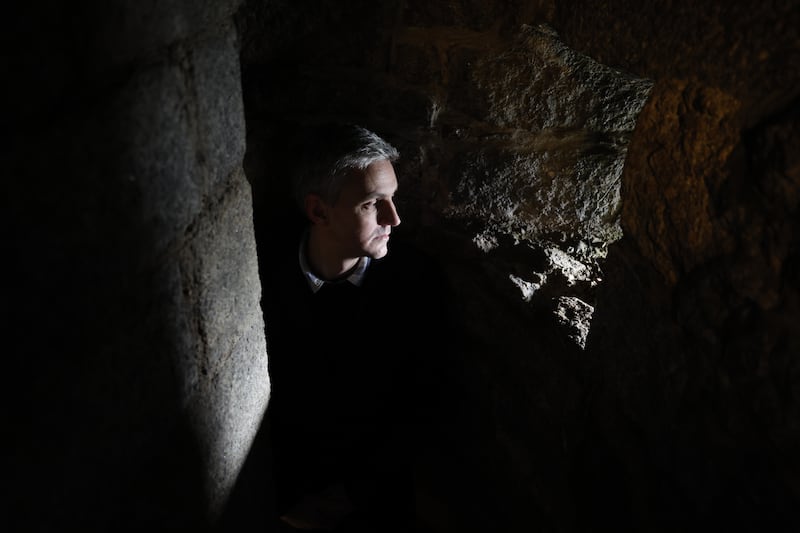 Rob Doyle: ‘I write about dark things’
“What I’m drawn to more than autobiography is mystery, not to solve it but to honour it. It’s not that I’m trying to be weird and difficult, but I do value the singular and unique.
“This [Cameo] has found a form unique to itself to express what I wanted it to. There is something glib about how people talk about realism in fiction. I’d take it more seriously if it was in inverted commas, because I think reality is more mysterious and multifaceted than we often take it for.
“As I advance through life it strikes me more forcefully that no one knows what reality is. We only think we do because of 300 years of science. Art is one way of staying at the exploratory frontier, the limits of the self.
“I write about dark things, but I am ecstatically excited to realise that things are weirder than I would have expected when I was younger. Finding new forms within writing is one way to keep honouring that. Cameo is a breakthrough, another way to dissolve the borders between reading, writing, existing. The only way I’ve found so far of sanely being in the world is to transmute it into books, essays and stories.”
Doyle prefers spinning yarns to plotting. “For me it is always about freedom, a voice and a style that allow me to go where I want. Every chapter is about a book, so it means I can go in any direction. One is about time travel, another about football or faith.
“To quote Borges, writing novels is a laborious and exhausting business. Why say over 300 pages what can less tediously be expressed in a synopsis? This book has hundreds of books and films and mangas in it. Yarning becomes a literally style, telling stories within stories.”
The Tatangelo chapter has a particularly gross scene, but Doyle insists that outraging the bourgeoisie is now passe for him. “I never feel these days like I’m pushing the boundaries. My stuff regularly gets described as provocative, but I simply describe things as they appear to me rather than attempt to confront or shock. That’s not where the energy is for me any more. So many people put on a front that truth and honesty seem shocking. I guess it’s just where my imagination is.”
Ren Duka is occasionally provocative and offensive. “There were years where artists were fearful and timid, because we were in this censorious culture where people were getting shut down and hung out to dry for transgressions of public codes.
“There was this idea that art should represent an ideal reality rather than reality as it is. Most artists are hostile to that: attacks on the freedom of the imagination. If I write in off-colour terms, we are all adults. I trust that my deep concerns are going to come through.”
Has writing ever taken Doyle to a bad place? “Occasionally. Last autumn I got a brutal seasonal depression. I continued to write, but I realised it was making it worse. My system was telling me there is a time to write and a time to rest.”
Next up is a collection of his nonfiction writing and a collaboration with the singer Lias Saoudi, of the band Fat White Family – already 80,000 words.
[ Ten Thousand Apologies: Fat White Band and the Miracle of FailureOpens in new window ]
“Writing for me is a survival instinct. When I am in a flow it comes relatively easy. This novel was written in a series of waves, but the process of turning that into crafted, readable, polished work is excruciatingly difficult. I am old-fashioned. I believe in beautiful sentences. There are no short cuts. It takes great attentiveness.
“Every time I write a book I have to discover how to write that book, so I am starting from scratch each time. I experiment with different tempos of writing. It’s both the most difficult thing I do but also the most natural.”
Cameo is published by Weidenfeld & Nicolson