
In 2025, when the Museum of Modern Art acquired photographs for its permanent collection by New Orleans-based artist L. Kasimu Harris, the moment carried institutional weight. Not because Harris was an outlier, but because his work reflects a broader, overdue correction in how American photography is seen and valued.
For decades, photography from the American South, especially work rooted in Black communities, lived largely outside the walls of major museums.
Harris’ work has been featured in MoMA’s “New Photography 2025: Lines of Belonging,” which runs through Jan. 17, 2026.
Journalism, Katrina and ethics
Harris was in graduate school studying writing and journalism at the University of Mississippi when Katrina hit his hometown in 2005. He worked on campus as a writer at the Daily Mississippian.
A trip back home 45 days after Katrina, combined with pressure from an Ole Miss professor to return to campus with work in hand, launched his focus and ultimately his career.

L. Kasimu Harris’s shelves photographed at his studio in New Orleans, Wednesday, Dec. 17, 2025. (Photo by Sophia Germer, The Times-Picayune)
STAFF PHOTO BY SOPHIA GERMER
“Anything that would catch my eye while I was at home during the break, I would stop and photograph,” Harris said.
Over time, he started paying closer attention to what was happening in New Orleans, particularly with Black bars and the gentrification happening as the city rebuilt itself. He decided he wanted to talk to White bar owners and Black bar owners for his graduation project, but none of the White bar owners agreed to participate.
“The way I saw it was I wanted to tell a fair and balanced story,” Harris said.
With access to White bars denied, he decided to focus solely on Black bars.
“It almost felt like I was an investigative journalist,” Harris said. “I felt that it was a lot of parachute journalism that happened afterward. My longer-term project was a response to that — like, let’s do a deep dive in that. … If I’m doing something in journalism, it’s gonna be facts. But when I’m doing art, I can arrive at the truth in a number of ways.”
Preserving what disappears
Harris is a photographic culture bearer. His “Vanishing Black Bars and Lounges” photography series is about more than Black bars closing. It is about more than New Orleans.
L. Kasimu Harris reflects into a photograph on the wall of his studio in New Orleans, Wednesday, Dec. 17, 2025. (Photo by Sophia Germer, The Times-Picayune)
STAFF PHOTO BY SOPHIA GERMER
“Even when I started this project, even though New Orleans was the inspiration, I always saw it as something bigger,” Harris said. “So the first place I got to do this work outside New Orleans was Pittsburgh.”
He continued photographing Black bars in Clarksdale, Mississippi, then Chicago, Detroit, Los Angeles and South Africa. One thing, he says, is certain.
“You can tell a Black bar from a White bar by what they drink,” he said.
He says he can recognize a Black bar simply by the signage outside — and that there are other subtle and not-so-subtle cues. White bars generally do not sell pints, a staple of older New Orleans Black bars, according to Harris.
“The pints are for the setup. A setup is, you get your pint — you can share it, you can drink it and you get a bucket of ice and you get some chasing,” he said.
His familiarity with New Orleans culture gives him a shorthand of understanding that does not always translate elsewhere. That familiarity didn’t ease his nerves in Detroit, even though people had told him it was a lot like New Orleans.
He compares entering unfamiliar Black bars in new cities to starting school in January instead of August — he has to walk a delicate balance.
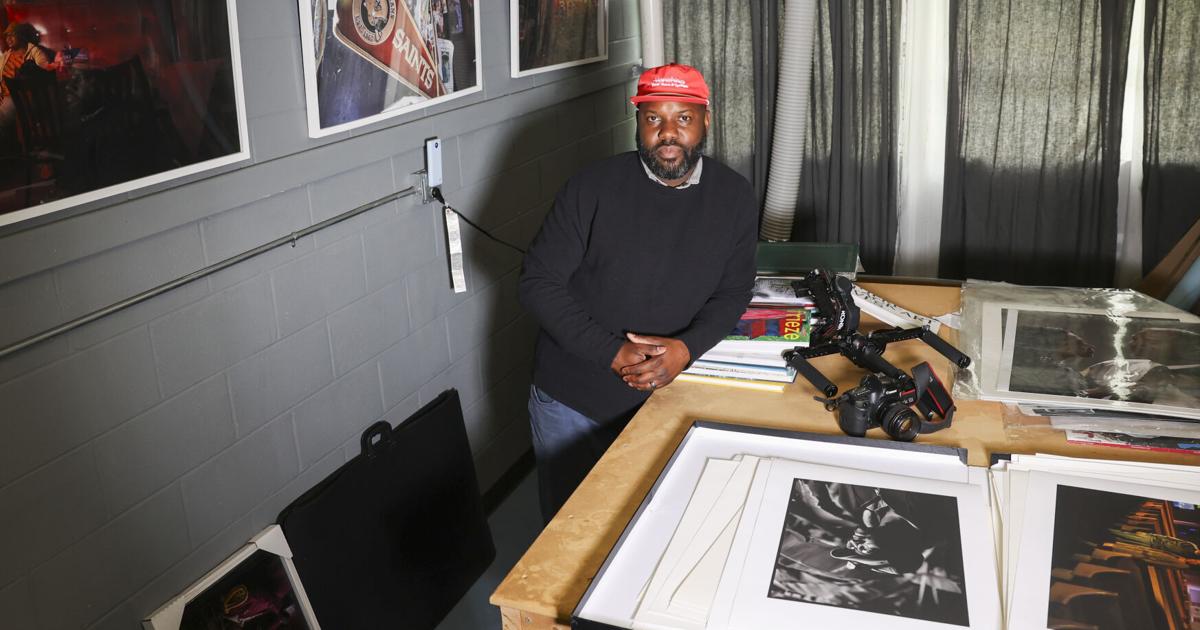
L. Kasimu Harris poses at his studio in New Orleans, Wednesday, Dec. 17, 2025. (Photo by Sophia Germer, The Times-Picayune)
STAFF PHOTO BY SOPHIA GERMER
Deeper than it seems
Harris’ wife, Ariel Wilson-Harris, sees the layered approach her husband takes as central to the work’s power.
“You wouldn’t necessarily think about all of this when you think about a bar,” she said. “To just go so much further and deeper into the community and then it connecting on a global scale — I think that is why this work is so important, not only to the city of New Orleans, but to the African diaspora as a whole.”
Brian Piper says he first became acquainted with Harris and his photography in 2018 when the New Orleans Museum of Art showed some of Harris’ work in an exhibition called, “Changing Course: Reflections on New Orleans Histories.”
Piper is the Freeman Family Curator of Photographs, Prints and Drawings at the New Orleans Museum of Art.
“One of the things that has always impressed me is how it (Harris’ photography) transcends what we might call traditional genres of photography,” Piper said. “It blends documentary. It blends storytelling. It blends sort of a theatrical view of things.”
Piper says that Harris has evolved in as “a picture maker,” using his eye for story and for narrative to get at the essence of a subject or place and distill it down to a powerful image.
“He is very attuned to the importance of African-American culture and history here in New Orleans, as a son of the city, but also as someone who has looked at these things around the world, especially when it comes to Black social spaces,” Piper said. “In his ‘Vanishing Black Bar’ series, he’s thinking about similarities, both in terms of the vibrancy of those spaces and in the threats to them from factors like gentrification.”
Michelle Schulte, chief curator of collections and exhibitions at LSU Museum of Art in Baton Rouge, says that since 1998 there has been more emphasis on people of different backgrounds telling their stories.
“But we’re still missing that view of people from African American backgrounds,” Schulte said. “For a museum like MoMA to recognize Kasimu and this photography from New Orleans — that’s a big deal. He’s real — a nationwide voice.”
L. Kasimu Harris’s shows photos that are part of his “Vanishing Black Bars & Lounges” series at his studio in New Orleans, Wednesday, Dec. 17, 2025. (Photo by Sophia Germer, The Times-Picayune)
STAFF PHOTO BY SOPHIA GERMER
Learning the system without becoming it
Harris’ understanding of institutions has also been shaped by service.
He has served on the board of the Ogden Museum of Southern Art for several years, an experience he says taught him as much about how museums function as about art itself.
“The art is paramount, but museums can’t operate without money,” Harris said. “Being on the board, you start to see how things really work — capital campaigns, strategic planning, even basic things like what happens when the air conditioner goes out.”
He acknowledges the tension between the financial realities of museums and the desire to make them more accessible and less intimidating.
That institutional fluency has helped him navigate his own career more deliberately.
“When MoMA asked for a hold, I knew what that meant,” he said. “That’s an intent — a proposal. Like, ‘I want to marry you’ — an intent to buy. All those things have helped me navigate my artistic career more seamlessly.”
That awareness has also sharpened his understanding of how intimidating museums can feel to people who do not know the rules or who have rarely seen themselves reflected on the walls.
Roots and responsibility
Harris’ mother, Eartha Harris, grew up uptown on Chestnut Street in New Orleans. She died in 2015, but her fascination with culture continues to inform his artistic practice.
L. Kasimu Harris’s shows photos that are part of his “Vanishing Black Bars & Lounges” series at his studio in New Orleans, Wednesday, Dec. 17, 2025. (Photo by Sophia Germer, The Times-Picayune)
STAFF PHOTO BY SOPHIA GERMER
“My mom was just a tenacious person,” he said. “Like she got fired from a job on Friday and showed back up to the same job on Monday. They were like, ‘What are you doing?’ And she’s like, ‘I got kids.'”
She later owned Le Earth Flowers, a floral shop that Harris says was well-known in the Black community.
Work before recognition
Ben Hickey, now executive director of the Center for Exploratory and Perceptual Arts in Buffalo New York, says Harris’ work reflects advocacy and cultural awareness.
Previously, Hickey was curator and interim director at The Hilliard Museum in Lafayette, where he curated a solo exhibit for Harris called “Vanishing Black Bars and Lounges” at the Hilliard Art Museum in 2022.
Hickey says Harris’ work comes from a place of love.
“It exudes it in every pixel, in every drop of ink in a print,” Hickey said. “That inherent quality is what drew me to him.”
Whether working inside institutions or photographing spaces far from them, Harris approaches both with the same concern: understanding the rules well enough not to mistake them for the point.
His photographs are shaped less by outcome than by intention — by choices made before the shutter is ever released.