

A new bookshop is always a cause for celebration, so welcome to The Whistleblower, Paddy Cosgrave’s latest endeavour on Dublin’s South Anne Street. The Web Summit founder promises “a space where literature, caffeine and great ideas collide across five floors of reading rooms, meeting rooms, event spaces, co-working rooms, podcast studios and of course a bookshop filled with amazing books on tech, policy and sci-fi”.
An image posted by Cosgrave on X in November 2025 displayed a sign showing rooms with the following names: Fidel Castro Meeting Room, Vladimir Lenin Office, Clara Zetkin Meeting Room, Politburo Boardroom, Assata Shakur Office, Deng Xiaoping Reading Room, People’s Hall, Zhou Enlai Reading Room, Xi Jinping Café, Thomas Sankara Studio and Rosa Luxembourg Studio.
The sign is red, if the theme wasn’t sufficiently clear from that list. It joins non-communist bookshops such as Hodges Figgis, Dubray, Eason and Ulysses Rare Books in the Grafton Street area, and long-standing communist bookshop Connolly Books in Temple Bar on the list of Dublin outlets explicitly enthusiastic about Sankara, the murdered revolutionary leader of Burkina Faso.
“Coffee will be free for whistleblowers and €10 for centrist dads,” Cosgrave pledged separately as the space neared completion. Jobs for general managers and baristas are advertised on Web Summit’s careers page. Centrist dads, we assume, should not bother to apply.
Want to relive the Famine? Good news – Americans have made a board game of it
January is a good time for a board game, with the evenings still dark, the temperatures low and the pubs in maintenance mode after the festive rush. So why not gather the family and break out a copy of The Great Hunger: Ireland’s Tragedy in the 19th Century?
Suspend your surprise as Overheard reveals that it is an American-made endeavour. It invites between two and five players to “represent families of tenant farmers and field hands”, initially expanding across a Risk-style map of Ireland as the population booms on the back of the nutritious potato, which can of course feed a family on just a “small, rocky plot of land”.
If only the story ended there. But no, along comes a non-player character: Phytophthora infestans, a fungus-like microorganism with a habit of ruining potatoes. An dubh: blight.
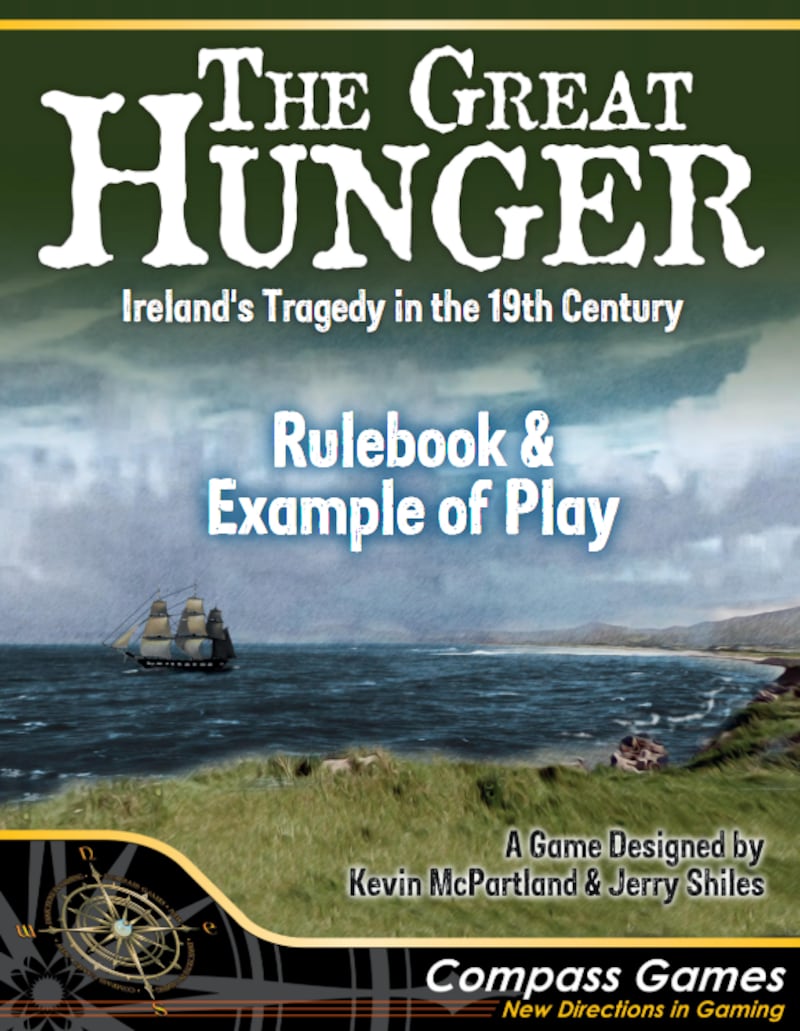 The partial rulebook available on the Kickstarter page for the game
Many Irish readers may remember from school or from consulting the generational trauma in their soul that this had cataclysmic consequences. The population of the island dropped from 8.2 million in 1841 to 6.6 million in 1851, due to starvation, disease and emigration, and all – from demographics to the look of the countryside to politics and culture – changed utterly.
This set of events is represented in gameplay through mechanics such as securing employment in factories or emigrating – via a six-berth boat that exists as territory on the map itself – to America. The player battles it out with their opponents to survive the disastrous events of the late 1840s.
According to the rule book, the player with the closest Irish ancestry goes first, or failing that – let’s say you’re playing this with your family of tenant farmers in a single-room turf bothán and everyone has equally close Irish ancestry – the player with the most Irish-sounding name. It is silent on what happens if everyone has an equally Irish-sounding name, or where a Scottish Gaelic surname with a long history in Ireland such as McDonald, to choose a random example, would rank. We assume you can draw straws.
The game ends as the blight abates, with victory handed to “the family with the largest surviving population across Ireland and America”. Just as it happened in history.
Those who wish to relive this moment can secure an early copy of The Great Hunger by pledging support on crowdfunding platform Kickstarter to the tune of around €47 plus €49 shipping (!), roughly the retail cost of 9½ sacks of potatoes.
Crisis? What crisis?
Politically moderate fathers of talent and ambition might, however, seek gainful employment with another tech company partly headquartered in Ireland. Airbnb, the international short-let booking platform, is hiring something called a “Global Crisis Management Disaster Response Coordinator”.
The whole world is in a terrible state of chassis, as Captain Boyle said in Seán O’Casey’s Juno and the Paycock, and a company of Airbnb’s size needs to be alert to any dangers. A “typical day” in the job, according to the listing on the platform’s website, includes the following: keeping an eye on “incidents and events globally”, paying particular attention to ones that might have a negative impact on Airbnb, figuring out what to do about them, organising and leading “large-scale and high priority” disaster responses, being the point of contact as they unfold, and “other duties as requested or assigned”.
In order to fulfil this somewhat daunting brief, candidates are expected to have various skills, including “operating effectively during high-pressure, fast-moving events, including nights, weekends and unexpected hours as required”, and also good experience in global intelligence analysis. Some travel required. Pay from €60,000 for the lucky winner.
The least Irish Seamus in the world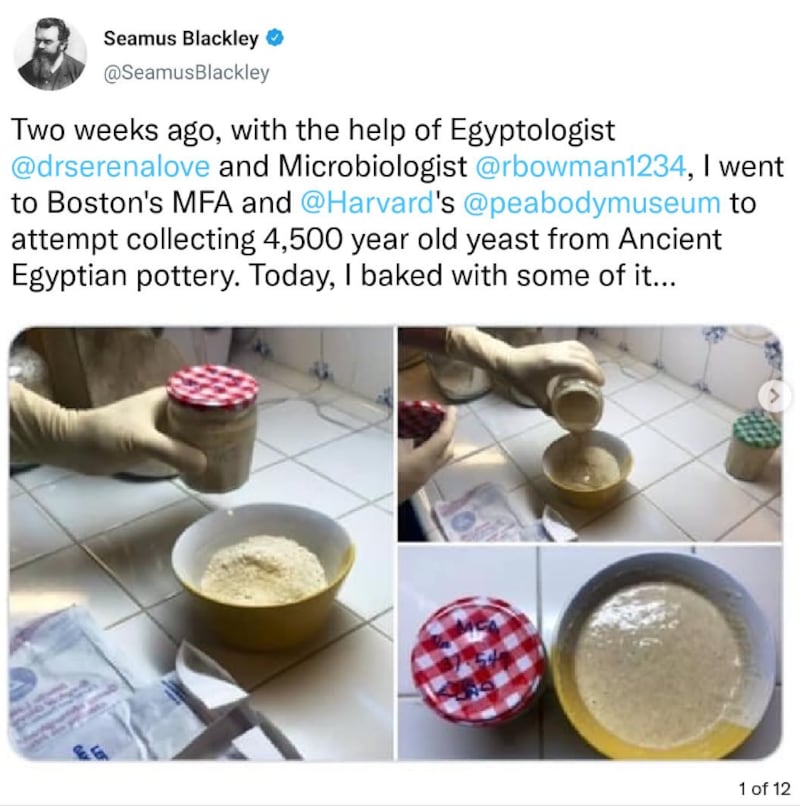 Seamus Blackley’s now-deleted Twitter thread about baking with ancient Egyptian yeast
Overheard maintains a professional interest in all noteworthy Irish people abroad, which made us alert to the existence of Seamus Blackley. A physicist by training, his main claim to fame is inventing the Xbox, Microsoft’s gaming console, an updated version of which is still widely played today.
He has also, in a twist, been prominent on social media in more recent years for baking sourdough bread using revitalised yeast extracted from ancient Egyptian pottery, a fascinating project that links us directly to the earliest bread-eating humans thousands of years ago. Smithsonian magazine once described him as a “gastroegyptologist”, which cannot be a common specialism.
His primary characteristic for us, however, is his name. He gives no outward indication of being an Irishman abroad, and in fact is comprehensively American in affect in the videos we have carefully studied. But his name is Seamus. And we couldn’t find a satisfactory reason why. So we got in touch.
“I am horrified to inform you that Seamus is a nickname chosen (by vote) for me at [game studio] Looking Glass when I was a young game developer,” he told Overheard. His wife, “though raised in England”, is a Quinn, however.
We’ll take it.