
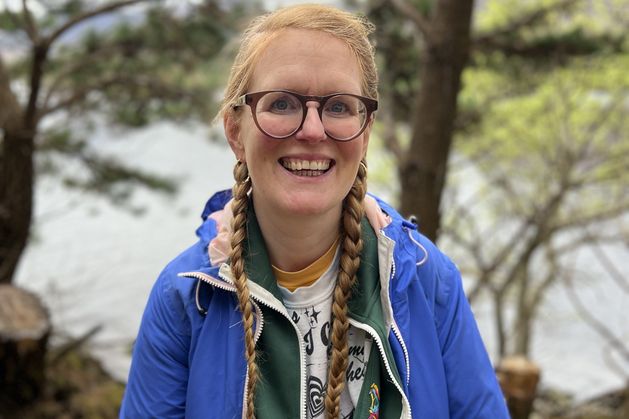
From immersive projections on city’s streets to tactile instruments that invite touch, Jane Cassidy is using her Arts Council residency to explore how creativity can bring people together across disciplines and generations
Cassidy, a Galway native who specialises in immersive audio-visual environments, is the recent recipient of an €18,000 artist residency at the Centre for Creative Technologies at the University of Galway. The award forms part of more than €500,000 distributed nationally by the Arts Council this year to artists working across Irish-language literature, digital and traditional arts, English-language writing, and film, in a bid to “further Ireland’s vibrant creative scene”. The residencies are delivered in partnership with universities across the country.
Her most recent public-facing work appeared over the Christmas period, projected onto the street-facing wall of St Nicholas’ Church just after sundown. Titled Trick of the Light, the piece invited Galwegians to pause, gather, and engage with the city through light, sound, and story.
Cassidy collaborated with her childhood friend and fellow Galway artist Jennifer Cunningham to create the multimedia installation, which drew on themes of Irish heritage, mysticism, and collective memory. The project was completed in just three weeks, a rapid turnaround that began with a single piece of music.
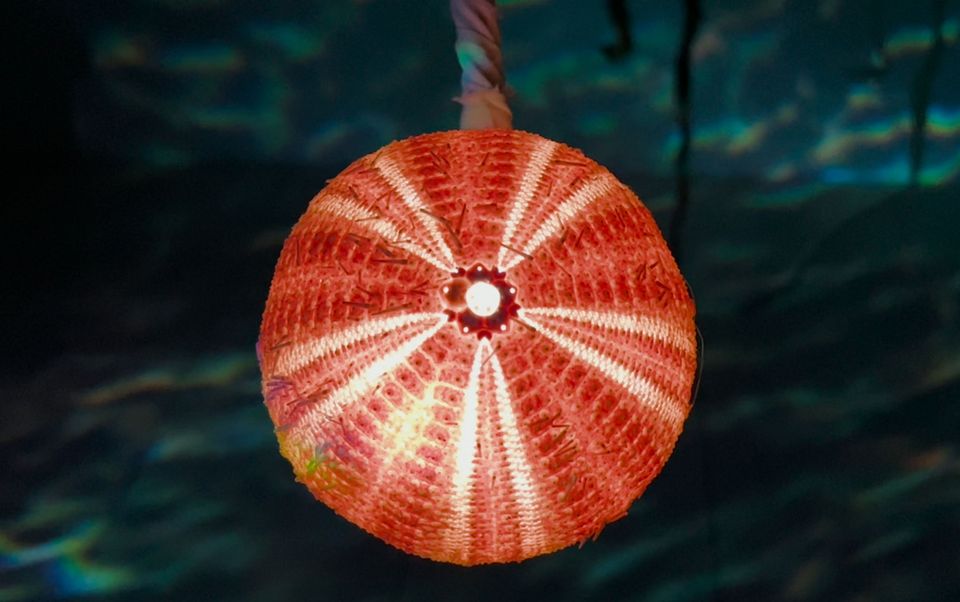
Urchin Chandelier at Customs House Gallery, Westport. Photo: Jane Cassidy
“City Council asked us if we would make work in response to a song written by the Merlin Park Training Centre,” Cassidy said. “The project was called Trick of the Light, and they’d written a song about stars needing darkness to shine.”
What was inspired by a blank canvas and a song evolved into a visual narrative designed to resonate across generations, balancing the poetic with the accessible, the artistic with the logical.
It ultimately led to Cassidy arranging a unique song piece using a pipe organ for the show to be displayed in front of.
“We did feel very aligned on it because we worked very fast together. It’s a spectacle show, but we didn’t want to be really loud, that it’s almost a little bit meditative.”
“Nothing is jarring,” she added. Everything kind of creates this smooth flow. So I just wanted it to be something that you could sit and watch on loop. We wanted to include bits of Galway in it, but not too navel gazing.”
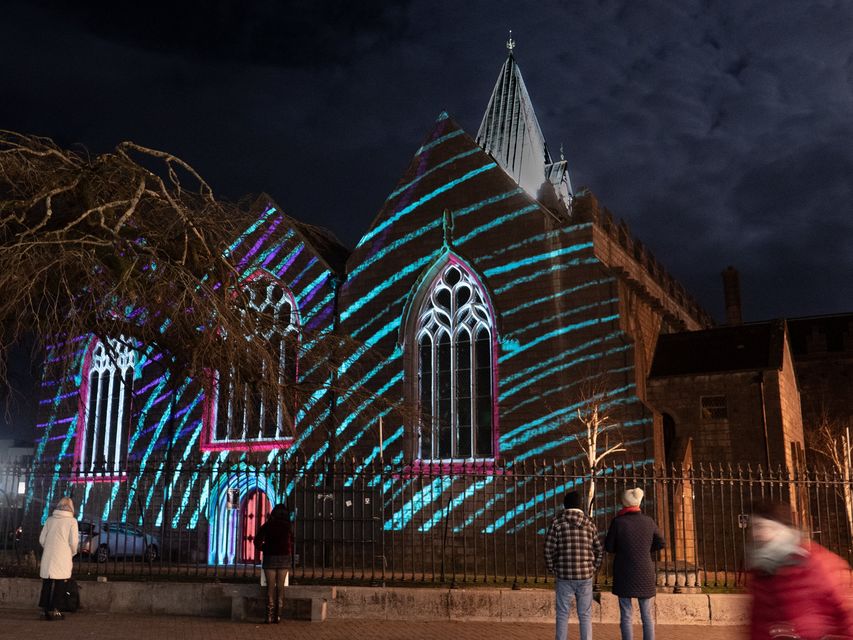
Trick of the Light in collaboration with Jennifer Cunningham at St Nicholas’s Church, Galway. Photo: Jane Cassidy
The projection unfolded in 15-second visual fragments synced to the accompanying music, weaving together images of Galway hooker boats, the bay, Neolithic engravings, Newgrange, and even the lone surviving angel inside St Nicholas’ Church, famously spared from defacement by Cromwell’s forces in the 1600s and known locally as ‘The Smug Angel’.
For Cassidy, the aim was to capture the quieter magic, mysticism, and meditation of the city. “Not too in your face, but still a spectacle.”
A commitment to accessibility runs through Cassidy’s practice. Her work consistently aims to engage people regardless of age or artistic background.
“I’m always interested in getting a very broad audience, from very young to old, irrespective of art experience,” she said. “I’m not just saying, ‘I want to make it for everyone.’ I really mean that kids can go in, grandparents can go in, and everyone can find something in it.”
“How you meet all those audiences isn’t always straightforward,” she added.
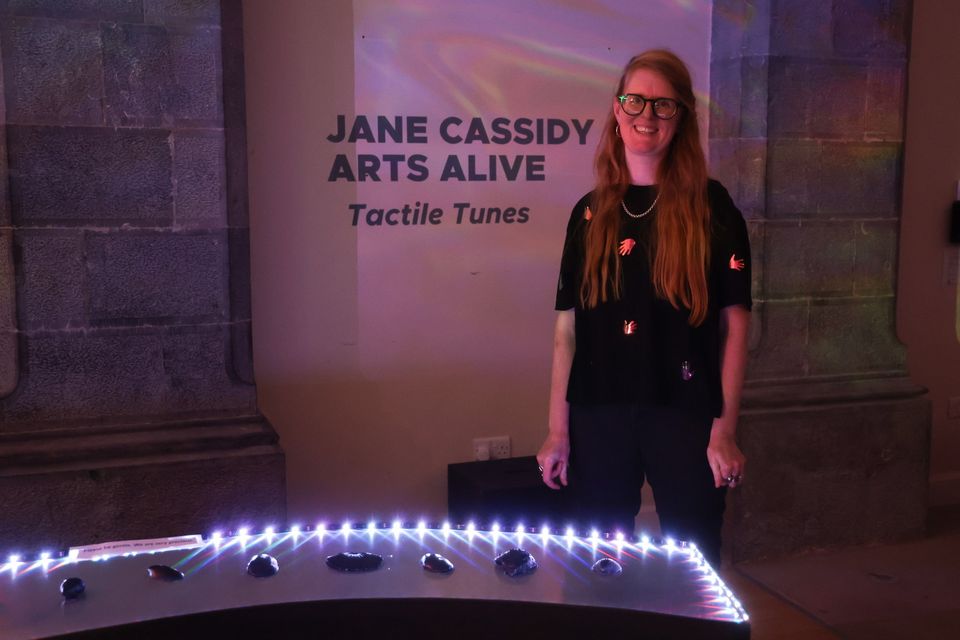
Jane Cassidy at Tactile Tunes, GIAF. Photo: Emilija Jefremova
Synesthetic media, work that blends sound, colour, light, and touch, has become Cassidy’s signature. But during her residency, she is exploring multidisciplinary collaboration in a broader sense. Through the Centre for Creative Technologies, she now has access to academics whose expertise draws her into worlds far beyond her own.
She is interested in what collaboration might look like between artists and climate biologists, engineers, or solicitors, an approach shaped by her experience teaching both at university level and in community settings.
“When you’re working on community projects, you work on a project together, it’s way more fun,” she said. “There’s no grading, no pressure, no homework, and you can still make phenomenal work.”
Cassidy said she drew inspiration from the experimental, cross-disciplinary ethos of institutions like Black Mountain College when proposing her residency.
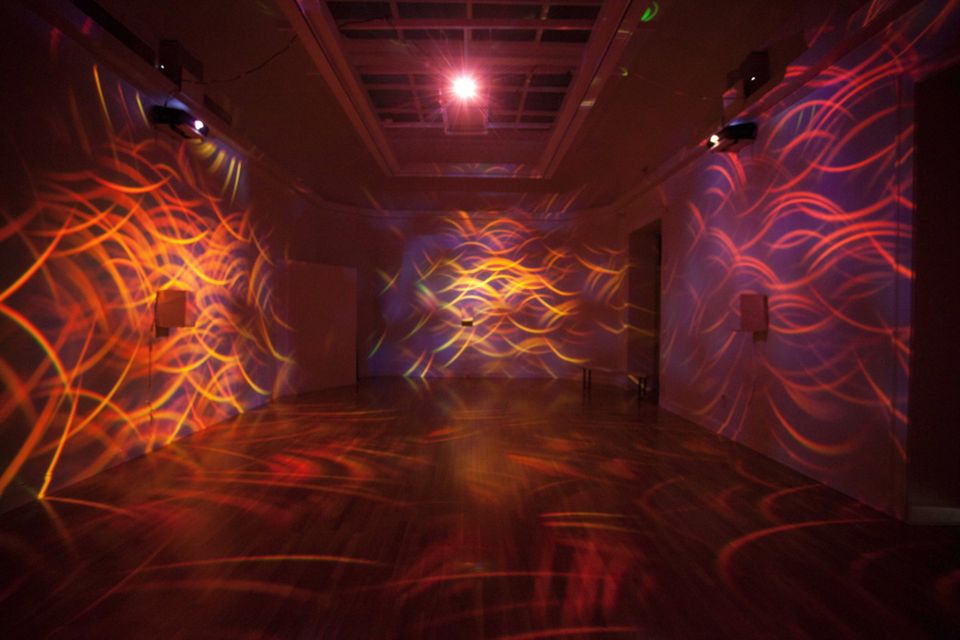
Long Since The Sun Has Set at Tulane University, New Orleans. Photo: Jonathan Traviesa
“Where it’s kind of collaborative, multidisciplinary,” she said. “One passion project I applied with was the idea of creativity practice drop-in sessions.”
These sessions are designed as creative resets, blending physical movement, breathwork, and meditation to prepare participants for creative output, particularly those working in fields where results are expected on demand.
“How often do you get human rights lawyers in with the artists?” Cassidy asked. “What can come from that? They can be so siloed. I think other departments might not see how much artists are interested, really broadly, in many ideas, across ecology, or environmentally, climate biology, we have big interests.”
That emphasis on collaboration has shaped Cassidy’s teaching since she moved from the classroom into community-based work. She now teaches practical skills such as projection mapping for theatre and creates projects like Tactile Tunes, aimed at widening access to creative technologies.
Last summer, Tactile Tunes was her contribution to the International Festival in Galway. She described one project as among the most meaningful of her career. Working with Arts Alive Galway, an arts programme for adults with intellectual disabilities, Cassidy and a team of ten participants created a series of accessible, interactive instruments.
“We were all really tired after it,” she said. “It was so much work. And having it at the Arts Festival was terrifying because you’re getting such a big audience. Then because we were making work that we invited everyone to touch, that was terrifying.”
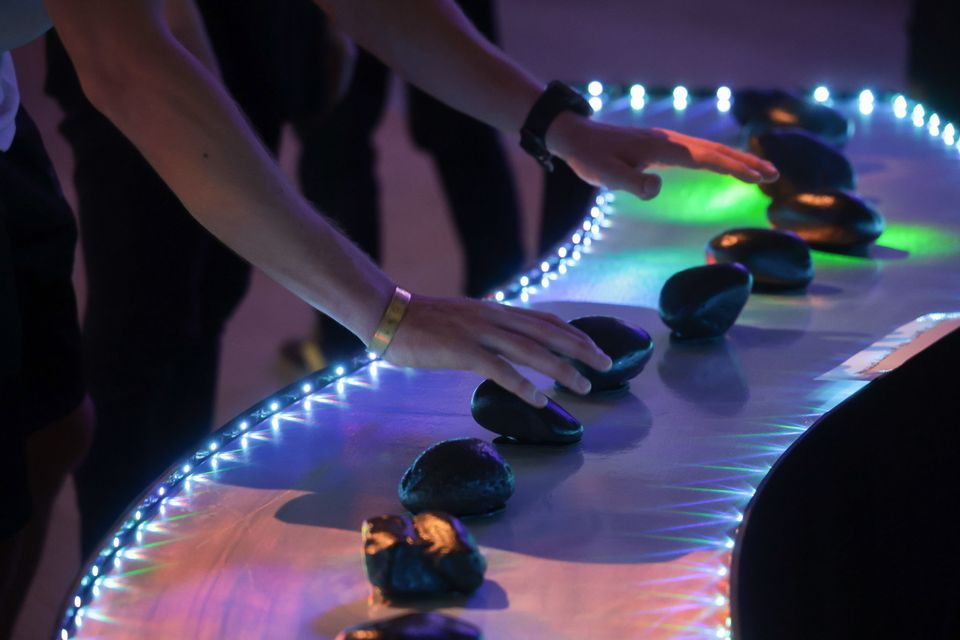
Tactile Tunes in collaboration with Arts Alive at GIAF. Photo: Emilija Jefremova
“You don’t go to museums and you don’t go to galleries where you allowed to touch the work. Genuinely we didn’t feel that there was that much of a precedent that we could learn from.”
Despite the nerves, the installation drew an estimated 7,000 visitors over two weeks. Set inside the Aula Maxima at the University of Galway, the exhibition used sensory-friendly materials and surfaces to create an interactive musical experience for all ages.
Cassidy showed me a video of her parents engaging with one of the pieces, holding heart-shaped cushions connected to a neon, psychedelic structure. When they placed their free hands together, a sound was triggered by the electrical resistance of the body. A different sound emerged when they leaned in for a kiss, all driven by touch, light, sound, and energy.
“What was most magical about that was seeing people interact with the pieces,” Cassidy said. “How you would have strangers making eye contact with each other as they were improvising on different instruments and trying to play together.”
Each morning, the exhibition space was reserved exclusively for audiences with additional needs, allowing groups to attend with support workers in a quieter environment.
“They had the space to themselves,” she said. “They had an hour to play all the instruments. That was magical.”
“Normally, audiences at art shows could be quite homogenous,” she added. “This brought everyone into the same room, playing together, laughing together.”
For all the success, Cassidy is candid about the difficulties that accompany ambitious creative work. The romantic image of the ‘tortured artist’, she agrees, exists for a reason.
“Every project I work on, I always have to resign myself to two weeks or two months of everything I make I’m like, ‘This is absolute shit.’” she said. “It’s torture. I’m like, ‘I’ve no skills. I’m not an artist. This is so terrible.’”
She laughs, but insists the discomfort is necessary.
“Now I also know that I have to go through that two weeks of working through the mire, that something good will come out of it, and that you have to commit to making crap. she said. “I think it’s absolutely necessary but it’s horrible.”
“You have to have faith that the good stuff will come out. But the torture is absolutely part of it.”
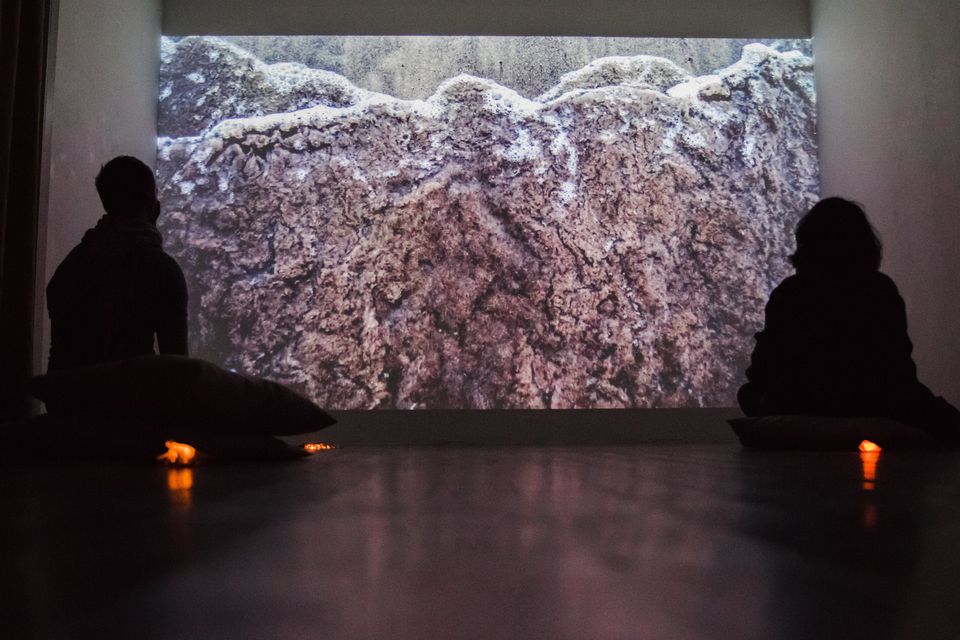
Urchin Chandelier at Customs House Gallery, Westport. Photo: Jane Cassidy
Wishing she has a quippy saying to share with fellow artists she encourages one thing – just persistence.
“You just have to keep making. Because creativity is a practise and if you step away from it, it definitely gets rusty, so you have to stay on it.”
Now, just two days into a seven-month residency, Cassidy says she is less focused on producing a single major work than on staying open and having diligence in this time.
“I’m going to go in with purpose and work very hard every day,” she said. “But I also want to leave myself open to what can happen.”
With access to new collaborators, disciplines, and ways of thinking, she hopes to widen the circle even further. If music, light, colour, storytelling, and design can be woven together as seamlessly as her work suggests, the question becomes not what art is — but who it can invite in.
Funded by the Local Democracy Reporting scheme.