
Everything is lost, we say, when all hope is gone.
——
Beginning, I thought this would be called Book of lost. That’s what I began to write. Knowing my mother is dying or knowing she has been told she soon will die, I thought I would collect losses of all different kinds and knit them together. To curate lostness is also to hoard what is uncovered via this process. To contemplate what is found. Two sides of a leaf. To write in such a way—to gather and archive these losses—is to grant a shape to language, to silence and absence, that surpasses ideas of linear time. Such a tongue forms the blurred impression of a lexicon inhabiting space in past-present-future, chronicling events we have only the scantest conception of.
——
I am thinking also of Roland Barthes and his Mourning Diary—the ways in which he put the loss of and mourning for his mother into a writing practice. This practice was secret, an intimate form of private mourning for his maman. Barthes wrote his grief in fragments located on dated pieces of white typing paper cut into quarters, seemingly trying to place himself via his writing within the unmoored timelessness of surviving his beloved mother. Barthes didn’t necessarily ever plan to bind these fragments into a coherent account, or to publish them.
——
I am putting into practice a reverse birthing, a sense of midwifery via prior remembrance. To do so enacts an attempt to ease my own way again into mourning, but this time before the fact. I have possessed knowledge of grief since I was eighteen years old, when the first fracturing of my family occurred with the drowning deaths of my father and brother in an irrigation channel in north-east Victoria on the second day of 1993. But when I think about it, the breakage, or damage, began unfurling prior to that—long years and distances, generations even—before I came into being.
——
I think my family had been impacted by grief all along, our whole lives, and none of us had sketched lines of connections between scattered events. For me, there was a drawn-out time between experiencing loss and finding ways to write about it. I was thinking, archiving, writing in fragments, and it didn’t occur to me to stitch these pieces into one cloth. These many scraps of knowledge tell a dislocated story, or stories, full of gaps and unknowns. There are countless moments in time and family histories where only the salient details stand out in relief. There are pieces that do not fit together but are nevertheless constituent parts of a larger fabric, and form parts of me—long echoes of mourning that must be intrinsic to who I am. I should be squared with trauma and loss, yet as it grows near again, I must begin to write these preparations for mourning, a practice for weaving a net that might hold.
——
The next summer after the accident—which is what we have always called the drownings—when our mother had bought a milk bar in Footscray as a path forward, I remember my sister, her hair long and brown, wore a flowing Delft-blue dress printed with vegetable dye. The dress buttoned up the front and had short sleeves and a collar, the fabric was embellished with tiny points of white created via a process of knots tied at intervals during the dyeing process. This is how I think of my sister during that summer, twenty-three years old, with long dark hair and sad brown eyes—like my own, like our father’s—wearing this dress with its unwritten circles of blankness, pinpricks in the fabric of the sky.
——
Where do dresses go?
——
At my father and brother’s funeral, not having anything that would do for such an occasion, I wore a borrowed dress. I insisted on not wearing black, though I can’t recall why. The dress my friend A loaned me was darkest indigo, with tiny white flannel flowers scattered across the fabric. It buttoned up from the waist to the base of the throat and had a skirt that flared demurely on the hips. I remember the dress with better clarity than the funeral.
——
Hanging in my wardrobe is the navy-blue lace frock my paternal grandmother wore to my parents’ wedding in 1967. My mother sold her own wedding dress, though one pointy-toed ivory satin shoe remained for years in a confetti-strewn plastic bag, entangled among other displaced markers of the past. For my grandmother’s marriage to my grandfather, there was no wedding dress, no photos, just the blueprint of my father already embedded within her womb. I was married in a dry, summer-yellow paddock shaded by gum trees, adjacent to my grandparents’ house, wearing a silk-satin dress sewn by my mother-in-law.
Now the house by the paddock, my grandparents’ house, is gone, or not gone but lost to me, though the road it sits upon retains our family name.
——
All these shades of blue.
——
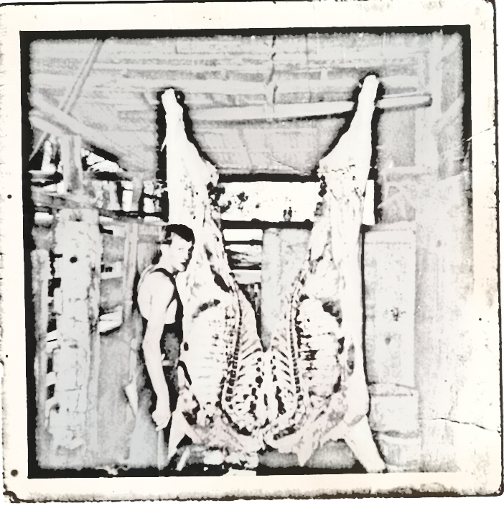
As a prank on New Year’s Eve 1992–93, my father removed and hid the street sign from the road named for our family. At that time, my grandparents lived at one end of this dirt road. The land adjacent to the road was composed partly of paddocks and otherwise of box ironbark state forest, the largest remaining such forest in the world. If you walked down the road, past my grandparents’ house, you would soon reach my grandfather’s slaughterhouse, by then disused, beautiful in its rusticity, teeming, you would think, with ghosts. If you continued, you would be closed in by bush on two sides of the track for a time before you reached the ancestral land of my mother’s family. Once, long ago, there had been clusters of different Scots colonisers, disparate strands, family names that became intricately woven together into my bloodlines. These families all lived in connection to this road, which had no name then, but was later named for my father’s people. One of these parcels of ancestral colonised land remained in our family at the beginning of 1993. My mother and father were building a house on these forty acres then. This is where they were camped in a borrowed caravan in the last days of my father’s and brother’s lives and was the place we left from to go swimming, on the afternoon of the drownings.
——
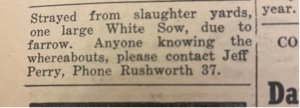
The street sign for Perry Road was never found,
It remains well hidden, somewhere. Buried.
Long
lost.
——
——
What have we got to lose?
——
During the final days of 2023, huge surf threatens six million people on the California coast. Homes look set to be swallowed, taken back. The local warnings say to avoid jetties or rocks. Never turn your back on the sea, they say.
——
Though my mother is dying, it is not an illness but a condition, an abdominal aortic aneurysm. She will not wane or slowly decline, though that is not entirely accurate either, but the end will be sudden, violent and bloody. When she was diagnosed three years ago, she was given an option for surgery, but she declined. To be fair, the surgery was major and came with commensurately grave risks, and my mother at that time lived alone. I offered to stay with her, but I think, honestly, these practical considerations were not at the heart of my mother’s rationale. The truth coiled up tight and mean is that she has had enough. The doctor gave her a prognosis of five to ten years, if she stopped smoking, or that’s what she told us.
——
Three weeks after the death of Sylvia Plath, my mother’s mother, aged thirty-six, died of smoke inhalation in a house fire caused by faulty wiring on an appliance. I know far more about Sylvia Plath than I do about my grandmother. The night of the fire, my teenaged mother was asleep in bed. She escaped from a window, helped by a neighbour. I can’t find any stories about the incident on the National Library’s Trove website, or in the Victorian State Library’s microfiche collection. There seems to have been no obituaries. On one of my searches, I come across an account of my maternal grandparents’ 1947 engagement soirée—with a list of guests and gifts; songs that a well-known singer in the town crooned to the gathered friends and family; and the words of my grandparents spoken on the night. All time between is lost regarding the written accounts of my mother’s mother. There are photos of her on her wedding day, wearing a smart cream suit and a little hat with a veil, standing outside a pair of open church doors. Another framed photo sits atop my mother’s crystal cabinet: my grandmother in a floral frock, knee-deep in the lake that had just been created by the damming of the Murray at Yarrawonga Weir—the trees in the background are still replete with leaves before their slow death. Those black trees are too far to swim to now, though my mother says when she was a girl, you could easily reach them. There were more of the trees left standing, then, in that blue light. In my great uncle’s memoirs, he wrote but one line about my mother’s mother—unfortunately, my sister was an alcoholic—as though this was all there was to say about her.
——
The first words I wrote in my journal in the days after the deaths of my father and brother were Sylvia Plath’s lines about the moon’s quiet desolation, and the elucidating postscript of the poem’s speaker, living in this place.
We perform grief as we write.
We practice and perfect
our losses.
——
——
How do you mourn without writing?
——
In the summer of 2008–09, at the height of water restrictions in the state of Victoria, which was in severe drought, many gardeners had no choice but to simply walk away from their gardens, leaving them to wither and die. My husband and I had just moved back to Melbourne from Bondi. We were living in an ugly flat in Elwood where every window looked directly into someone else’s dwelling. I watered my poor little balcony offerings at midnight on the allocated days.
——
The year before he died, my ninety-year-old paternal grandfather stood at the benchtop stove in his canary yellow kitchen and lamented the limitations on water placed on him while he was taking the drug Warfarin. He was allowed one litre per twenty-four-hour period. He listed all the ways of consuming water in a day: ‘That’s your cups of tea, glasses of water, your soup, your stews.’ I nodded and made noises of sympathy; I could see his point. It was a harsh constraint. But too soon, his thirst would be subsumed by silence when the cancer took his voice,
left him dry,
made of him
an almost silent husk
in the shape
of a fœtal position,
that kind of punctuation,
and tense.
——
For this book to be a feasible concept, my mother must first die. Her death must transcend this abstraction and become a concrete event that is real, that has occurred. Unlike Barthes, who began his mourning through writing after the loss had taken place, I must begin practising mourning before the fact. Though, like Barthes, it is not for the sake of a book that may never come together—I am writing to stop the earth swallowing me up. Or that is where I place my hope.
——
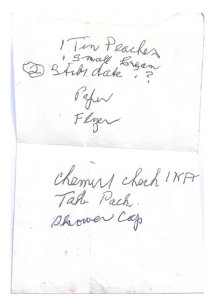
I can see why Barthes composed his mourning diary as more like mourning notes, fragmented on those small slips of paper rather than in a journal (cahiers). The death having occurred, the idea of making a connected, solid narrative is to accept fully and wholly, to consolidate and assimilate the loss entirely, and to put an end to it no less, which is, of course, an impossible, an unthinkable undertaking. It is easier for me to write this in fragments that are nevertheless held together as a narrative, precisely because of the nature of these words as preludes.
After his mother’s death, Barthes begins by comparing the first night of mourning to a wedding night. Marking a threshold. The beginning of something. Though his tone makes it clear that even he finds such a proposition faintly absurd.
——
I swim with my daughter at the edge of the lake, partitioned off with metal poles and concrete decks into a freshwater pool I swam in as a child. When I was small, my second cousin drowned here. It happened during a school swimming lesson. He was twelve years old and, like me, a twin. It turned out there was something wrong with his heart. He was the age my son is now. My son, who cannot hold a conversation, has a lithe, fish-like quality in water. He has also swum in this freshwater pool. He seeks out deep pressure by sitting at the bottom. My mother says she spent her childhood at this pool, though the decking was made of wood then, not concrete. She says she lived here, and there are other words, things left unsaid that swim in the waters of this place. My daughter can’t really swim, though I’ve taught her to float, to tread water, to doggy paddle. The years of intermittent lockdowns and closures messed up proper swimming lessons for us. In the lake pool, in the deep end I hold on to one of the metal beams above me, as I did when I was a child. My body immediately floats to the surface. I beckon my daughter to climb on top of me, to lie supine upon my torso and legs, and when she does, it is like we have returned to the day of her birth—she is face up, and I am a boat, a vessel who will try to bear her to shore.
——
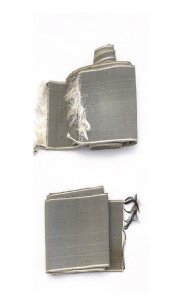
In an interview with Eleanor Wachtel, Anne Carson once remarked of the white space on the back of Nox, her elegy for a lost brother, upon which people could use to write their own elegies. Though I would never mark my copy of Nox, I think all my elegies have been written on the back of hers. In Nox, Carson attempts to gather materials to make sense of lost brothers, her own and the brother of the ancient poet Catullus, but also, she tries to capture the way her mother grew mute around the crimes and subsequent absence and opacity of her son. In Nox, absence on the back of the joined accordion manuscript grows into a white staircase of lost time, unwritable, unrecoverable, unilluminated. Everything in this elegy is rendered futile except the attempt to find the silvered obverse side of a leaf, the beauty that might be gleaned when the wind turns and shows a glimpse of what is still possible to see—the shining parts contained within any life. And to contain both sides of the leaf. Of all the leaves.
——
——
How do we forget our childhoods so? The amnesiac blank gauzing such vibrant days. Those unremembered times belong to others, much more so than to us.
——
When he was alive, my brother used to visit a friend who lived in the downstairs flat of a set of four Art Deco abodes where I came to live years later. Sometimes, in bed at night in the empty flat, I heard footsteps in the hallway of the flat next door and pretended in the way you can when suspended between sleep and wakefulness that it was my brother walking close by.
——
There were footsteps, but they didn’t sound with the resonance of ghosts, being clearly possessed of life, and weight, and hard-soled shoes.
——
We begin to lose time. One of the effects of global warming on the Earth is that the drastic loss of polar ice is slowing the planet’s rotation, which in turn prompts a counterreaction causing its liquid outer core to speed up. Within the decade, it is predicted that we will need to subtract a leap second for the first time.
——
The backs of my hands have become crepe papered.
This fragile envelope we dwell within.
Once, I saw my elderly grandmother fall onto the gravel of a driveway, a minor accident without immediate consequence. Minutes later though, at my uncle’s table, she held out her wrist and hand to show me the small graze on the surface, and how, beneath the tissue-paper veneer of her skin, blood readily blackened, spreading halfway up her forearm to form a terrible bruise that remained on the other side of her skin. I marvelled at the brittle, transparent delicacy of that envelope.
My mother’s skin now is the same, so quick
to shadow, and show its woundedness,
holding tenderly her vulnerability to hurt—
this slow collapse,
a prelude for an ending.
——
In the weeks before I am to go overseas to celebrate my 50th birthday and having submitted my PhD thesis, my mother says on the phone, apropos of nothing, ‘I hope I don’t die while you’re overseas.’ I don’t know what to say, except to scold her for planting such a malign seed in my mind. Three years have passed since the prognosis, which promised, in my mind at least—a contract or guarantee—five to ten years without surgery.
Between the first time she invokes the spectre of her imminent death and my leaving for Europe, my mother continually brings up the possibility. She tells me to give my twin brother, who lives with her now, instructions that if she should die, he should call her friend C who lives a few doors up. C knows what to do in such an event. My twin brother clearly won’t know.
——
After the deaths of my father and brother, I tell a grief counsellor about my brother’s joking words in the hour before his death, as we (why?) talked about where we would each wish to be buried when we died, or rather, it was only my father and brother who jokingly talked about what they would like done with their bodies when they died.
My brother said, ‘I’m never gonna die!’ and the moment was so un-freighted with the possibility of catastrophe that it passed or would have passed unremembered were it not for what followed. The grief counsellor asked, ‘Do you think he tempted fate?’
——
My copy of Sylvia Plath’s Ariel with the dark-green cover, purchased from Metropolis Bookshop in Acland Street in the early 2000s, disappeared from my bookshelves at an indeterminate time, taken by an unknown person. If you’re reading, I guess you know who you are. This book that was once mine must continue to occupy space somewhere in the world. I hope so, despite the theft.
——
I have a pile of old books that have no significance to me other than that they have been handed down, like my great-grandmother’s arithmetic workbook from the first few years of the past century. At the end, she has written in violet ink
the end of this mad work
——
For a few days after speaking to my mother—including the day I blurt out to my brother just before he leaves a pre-birthday lunch at a local pub, ‘By the way, Mum says if she dies while I’m in Europe, you’re to call C’—I can hardly breathe. I wake in the night with my mother’s words replaying in a stark nocturnal echo. I’m appalled that she would embed this fear within me, knowing how it will cloud the days of my trip. What if she does die while I am in Europe, and I am left to travel home alone in reeling bereavement? I have just read the account of a woman on a plane who held a sobbing stranger in her arms for the duration of a long journey. Just before the flight, the sobbing woman had been told her mother had died. The woman who held her said she knew how to comfort in this way precisely because she was a mother herself.
——
I remember structures made of wood: the greenhouse that my paternal grandfather built for my grandmother in that dry place. I remember fuchsias hanging in pots made of slatted wood that I return to again and again in memory, as though it might unlock the past and deliver me to this benign place in which nothing much happened. Plants were tended. On the door a wooden sign was mounted with the words ‘The Mutton House’ burned into it. A butcher shop joke, lost on me. At the bottom of the hill, a sign hung on a signpost of identical design that said: ‘Perry’s Place’.
——
My husband says if my mother dies while I’m away, he simply won’t tell me. I implore him not to do that. Not that such a thing is even remotely possible anymore, but if it was, I would still want to know. To endure that terrible grief journey home would be better than not knowing, and arriving at the locus of dislocated loss.
——
Jenny Offill’s fragmented novel Weather is perhaps the most comforting book I have ever read about imminent climate catastrophe, because its protagonist accepts what is coming implicitly and seams it into her consciousness, her character and being. She plans for this frightening future as one might plan for retirement, musing on possibilities and contingencies. The narrative is tied up with grief in micro and macro ways, relating to already extant sorrows in the protagonist’s personal life alongside a broader anxiety for the world and everyone in it both now and in the future, that foreign land. For this gift of open-hearted acknowledgement of what the future holds, I would weep for gratitude.
——
Barthes writes, two days after his mother’s death, that writing these fragments is to entrust himself to the comforts of unoriginal processes, to thoughts and feelings many have experienced and expressed before him.
——
of course the heart will burst her heart will burst her heart her heart is bursting oh! my heart will explode but only after my mother’s heart has burst and the colour is red and her heart does not swell with happiness with joy with love but with red blood and bleeding out and heart bursting is the way she will die and it is coming and we know it and her heart will burst and her heart will wither and die deflate and die like a sad red balloon and it seems my mother will die of a broken heart.
broken heart my mother
will die
she tells me my mother
tells me
in so many
words
to ready myself
for the river of blood
that will end
her heart
{my heart}
&
a lacerated heart a space full of blood rushing to become
violently ruptured & emptied
this
white space.
——
We are not the sum of our losses. These elegies are the sum of our losses. What we
write about.
——
In India, temperatures this week have reached 49 degrees. Heat records are broken repeatedly until records lose their meaning, like saying a word a hundred times over. While those who can afford it retreat to air-conditioned rooms and employ other methods to cool themselves, the poor wait for hours in this heat for water trucks to arrive and dole out an allowance that will enable them to drink, wash, cook and cool themselves. Temperatures rise. In their beds, no one can sleep, licking parched lips, countering no oasis even in dream.
——
My mother keeps pointing out to my husband, as if it’s a dark joke, which it is, that the wooden ancestor chest that my three-times-great-grandmother Lucy Guthrie brought from Scotland, currently sitting in my mother’s dining room, will soon be occupying space in our house. That her loss will be our gain.
——
I am writing an impossible book.
[I will hold death at bay with these words.]
…
Dr Dani Netherclift lives on unceded Taungurung Country. She is the author of Vessel: The Shape of Absent Bodies, out now with Upswell, and from January 2026 with Assembly Press in Canada and the US. Dani is the president of the Mansfield Readers and Writers Festival.
Our memoir essays this season are written by sisters and presented as companion pieces.