
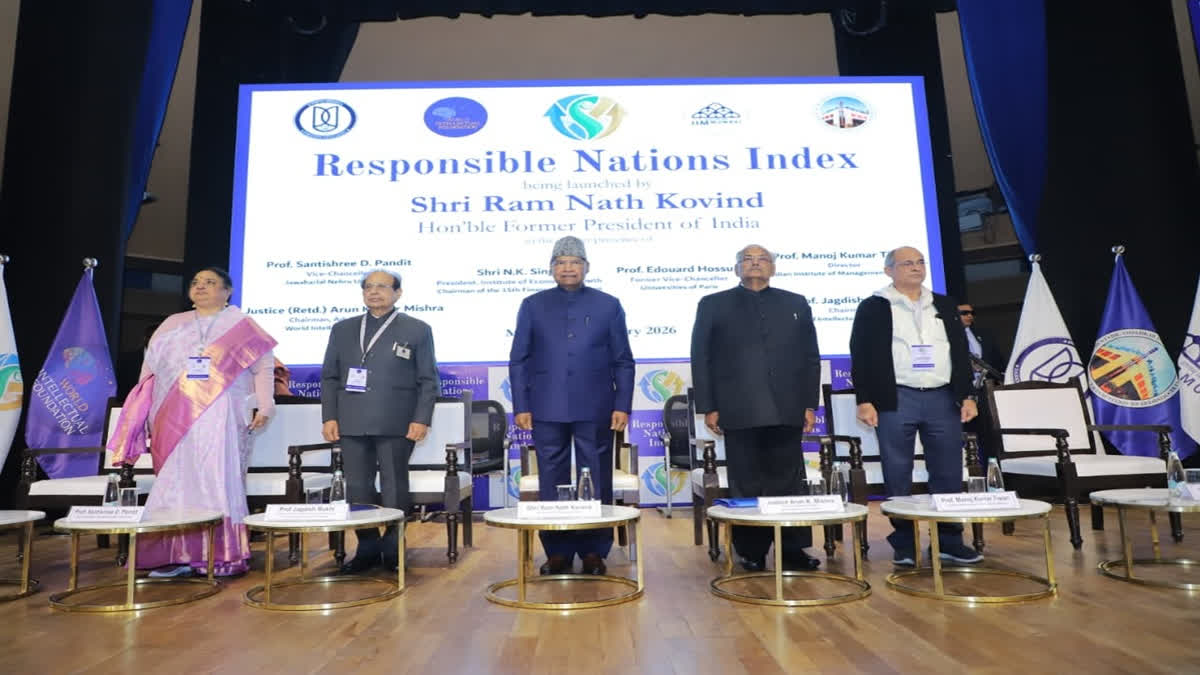
Former President Ramnath Kovind and other dignitaries at the launch of RNI in New Delhi (ETV Bharat)
New Delhi: India is ranked 16th among 154 countries in the Responsible Nations Index (RNI), launched by former President Ram Nath Kovind here on Monday.
Speaking on the occasion, the former President said, “The index is an innovative academic concept that defines what constitutes a responsible nation. The index reveals how responsibly a country behaves toward its own citizens and toward all of humanity. I congratulate the WIF. For the coming generation, this is an important step.”
In his address, Sudhanshu Mittal, Founder and Secretary, World Intellectual Foundation, said the RNI represents a shift from power-centric assessments to responsibility-centric evaluation of nations.
“The Responsible Nations Index asks a fundamental question—how responsibly does a nation exercise its power? Prosperity without responsibility is unsustainable. RNI seeks to encourage ethical governance, humane development, and global stewardship,” he said.
The RNI is the culmination of a three-year-long academic and policy exercise, conceptualised and developed by the World Intellectual Foundation (WIF). Anchored in India’s civilisational ethos of dharma and global well-being, the Index seeks to reframe global discourse around nationhood and progress.
WIF is a global think tank committed to advancing ideas that promote ethical leadership, responsible governance, and sustainable global futures through rigorous research and dialogue. Institutions such as Jawaharlal Nehru University (JNU) and Indian Institute of Management (IIM) Mumbai played a key academic role in shaping the intellectual foundations and methodological rigour of the Index.
The RNI is designed to assess national performance through the lens of responsibility rather than power or economic output. It is grounded in a normative framework that emphasises equity, sustainability, peace, and ethical governance, while remaining empirically robust and globally comparable.
The Index evaluates countries across three core pillars of responsibility like Internal Responsibility a nation’s obligations towards the well-being, dignity, and empowerment of its citizens; environmental responsibility-a nation’s commitment to ecological protection and sustainable development; and external responsibility – a nation’s conduct and contribution within the international system.
The pillars are operationalized through seven dimensions-Quality of Life, Governance, Social Justice and Empowerment, Economic Performance, Environmental Protection, Commitment to Peace, and International Economic Relations-captured through 58 carefully selected indicators.
Data for the RNI is drawn from credible and publicly accessible international sources, including the World Bank, United Nations agencies, IMF, WHO, FAO, ILO, and the World Justice Project, using the latest available data as of 2023.
This ensures that the comparative landscape is both geographically comprehensive and socio economically balanced. By structuring the rankings across regions, income classifications, and developmental contexts, the RNI offers a nuanced understanding of how responsibility manifests across diverse governance systems, socio-economic conditions, and historical trajectories.
Together this presentation captures global variations in governance ethics, social justice, environmental stewardship, and international conduct-providing a robust snapshot of responsibility in the contemporary world order. According to the RNI 2026, Singapore has bagged the top spot, followed by Switzerland and Denmark.
Cyprus has been placed at the fourth spot, followed by Sweden, as per the RNI.
“The preliminary results reveal several important trends about the global distribution of responsibility. A cluster of northern and select eastern European nations consistently score high, reflecting strong rule-of-law cultures, robust and inclusive welfare systems, and sustained commitments to decarbonisation and climate ethics. Notably, several emerging economies show exceptional performance on dimensions such as peacekeeping contributions, inclusive welfare delivery, renewable energy adoption, and equitable development, often surpassing high-income nations that traditionally dominate global indices,” read the report.
These patterns reaffirm that responsible national conduct is shaped less by the size of an economy and more by the quality of its institutions, the ethical orientation of governance, commitment to social justice and the extent to which development benefits are equitably shared, it said.
The RNI underscored a crucial global insight: responsibility is not a by-product of wealth, but of political will, institutional integrity, and long-term commitment to equity and social justice.
Prof Santishree D Pandit, Vice-Chancellor, Jawaharlal Nehru University and Prof Manoj Kumar Tiwari, Director, IIM Mumbai, were among dignitaries present.