
Since leaving the Naval Service last year, I have followed growing commentary suggesting Ireland should outsource elements of its defence and security, particularly in our air and maritime domains.
Much of this discussion is well-intentioned and framed as pragmatic. It reflects genuine concern about capability gaps, cost pressures, and a rapidly changing defence environment. However, it also raises strategic questions that deserve careful and sober consideration.
No modern state can reasonably be expected to defend itself entirely alone. Alliances, partnerships, and cooperation are unavoidable features of contemporary defence and security, and Ireland is no exception. Intelligence sharing, interoperability with neighbours, and collaboration with partners are essential.
Ireland also sits within the European Union, where mutual assistance and solidarity clauses are often cited as reassurance. These mechanisms, however, remain largely untested in Irish circumstances and should not be assumed to substitute for national defence capability.
The critical issue is not cooperation itself, but where cooperation quietly becomes substitution. Where core defence functions are no longer exercised by the State but are instead carried out on its behalf by others.
Debate in Ireland has increasingly focused on outsourcing air and maritime functions, while land defence rarely features. That is not accidental. Government threat assessments, and the experience of other small states, consistently point to air, maritime, and cyber domains as the primary areas of risk: airspace incursions, subsea infrastructure, sea lines of communication, and digital vulnerabilities.
These threats are often less visible to the public, which makes decisions about them all the more consequential.
Neutrality frequently enters this discussion as a limiting factor. In practice, neutrality is sometimes conflated with low or minimal capability, rather than understood as a policy position that still requires credible means of defence and enforcement.
Neutrality does not remove the need to monitor, control, and defend sovereign airspace, waters, and infrastructure — it simply shapes how that capability is structured and with whom Ireland cooperates.
Cost is often presented as the decisive argument. Naval and air assets, joint command-and-control systems, and cyber defence are expensive capabilities to develop and sustain. There is no inexpensive version of sovereignty.
Surveillance alone, however, is not the main cost driver. The real cost lies in maintaining credible response and enforcement capability. The ability to detect activity, without the means to act, leaves the State informed but operationally incapable in areas of sovereign responsibility
Deterrence, in this context, is about denial — having sufficient capability to impose cost and friction on a potential adversary. If there is no credible response, there is little to deter. Patrolling and surveillance provide a decisive presence, however, it does not equate to defence unless backed by the ability to enforce sovereign rights and take military action when required.
Proposals for the UK or other partners to patrol Irish waters or provide routine air policing are often presented as practical responses to current gaps. In the short term, such arrangements may appear sensible. Over time, however, reliance on another state to routinely perform core defence tasks becomes dependency rather than partnership. That distinction matters.
Control matters most in moments of crisis. If a UK or French aircraft or naval unit encountered a threat requiring immediate action in Irish-controlled airspace or waters, it would act under its own national command, rules of engagement, and political authority.
That is an operational reality of military decision-making, not a criticism of any partner. But it also carries a clear sovereignty consequence: decisions affecting Irish airspace or waters could be made elsewhere, without reach-back to Dublin in time-critical situations.
Sovereignty that is not exercised in practice becomes theoretical. To put it simply: if you do not walk your land regularly, you should not be surprised if someone sets up camp and starts using it for their own purposes.
There are several well-documented international cases where states effectively outsourced key elements of their defence or security, only to suffer serious negative consequences. These examples are frequently cited in defence and security studies because they illustrate the risks of dependency, loss of autonomy, and strategic vulnerability.
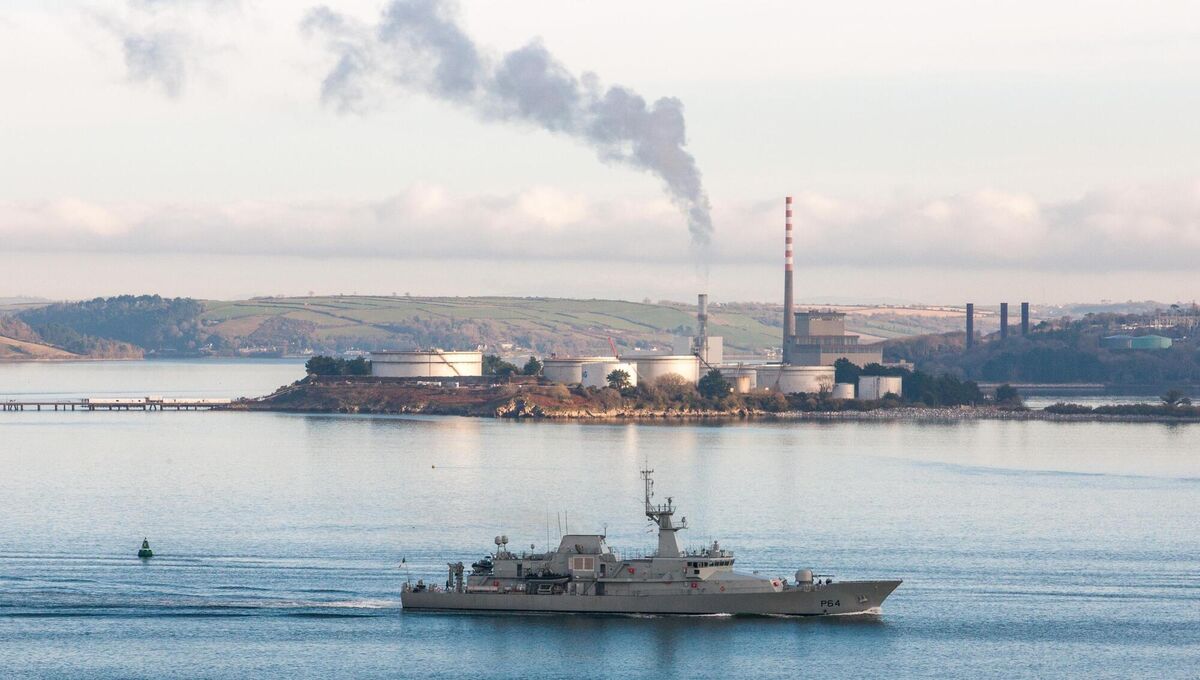 The LÉ George Bernard Shaw as she heads out of the harbour on patrol in Co Cork. Picture: David Creedon / Anzenberger
Ukraine provides a stark example. In 1994, it gave up the world’s third-largest nuclear arsenal under the Budapest Memorandum, receiving security assurances but no binding defence commitments. When those assurances failed in 2014 and again in 2022, Ukraine lacked an independent strategic deterrent at the critical moment.
Mali offers another case. Counter-insurgency was first outsourced to France and later shifted to Russia’s Wagner Group following political disputes. Security deteriorated, human rights abuses increased, and Mali became strategically dependent on an external actor with limited leverage and few exit options. Outsourcing security narrowed, rather than expanded, national resilience.
The Baltic states’ reliance on Nato air policing is sometimes cited as a positive model. It works because it is embedded in a binding collective defence alliance, backed by integrated command structures and credible force.
Even so, dependence remains: deterrence rests on alliance cohesion, and any weakening of that cohesion would immediately expose vulnerability. Outsourcing works best, and only, when it is part of shared defence, not a replacement for sovereign capability.
Across these cases, negative outcomes tend to stem from common factors: loss of decision-making autonomy; dependency on external political will; erosion of indigenous capability; strategic surprise when guarantees fail; and increased foreign influence over national policy.
Ireland should be aspiring for full-spectrum military capability. It requires a credible defence posture appropriate to its assessed risks.
Recent improvements in naval ship availability and maritime surveillance aircraft outputs are valuable but lack the capability required. They are not a substitute for balanced capability across air and maritime domains, including joint domain awareness, command and control, and the ability to respond credibly and robustly when sovereign rights are challenged.
The debate, then, is not neutrality versus alliances. It is whether Ireland remains an active and capable participant within partnerships or gradually becomes a passive consumer of defence services provided by others.
Alliances are necessary. Cooperation is essential. But outsourcing defence as a substitute for national capability carries immediate strategic costs.
Tony Geraghty was a commander in the Irish Naval Service until his retirement in 2025