
China’s economy grew 5 percent in 2025, hitting Beijing’s annual target even as it registered one of the weakest expansions in decades, according to official statistics.
The Chinese economy grew in line with official expectations despite United States President Donald Trump’s trade war, official data showed on Monday, as surging exports helped offset weak consumer spending and a prolonged property downturn.
Still, despite shrugging off Trump’s tariffs, growth was still well below the historical trend of about 8 percent between 2000 and 2025.
The world’s second-largest economy slowed to annualised growth of 4.5 percent in the October-December period compared with expansions of 4.8 percent and 5.2 percent in the third and second quarters, respectively.
“Generally speaking, the national economy sustained momentum of steady progress in 2025 despite multiple pressures, and high-quality development registered new achievements,” China’s National Bureau of Statistics said in a statement.
“However, we must be aware that the impact of changes in the external environment is growing, the contradiction of strong supply and weak demand in the domestic market is prominent, and the numerous longstanding issues and new challenges still remain in the economic development.”
Exports drove the Chinese economy’s expansion, with their total value rising 6.1 percent to 26,989 billion yuan ($3.9 trillion), according to the data.
China’s trade surplus reached a record high of nearly $1.2 trillion last year, according to official data released last week, as Chinese firms sought out new markets in Asia, Africa, Latin America and Europe to mitigate the fallout of Trump’s tariffs.
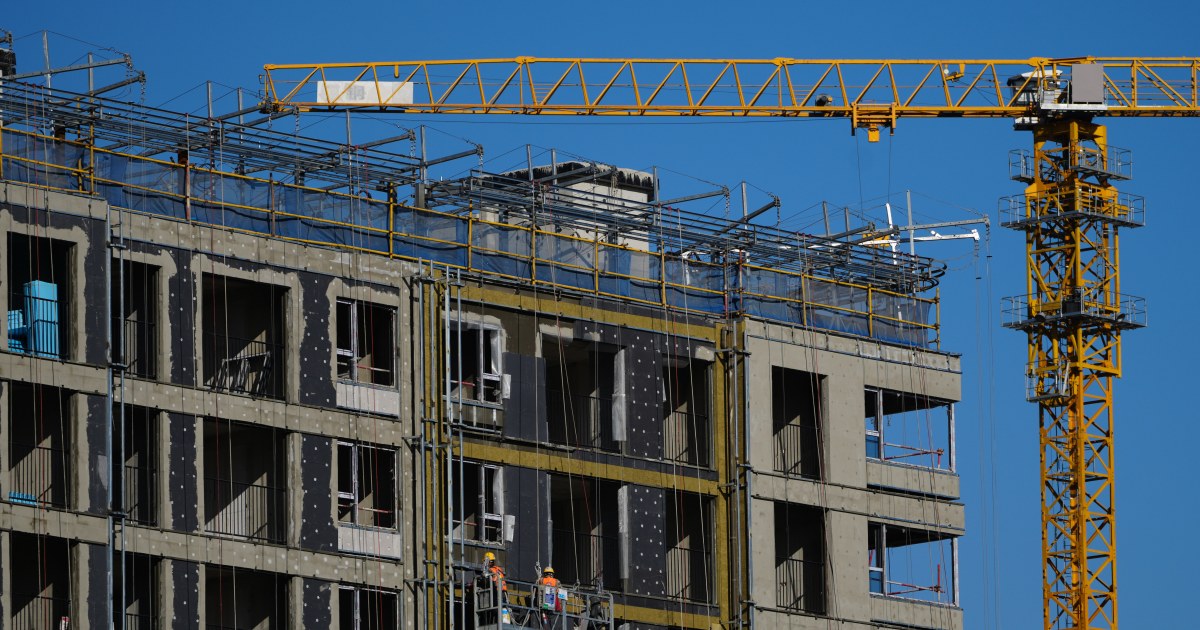
Consumption and real estate, both persistent drags on China’s economy in recent years, continued to weigh on growth in 2025.
Retail sales grew 0.9 percent on a yearly basis in December, compared with 1.3 percent the previous month, marking the slowest rise since Beijing lifted its ultra-strict COVID-19 controls in late 2022.
Fixed-asset investment fell 3.8 percent across the year, with spending on infrastructure and real estate development declining by 2.2 percent and 17.2 percent, respectively.
“Today’s GDP read shows that it’s mission accomplished for 2025, as China managed to complete its growth target of around 5 percent,” Lynn Song, chief economist for Greater China, told Al Jazeera.
“However, growth clearly decelerated in the second half of the year, and now the focus shifts to how to achieve another year of solid growth in 2026 to get the 15th five-year period off to a strong start,” Song added, referring to Beijing’s five-year plan for 2026-30.
Dexter Roberts, a nonresident senior fellow at the Atlantic Council’s Global China Hub, said the economic figures pointed to China’s difficulties in transitioning away from export-led growth.
“China really needs to find a way to boost confidence among households and also companies, but that’s just not happening and if they don’t get the job growth and the wage growth up, people will continue to not open their wallets and not spend,” Roberts told Al Jazeera.
“When you’re one single largest asset, the property that you own, has depreciated in value, people don’t feel like opening their wallets and spending. They want to save for a rainy day in the future,” Roberts said.