
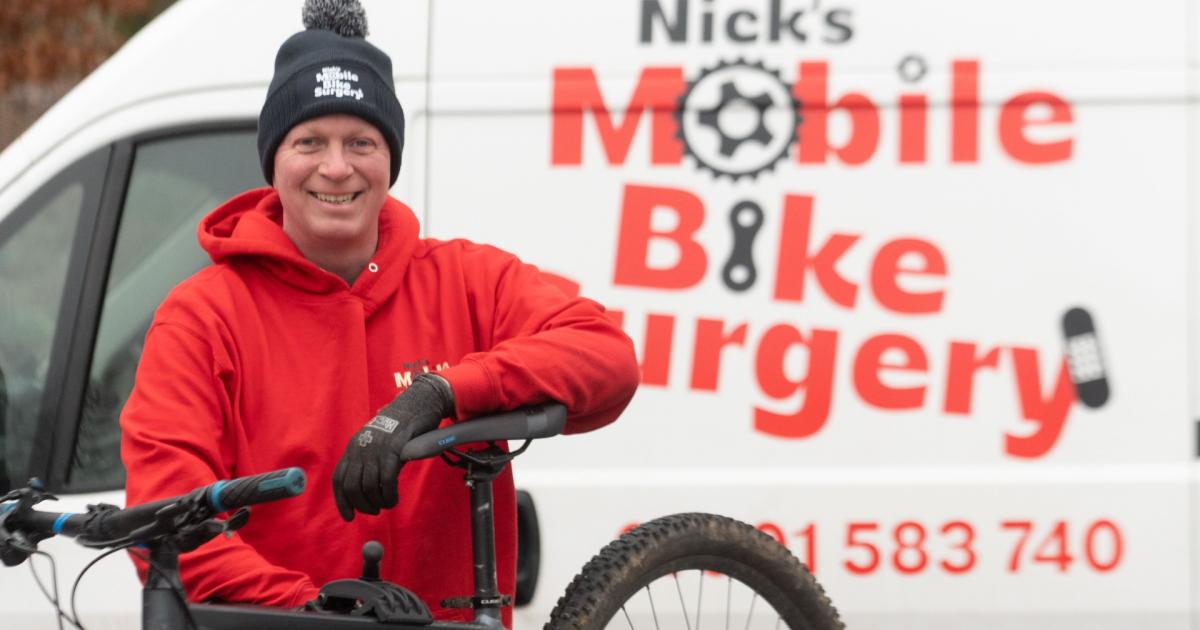
Former Scottish Renewables director Nick Sharpe, who also lived life in fast lane as a journalist at a national paper, has spoken about his recovery from a major breakdown and crippling anxiety.
The 46-year-old has turned his life around after being inspired to return to his first love – repairing bikes – after starting as a volunteer in his village during lockdown.
Langbank man Nick Sharpe on mental health struggles (Image: contributed)
Now with his new venture as a mobile bike mechanic, he also wants to reach out to talk about men’s mental health.
Opening up about his own struggles Nick said: “I’ve battled with my mental health since I was in my early twenties.
“But it took many therapy sessions to realise that it was my addiction to the adrenaline caused by stress which was the problem.
“Despite that realisation, traditional talking therapies really didn’t make much difference in the long-term.
“They say that sometimes things need to get worse to force you to make the change that’s needed – in my case that meant the stress of my job increasing to a point where I just couldn’t take it any more.
“Anxiety is a terrible condition, but it’s often downplayed by people who don’t understand it.
“Imagine feeling like you are just about to walk into the biggest job interview of your life but feeling that way for every waking moment indefinitely: that’s anxiety at its worst. I know there are so many people out there who will recognise that feeling.”
Langbank man Nick Sharpe on mental health struggles (Image: contributed)
Nick was at the height of his powers as a director of communications with Scottish Renewables, meeting the demands of powerful corporations making multi-million-pound investments.
Langbank man Nick Sharpe on mental health struggles (Image: contributed)
Prior to that he’d spent 15 years as a national newspaper journalist – a job which saw him dispatched to an unfolding shooting massacre and take a helicopter flight into an erupting volcano.
But two decades of living a pressure-cooker existence eventually triggered a collapse in three years ago.
Nick, 46, said: “After years of feeling ready to take on any challenge, suddenly I couldn’t even catch a train or go to the supermarket without crying. I was crippled with anxiety.
“I remember getting off the train in Glasgow one morning and having to lean against a lamppost because my legs were so wobbly. Sweat was running down my back. I felt terror as if I was being forced to meet a monster.
“I desperately wanted to get back to ‘normal’ but eventually, after a particularly dreadful few days of anxiety, my therapist and I agreed that enough was enough. I went home to my wife and said, ‘I need to do something else’.”
Nick was forced to take a seven-month absence and decided it was time for a complete change.
Now he has a new joy for life, going back to the beginning and rediscovering his love of bikes.
Nick has set up a mobile bike repair business, Nick’s Mobile Bike Surgery, covering Greater Glasgow and Clyde area.
Dad-of-two Nick said: “I’ve fixed bikes all my life. During lockdown, when there wasn’t much to do, I’d put a post on the village Facebook group offering to help fix folks’ bikes for free. It was so popular, I almost ran it as another job, fixing about 40 bikes in nine months.
” I just loved going round the village chatting to people and even received a commendation from the local Provost for charitable work during the pandemic.”
After working as a journalist and being first at the scene of some of the biggest stories, then in diving into the corporate world Nick says he is finally finding peace.
He added: “I realise now that I spent 20-odd years fuelling myself on adrenaline, panic and caffeine.
“I was stressed for decades but was too busy to notice the damage I was doing to myself until it was too late.
“People would think I was knocking it out of the park, but I remember sometimes being being almost paralysed with nerves.”
But after months of working as a bike mechanic he is finally learning to cope with stress after a dramatic career change and looks after his own mental health.
He added: “Seven months in things have become much easier and I’m more in control of my life than I’ve ever been, which I think is what I have been needing all along.”
Looking ahead he hopes that men’s mental health will be more openly talked about.
Nick added: “The issue of men’s mental health has come to the fore since covid, with a much better understanding now of the dangers of keeping emotions bottled up.
“I’m lucky in that my wife understands me better than anyone and I’ve got a supportive group of friends. I would urge others who don’t have that support network to reach out to professionals if they are struggling, starting with their GP.”