
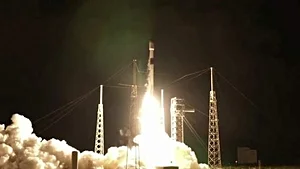
SpaceX overcame adverse weather conditions to launch 29 new Starlink satellites on January 18, 2026, marking the company’s 601st space mission. The launch, which took place from Cape Canaveral Space Force Station, unfolded in the midst of gusty winds and a cold front sweeping across Florida.
Launch Amid Chilly Weather
At 6:31:40 p.m. EST, a Falcon 9 rocket thundered into the evening sky, carrying the 29 Starlink V2 Mini satellites into orbit. Despite early forecasts predicting only a 60% chance of favorable conditions, the mission went ahead as planned, with the cold front’s high winds subsiding just in time. By the time the rocket ignited, the winds had dropped to a manageable 14 mph, and visibility held steady at 10 miles, allowing for a smooth launch.
SpaceX’s technical team and the 45th Weather Squadron worked in tandem to monitor the evolving weather conditions. Early in the day, the winds at NASA’s Kennedy Space Center reached 61 mph, prompting concern over the launch’s viability. However, by evening, the situation improved, and the Falcon 9 was cleared for liftoff. Temperatures hovered around 56-57 degrees Fahrenheit, far colder than typical Florida weather, but not enough to derail the mission.
The successful launch of Starlink 6-100 continued SpaceX’s mission to expand its low-Earth orbit constellation, which aims to bring high-speed internet access to underserved regions worldwide. The satellites were deployed into a 164 x 157-mile orbit, tilted at a 43-degree angle to the equator. This constellation is part of SpaceX’s broader effort to provide internet coverage to remote locations that traditional infrastructure cannot reach.
Veteran Booster’s 24th Flight
In a hallmark of SpaceX’s reusable technology, the Falcon 9’s first-stage booster, designated B1080, completed its 24th successful flight. After deployment of the satellites, the booster landed on the drone ship “A Shortfall of Gravitas” stationed in the Atlantic Ocean. The booster touched down a mere 8 minutes and 20 seconds after liftoff, showcasing SpaceX’s ability to reuse equipment with remarkable frequency. This particular booster has been part of missions to the International Space Station, the Euclid mission, and 17 other Starlink launches, underlining its reliability in the company’s spaceflight strategy.
As SpaceX celebrates its 601st mission, company CEO Elon Musk took to social media, reflecting on the achievement and his bold prediction that the Falcon 9 rocket could surpass 1,000 launches before being retired. The continued success of the Falcon 9 booster is a testament to SpaceX’s commitment to cost reduction and increased launch frequency, which has revolutionized the economics of space exploration.
The mission also marked the fifth orbital launch from Florida’s Space Coast this year, further cementing the region’s importance in the space industry. With the ongoing development of both the Cape Canaveral Space Force Station and NASA’s Kennedy Space Center, the area has become a central hub for space activity, contributing significantly to local economic growth and the global spaceflight industry.
Despite the cold weather advisory issued for northern Brevard County, where wind chills dipped as low as 27°F, the local community remained focused on the success of the launch. For residents, launches like these have become a familiar part of daily life, a reflection of how integral the space industry has become to both the local economy and national security.
Looking ahead, SpaceX’s expansion of the Starlink constellation continues at a rapid pace. With each successful launch, the company moves closer to its goal of creating a truly interconnected world. As SpaceX sets its sights on even more ambitious projects, including lunar landings and eventual missions to Mars, the regular cadence of Starlink launches is proving to be a key part of its broader space ambitions.