

Key takeaways
Long and Hodgman, who previously starred in Apple’s Get a Mac campaign in the late 2000s, have reunited for Novo Nordisk’s Ozempic campaign.
Novo’s latest brand campaign seeks to differentiate Ozempic from other GLP-1 drugs on the market by underscoring its multiple clinical indications for people living with type 2 diabetes
The ad campaign debuts amid continued competition by Novo for market share against not only primary pharma rival Eli Lilly but also a litany of telehealth firms that sell GLP-1 drugs.
Actors Justin Long and John Hodgman have reunited for Novo Nordisk’s There’s Only One Ozempic campaign, which debuted Tuesday morning.
Novo’s latest consumer-focused brand campaign seeks to differentiate Ozempic from other GLP-1 drugs on the market by underscoring its multiple clinical indications for people living with type 2 diabetes.
These include lowering A1C percentages, providing greater cardiovascular protection and preventing kidney disease.
As such, the pair are featured in a handful of light-hearted ads that take place in front of a water cooler, a whiteboard and on a game show set.
In the spots, Long represents Ozempic and its FDA-approved indications, while Hodgman represents “other GLP-1s for type 2 diabetes.”
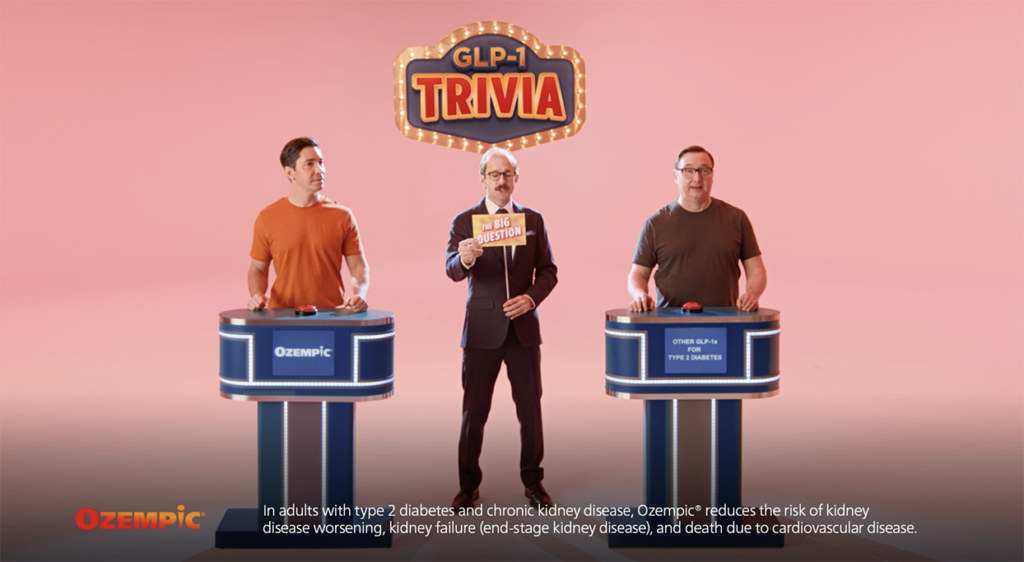 Image courtesy Novo Nordisk, used with permission.
Readers may recall that the pair achieved advertising fame in the late 2000s for their participation in Apple’s long-running Get a Mac campaign — where Long represented Mac and Hodgman represented PC.
While designed to be humorous with friendly banter, the ads address the audience directly and underscore the importance of recognizing the difference between Ozempic and other GLP-1 drugs available on the market.
Building off the momentum from Novo’s prior use of Pilot’s 1974 hit “Magic” in Ozempic ads, this campaign also features a new jingle.
Novo developed There’s Only One Ozempic in partnership with Rogue Producer, an independent advertising and content production department.
The Danish drugmaker also worked with a number of agencies on the effort, including BGB for project management and partner coordination, Burson for social content execution, Real Chemistry’s Starpower for talent coordination and CMI Media Group/WPP Media for all paid campaigns across digital platforms.
The ad campaign from Novo debuts amid continued competition for market share against not only primary pharma rival Eli Lilly but also a litany of telehealth firms that sell GLP-1 drugs and compounded semaglutide, the drug’s primary ingredient.
Though Ozempic sales reached $4.7 billion in Q3 2025, sales of the blockbuster drug have slowed in recent years due to slowing demand as a result of reduced coverage for weight-loss medications and additional entrants to the market.
Considering how Ozempic enjoyed first-mover advantage and became synonymous with the weight-loss drug boom of the past few years — similar in defining its own product category like Kleenex did for facial tissues — Novo is now trying to differentiate its lead medication for consumers.
Ed Cinca, SVP of marketing and patient solutions at Novo, said the objective of the campaign is to educate both patients and providers on the efficacy, safety, and risks associated with GLP-1 drugs as well as Ozempic’s distinct clinical advantages over its competitors.
To strike a new chord with the audience, Cinca said the pharma giant sought to create an ad campaign that is irreverent and attention-grabbing.
“In one part, we need to break through the clutter,” Cinca said. “There’s quite a lot of misinformation in the marketplace and a lot of misunderstanding. For us, it’s about finding something that’s unique, that’s irreverent and can draw attention and break through that clutter.”
There’s Only One Ozempic will be a social-first campaign from Novo as it rolls out.
By eschewing linear TV, Cinca said Novo will be advertising where its target audience is most active: on social media platforms and connected TV. He said that Novo was not influenced by the Trump administration’s ongoing pharma TV ad crackdown when it decided to opt for social media instead of linear TV.
The campaign echoes Novo’s prior efforts to combat the sale and marketing of unapproved compounded “semaglutide” products.
Following Hims & Hers’ controversial Super Bowl ad last year, ran a print ad in The New York Times featuring text that reads, “Check before you inject.”
Given how popular these drugs have been and subsequently how much misinformation around them has proliferated online, Cinca said Novo is aiming to set the record straight with this splashy campaign launch.
“We want patients to know that they need to recognize the differences between products,” he said. “We want to ensure that they’re driving decisions based on real information, that they’re pausing to understand and do a little bit of a double click on how these products are different. What Ozempic brings to the table that’s unique.”