
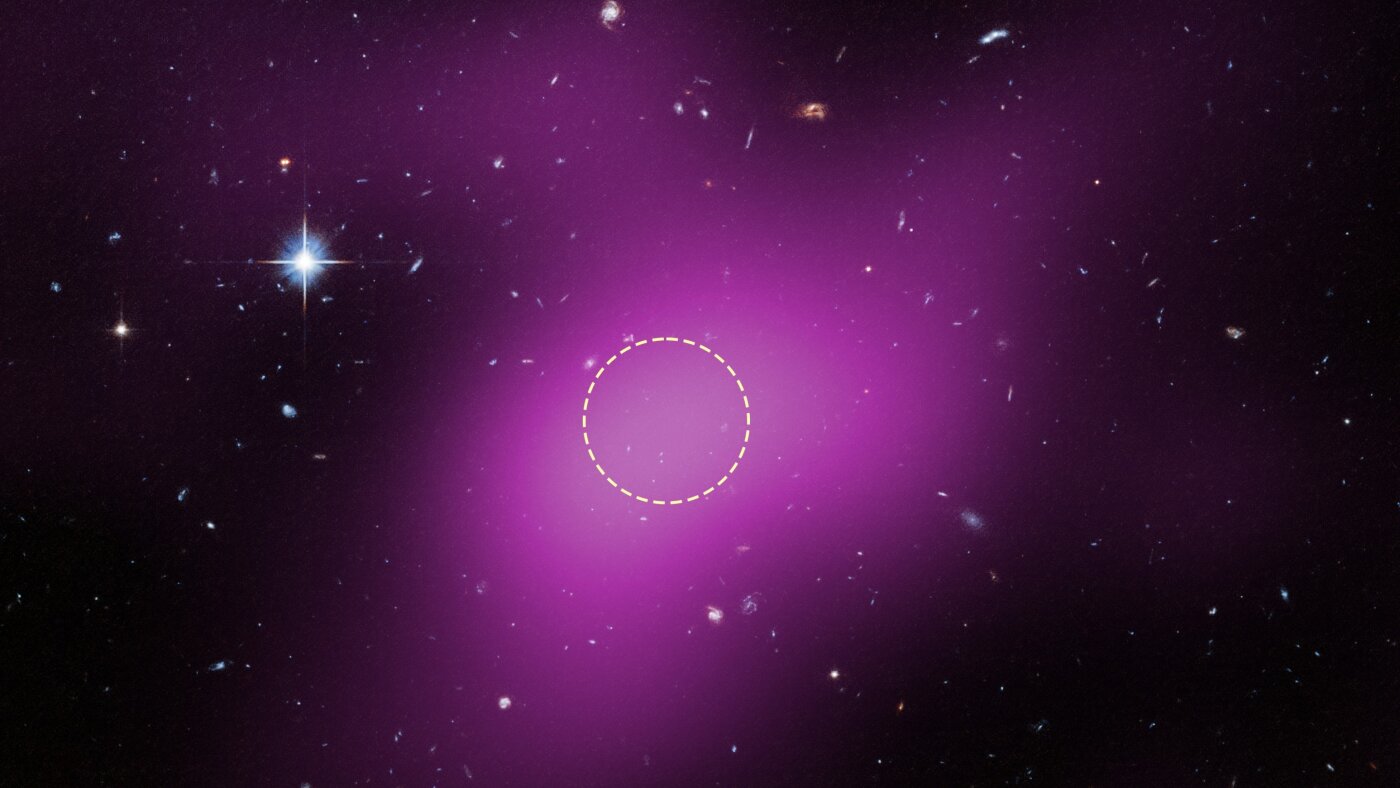
This image shows the location of Cloud-9, which is 14 million light-years from Earth.
Science: NASA, ESA, VLA, Gagandeep Anand (STScI), Alejandro Benitez-Llambay (University of Milano-Bicocca); Image Processing: Joseph DePasquale (STScI)/NASA
hide caption
toggle caption
Science: NASA, ESA, VLA, Gagandeep Anand (STScI), Alejandro Benitez-Llambay (University of Milano-Bicocca); Image Processing: Joseph DePasquale (STScI)/NASA
Cloud 9 is a failed galaxy. It’s a clump of dark matter, called a dark matter halo, that never formed stars.
But this failure could be the key to a mystery almost as old as the universe itself: dark matter.
Scientists don’t know what dark matter is, but Cloud 9 could offer new clues. Three researchers weigh in on this new discovery and why it could be a missing piece to the story on how the universe formed.
Check out our episode with astrophysicist Jorge Moreno on the mysterious Great Attractor and our summer series on space.
Have a scientific question you want us to answer? Email us at shortwave@npr.org.
Listen to every episode of Short Wave sponsor-free and support our work at NPR by signing up for Short Wave+ at plus.npr.org/shortwave.
Listen to Short Wave on Spotify and Apple Podcasts.
This episode was produced by Rachel Carlson. It was edited by Rebecca Ramirez. Tyler Jones checked the facts. The audio engineer was Robert Rodriguez.