
Pakistan has imported over 50 GW of solar modules from China, including 18 GW during the country’s last fiscal year. In the absence of official installation figures, Islamabad-based thinktank Renewables First says up to 33 GW of solar capacity could have been deployed in Pakistan to date.
January 20, 2026
Patrick Jowett
Pakistan imported a cumulative 51.5 GW of solar modules from China as of November 2025, according to figures shared by energy think tank Renewables First.
Data available through Renewables First’s solar analytics portal highlights that imports of Chinese solar modules have accelerated over Pakistan’s last two fiscal years. At the end of the most recent fiscal year in June 2025, Pakistan had imported a cumulative 48 GW of modules, with associated costs totaling more than $2 billion.
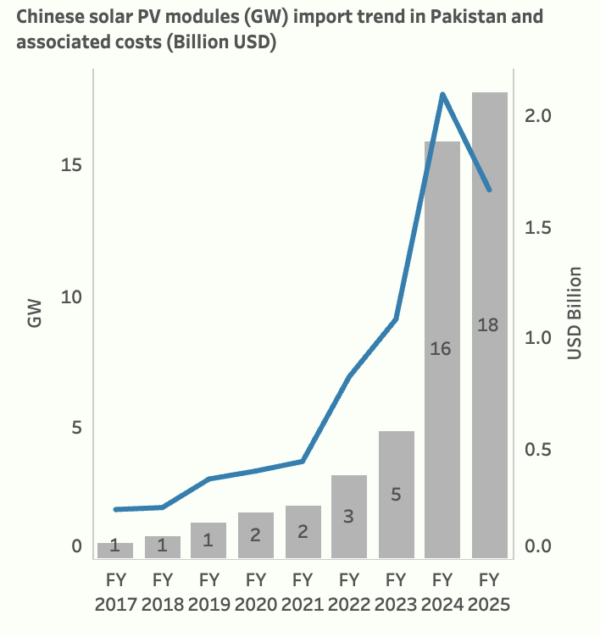 Cumulative solar module imports to Pakistan
Image: Renewables First
There is currently no official data covering Pakistan’s cumulative solar capacity due to data limitations in tracking behind-the-meter and off-grid installations. Official data is only available for Pakistan’s net-metering capacity, the latest of which confirms 6.8 GW had been installed as of September 2025.
Rabia Babar, Manager Data for Energy & Climate at Renewables First, told pv magazine that estimates suggest between 27 GW and 33 GW of solar capacity have been deployed across different market segments, including net-metering, in Pakistan.
“The widespread uptake of solar is increasingly evident in declining midday grid demand compared to previous years, followed by sharp evening demand surges – typical in grids with high solar penetration,” Babar explained.
Babar added that solar adoption in Pakistan is highest in the residential market but take up is also strong among C&I customers. “In 2026, deployments are expected to increase further, driven mainly by residential, C&I, and agricultural consumers,” she predicted, adding that the ongoing import of Chinese solar panels in the current fiscal year points towards continued growth in solar adoption.
In contrast, no utility-scale solar projects came online in Pakistan last year. The country’s cumulative utility-scale solar capacity is estimated at around 780 MW.
Looking ahead, Babar said greater access to battery storage may influence consumer behaviour in 2026, with the economies of solar-plus-storage systems attractive to both residential and commercial customers.
Babar also said that proposals to shift the net-metering framework to a net-billing model, currently under consideration, could potentially create uncertainty for investors.
“New users could face lower incentives, which may affect confidence and financing for residential and C&I solar projects,” Babar explained. “In my view, clear policies and timelines from the government can enable the market to adjust smoothly to upcoming changes.”
This content is protected by copyright and may not be reused. If you want to cooperate with us and would like to reuse some of our content, please contact: editors@pv-magazine.com.
Popular content