
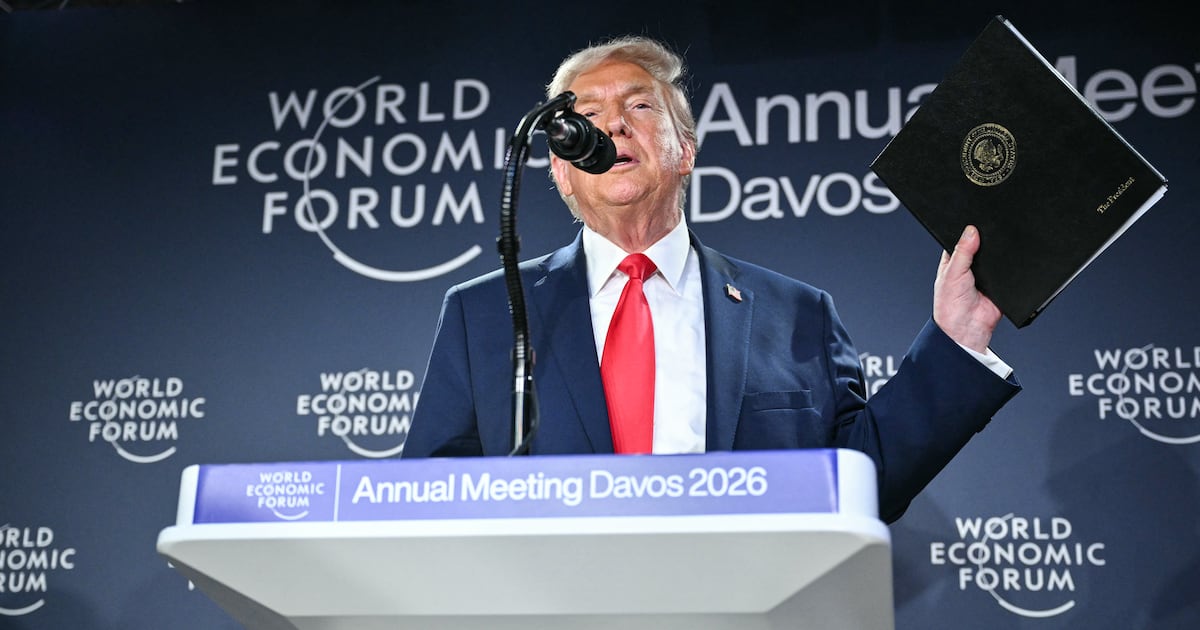
US president Donald Trump has dropped his threat to impose tariffs on several European countries for their stance on Greenland, saying he had reached a deal with the North Atlantic Treaty Organisation (Nato) on the island’s future.
“Based upon this understanding, I will not be imposing the tariffs that were scheduled to go into effect on February 1st,” Mr Trump wrote on his Truth Social platform after a meeting with Nato secretary general Mark Rutte at the World Economic Forum (WEF) in Davos.
Mr Trump had earlier told delegates at the forum that he would not use force to acquire the Arctic island but said he was seeking “immediate negotiations”.
Taoiseach Micheál Martin on Wednesday night welcomed the fact that a framework had been developed, saying “collectively we need to de-escalate this situation, we need to dial down and engage in those areas that matter”.
After days of escalating tensions that have strained transatlantic ties and roiled markets, Mr Trump took the possibility of military action off the table while claiming the US would be “unstoppable” in an armed conflict with Europe over the island.
“People thought I would use force. I don’t have to use force. I don’t want to use force. I won’t use force,” he said.
On Wednesday night, he appeared to also remove his threat to impose fresh tariffs on Denmark and seven other European countries if they refused to agree a deal.
Donald Trump, speaking in Davos, has said that the US needs Greenland for international protection, but he will not use force to get it. Video: Reuters
He said he will not be imposing tariffs that were scheduled to go into effect on February 1st.
In a post on Truth Social he said, based upon a “very productive meeting” with Mr Rutte, they “have formed the framework of a future deal with respect to Greenland”.
“This solution, if consummated, will be a great one for the United States of America, and all Nato nations,” his post said.
Despite confusing Greenland with Iceland on several occasions, and incorrectly claiming the US gave the territory back to Denmark after the second World War, Mr Trump, in his speech at Davos, insisted that only the US could protect “this giant piece of ice” and that the island was vital to Washington’s security interests.
He said Europeans had a choice over Greenland.
“You can say yes and we will be very appreciative, or you can say no and we will remember.”
He claimed Greenland was part of North America and that an acquisition by the US should not be viewed as a threat to Nato.
In a wide-ranging speech to the forum in Davos, which lasted more than an hour, Mr Trump said Europe was “not heading in the right way” due to “ever-increasing government spending, unchecked mass migration and endless foreign imports”.
Simmering tensions over Mr Trump’s stated intention to annex Greenland have triggered the biggest crisis in Europe-US relations since the second World War.
The tone of European leaders has hardened markedly in recent days on the back of Mr Trump’s threats and amid accusations that their attempts to placate the US president had backfired.
 Old order ‘not coming back’ as Trump overshadows World Economic Forum
The European Union’s 27 leaders will meet in Brussels on Thursday evening to discuss the sudden backtrack by the US president.
The emergency European Council summit had been convened to game out how to talk Mr Trump down from his demands and debate possible EU retaliation.
Discussions between the European Commission and national capitals beforehand indicated a clear desire from most governments to avoid an economically damaging trade war between Brussels and Washington.
The EU summit is still expected to sound out the levels of political support for various steps of possible retaliation, in the event the Trump administration resumes its threats of tariffs in pursuit of Greenland.
French president Emmanuel Macron was expected to advocate for the EU to take a tougher stance in its relations with the White House than it has to date.