
A research team at the University of Vienna reports quantum interference of sodium nanoparticles containing more than 7,000 atoms, using a source that can produce clusters up to about 10,000 atoms.
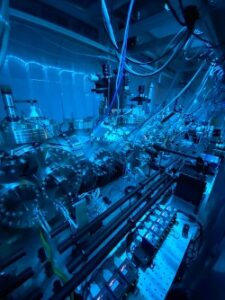
MUSCLE at the University of Vienna, where quantum interference of massive nanoparticles was detected. To isolate vibrations, the experiment is mounted on a table weighing several tons that floats on an air cushion. Credit: S. Pedalino / Uni Wien
“Intuitively, one would expect such a large lump of metal to behave like a classical particle,” lead author and doctoral student Sebastian Pedalino said in a press release. “The fact that it still interferes shows that quantum mechanics is valid even on this scale and does not require alternative models.”
While quantum superposition—the ability of a particle to exist in multiple states or locations simultaneously—is a staple of quantum mechanics, maintaining this state in large, complex objects has remained an engineering “holy grail.” The Vienna team, led by Markus Arndt and Stefan Gerlich, used sodium clusters with a mass exceeding 170,000 atomic mass units (amu), larger than most proteins.
The MUSCLE experiment
The test was conducted using the multi-scale cluster interference experiment (MUSCLE).
To observe interference, the team had to minimize environmental disturbances that would destroy coherence. They produced the sodium clusters under cryogenic conditions (77 K, the temperature of liquid nitrogen) to reduce thermal decoherence, and ran the interferometer in ultra-high vacuum (about 9 × 10⁻⁹ mbar, roughly 10⁻¹¹ of atmospheric pressure) to limit collisions with gas molecules.
The scientists produced sodium clusters containing roughly 5,000 to 10,000 atoms and sent them through a three-grating interferometer made from standing ultraviolet laser light. The first grating spatially confined the particles to build up coherence, and the second grating acted as a beam splitter for the clusters’ matter wave. Scanning the third grating revealed an interference fringe pattern, and the team showed the fringe visibility followed the quantum prediction rather than a classical shadow-pattern model
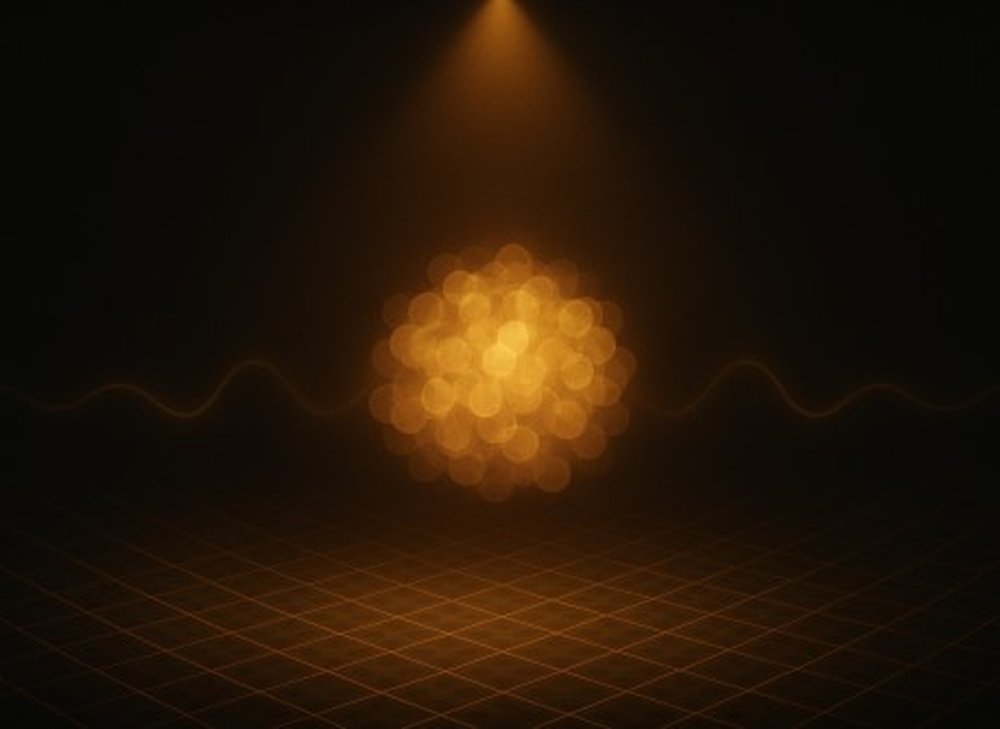
AI-generated interpretation of the wave properties of matter. A blurred cluster composed of many atoms floats in the cone of light. The blur represents a delocalised quantum state: the cluster has no fixed location but is spatially extended as a wave function. Below it, a grid stretches out, reminiscent of several possible interferometer paths. The cone of light symbolizes the measurement process: only when the particle enters the ‘spotlight’ during the measurement is the cluster clearly determined at a specific location. Credit: OpenAI Free License
The study achieved a macroscopicity value of 15.5. This metric quantifies how strictly an experiment tests the limits of quantum theory. This study has a value 10 times higher than any previous experiment.
This new level of sensitivity presents new opportunities for nanotechnology and materials science, opening new doors for measuring properties of nanoparticles and investigating the transition of matter from individual atoms to bulk metallic solids.