
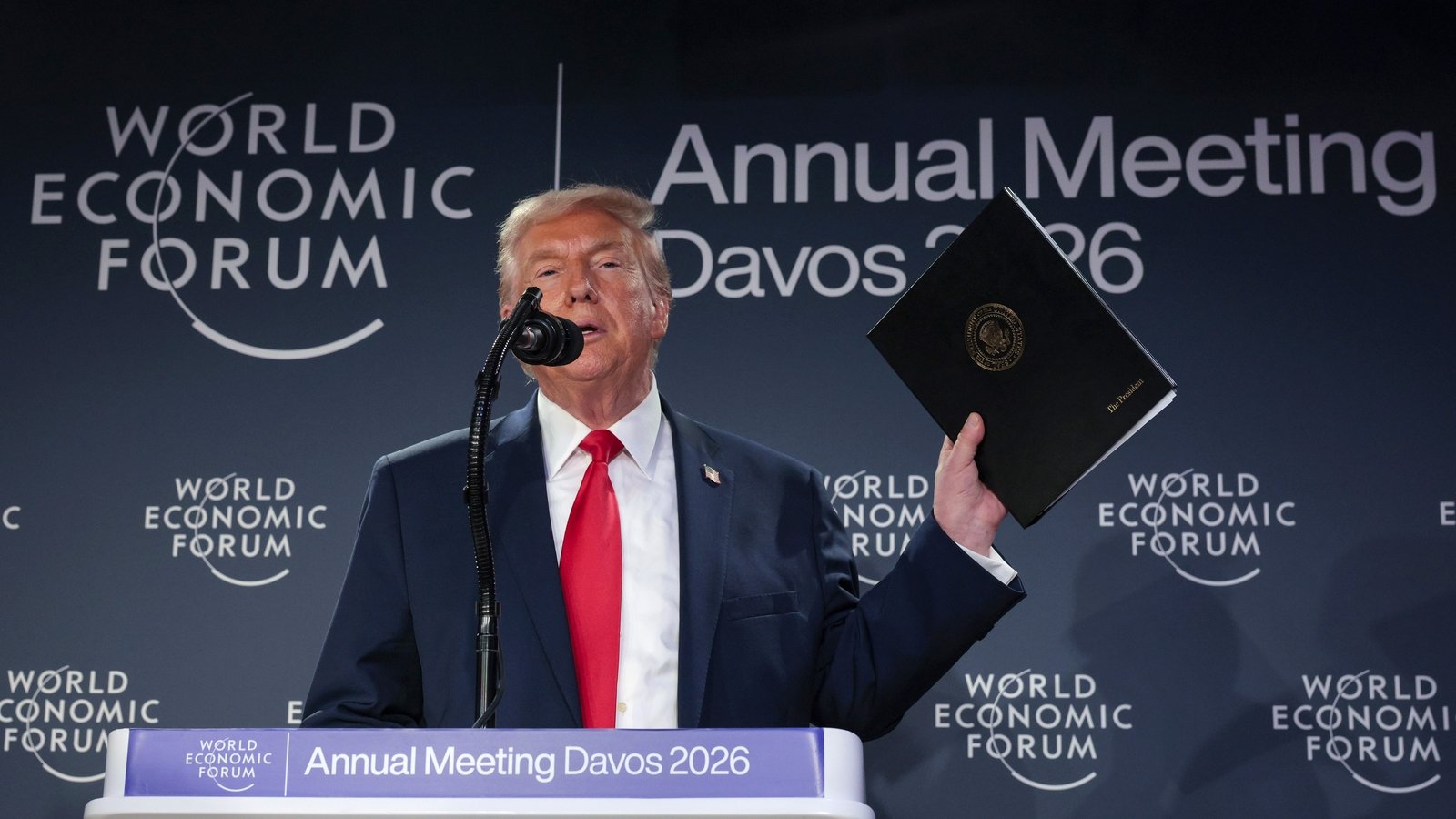
US President Donald Trump backed down on threats to seize Greenland by force from ally Denmark, announcing a vague deal aimed at ensuring security of the Arctic territory.
Mr Trump cast his retreat – also lifting the promise of sanctions against European nations that spoke out against the threats to Denmark – as a win, saying the deal gives the US “everything we wanted”.
The agreement, he told reporters at the World Economic Forum in Davos, was negotiated with NATO Secretary-General Mark Rutte and would last “forever”.
“I think it puts everybody in a really good position, especially as it pertains to security, and minerals and everything else,” Mr Trump said, hours after a speech in which he appeared to remove the threat of force to seize Greenland.
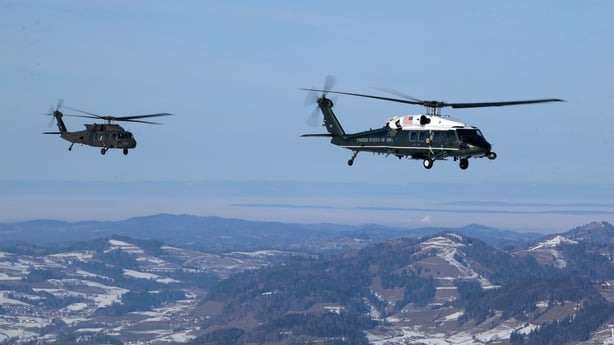
Blackhawk helicopters, part of the US presidential helicopter squadron, travelling from Zurich to Davos
However, there was no sign that Mr Trump had succeeded in his repeated vow to make Greenland part of the United States.
When asked if Denmark would continue to control the territory, Mr Rutte said the subject of Greenland’s sovereignty “did not come up” in his talks with Mr Trump.
Speaking to Fox News’ ‘Special Report with Bret Baier,’ Mr Rutte gave few details of what the new status for Greenland might be, only saying that NATO would continue to work on securing the Arctic region from adversaries such as Russia or China.
Meanwhile, the NATO chief said that “there’s still a lot of work to be done”.
Mr Trump said in a social media post that he would be scrapping tariffs of up to 25% threatened against Denmark and other European allies that have sent troops to Greenland in solidarity – including Britain, France and Germany.
Read more: Taoiseach and Tánaiste welcome Trump tariff climbdown
NATO spokesperson Allison Hart said that Denmark, Greenland, and the United States will negotiate on “ensuring that Russia and China never gain a foothold – economically or militarily – in Greenland” – a key stated concern of Mr Trump.
Some relief in Europe, markets
Global markets that had been rattled by the rift and the threat of tariffs saw relief, with Wall Street’s key indices climbing.
Mr Trump’s threats had triggered one of the biggest transatlantic crises in decades, with warnings that he could single-handedly destroy NATO through aggression against a fellow member.
His apparent turnaround brought guarded relief in Denmark, long a steadfast US ally, where Mr Trump’s bellicose language has triggered shock and feelings of betrayal.
“Trump said that he will pause the trade war, he says, ‘I will not attack Greenland’. These are positive messages,” Foreign Minister Lars Lokke Rasmussen told Danish public television DR.
Last week Mr Lokke had flown to the US and met Vice President JD Vance, only to say afterwards that the United States had not budged on seeking to control Greenland.
But Aaja Chenmitz, one of two Greenlandic politicians in the Danish parliament, questioned why NATO would have a voice on the island’s mineral wealth.
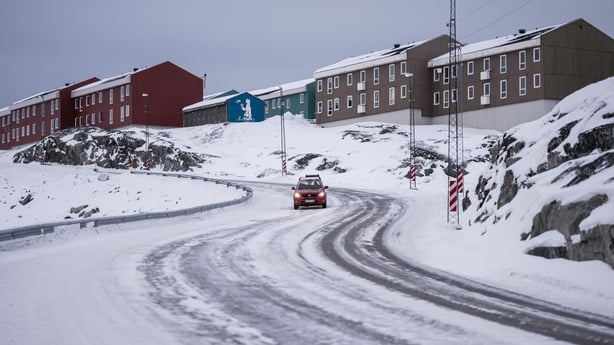
Aaja Chenmitz questioned why NATO would have a voice on the island’s mineral wealth
“NATO in no case has the right to negotiate on anything without us, Greenland. Nothing about us without us,” she posted.
In Nuuk, where authorities started handing out brochures on how to live through a crisis, 65-year-old pensioner Lis Steenholdt said that Greenland and Denmark had been firm that the island is not for sale.
Facing down Trump
Mr Trump has repeatedly said that the United States, the key force in NATO, deserves Greenland as it would be forced to defend the island against Russia or China, although neither country holds any claim to the island.
Addressing Davos for the first time in six years, Mr Trump called Denmark “ungrateful” but appeared to take the threat of military action off the table.
“I don’t want to use force. I won’t use force. All the United States is asking for is a place called Greenland,” Mr Trump said.
Mr Trump, 79, repeatedly referred to Greenland as Iceland in his speech.
Canada’s Prime Minister Mark Carney won a standing ovation at Davos when he warned of a “rupture” in the global order long championed by the US. French President Emmanuel Macron for his part said Europe would not be bullied.
Mr Trump attacked both leaders, mocking Mr Macron for wearing sunglasses at Davos, which the French president said was because of an eye condition.