
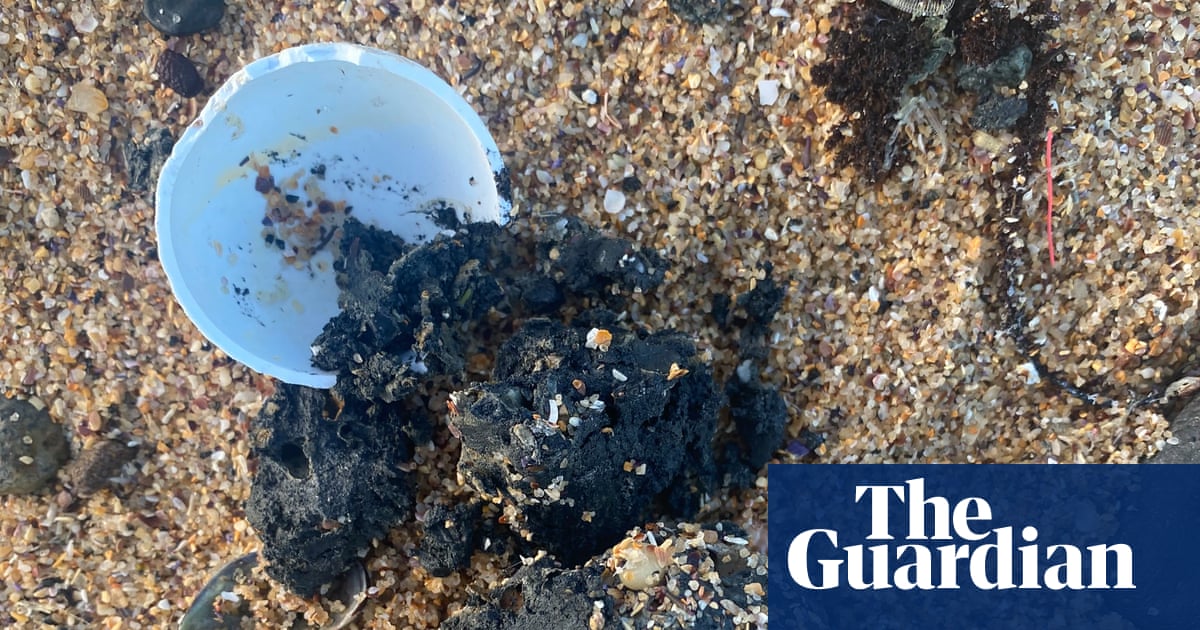
Debris balls have washed up on Sydney’s beaches after a weekend of heavy rain, with the objects found on Malabar beach next to a sewage treatment works and also in Botany Bay.
Sydney Water erected a sign at Malabar beach warning of the potential pollution.
“This area may be affected by sewage debris balls,” the sign states. “Please do not touch any debris. We are cleaning the area and apologise for any inconvenience.”
On Tuesday evening, there were more than a dozen black and grey blobs among other beach debris. When broken open, they had a foul smell. There were also smaller, grey balls.
Guardian Australia reported on Saturday that a giant fatberg, potentially the size of four Sydney buses, within Sydney Water’s Malabar deepwater ocean sewer had been identified as the likely source of the debris balls that closed beaches a year ago.
Signage and debris balls at Malabar beach on Tuesday. Photograph: Anne Davies/The Guardian
A secret Sydney Water report stated their “working hypothesis” was the buildup of fats, oils and grease was in an “inaccessible dead zone” at the start of the outfall, which delivers primary-treated sewage 2.3km out to sea.
Debris balls are released when “sloughing events” occur due to a rapid change in pumping pressure, previously caused by power outages or heavy rains, the report suggests.
Sign up: AU Breaking News email
Over the weekend, Sydney was hit by a storm, which saw the city inundated with falls of more than 100mm within hours.
Debris on Malabar beach. Photograph: Anne Davies/The Guardian
Debris also washed up on Foreshore beach near where Mill Stream enters Botany Bay.
The beach is regularly scored by Beachwatch as one of Sydney’s most polluted because it is located near one of the main overflow valves for the Malabar sewage system.
On Wednesday morning, the beach was littered with waxy, grey lumps, some as large as half a house brick, as well as smaller balls.
Two men in hi-vis, who identified themselves as contractors for Sydney Water, were cleaning up the beach. They told Guardian Australia it was their second day and they were removing wet wipes and chunks of grease.
Workers on Foreshore beach in Botany Bay on Wednesday morning. Photograph: Anne Davies/The Guardian
Sydney Water has an agreement with Sydney airport and the EPA to discharge sewage into Mill Stream until July 2027.
Sydney Water said on Wednesday it was taking “immediate actions and long‑term corrective measures” after the balls were found on Malabar and Foreshore beaches.
“The exact origin and cause are under investigation,” a spokesperson said.
“Sydney Water crews have been on site over multiple days, leading both coordination and on-beach clean-ups – supported by council – while undertaking visual inspections, collecting and removing observed debris balls, and disposing of all material in accordance with environmental and safety requirements.”
The Environment Protection Authority said it was notified about the balls at Malabar and sewage pollution at Foreshore beach on Monday.
“Sydney Water managed clean-up of both beaches and is continuing to inspect beaches for residual pollution as needed,” a spokesperson said. “The ongoing advice to beachgoers is not to touch debris balls – or any other suspicious debris found at a beach.”
Comment was sought from Randwick City council and the NSW water minister, Rose Jackson.
Unlike most cities, Sydney relies on primary treatment for most of its sewage.
The Sydney Water chief executive, Darren Cleary, last week defended the use of three deepwater ocean outfalls at Malabar, Bondi and North Head to dispose of 80% of the city’s wastewater.
“Deep ocean outfalls have been meeting environmental standards for nearly three decades,” he said.
Cleary said Sydney Water conducted regular testing around the site where diffusers release sewage 2-4km offshore, and Sydney beaches generally had very good water quality.
“The issue of the debris balls is an unexpected event,” he said.
Sydney Water is working to introduce higher levels of processing at inland plants to produce recycled water for industry and, in particular, datacentres, which require large amounts for cooling.
Its spokesperson said on Wednesday a 10-year $3bn Malabar system investment program would “upgrade key upstream wastewater treatment facilities and significantly reduce the volume of wastewater that needs to be discharged via the Malabar deep ocean outfall”.
The secret report suggested that dealing with the fatberg at Malabar would require shutting down the outfall for maintenance and diverting sewage to “cliff face discharge”, which would close Sydney’s beaches “for months”.
This had “never been done” and was “no longer considered an acceptable approach”, the August 2025 report acknowledged.