
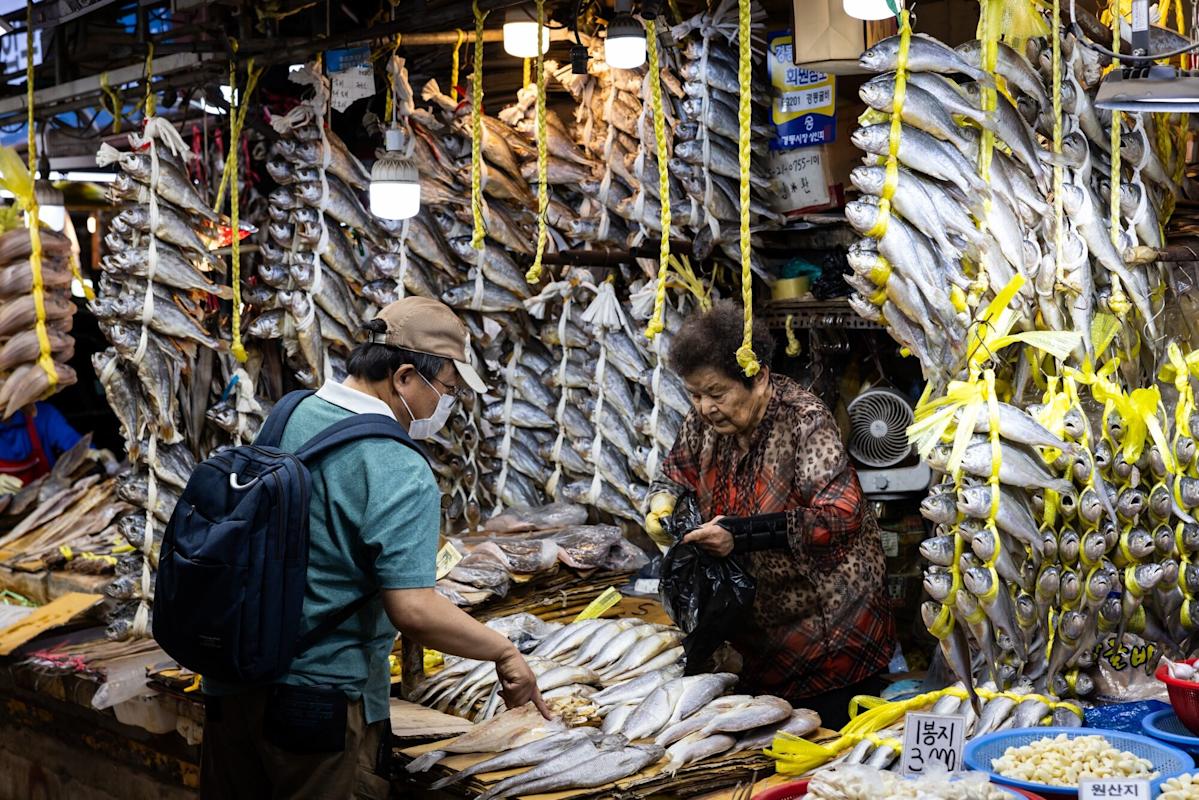
(Bloomberg) — South Korea’s economy shrank in the final quarter of 2025 due to a broad pullback in demand, underscoring the challenge for authorities whose policy options to stimulate growth are constrained by a wobbly won and mounting financial risks.
Gross domestic product contracted 0.3% in the three months through December from the previous quarter, the Bank of Korea said Thursday. That marked a sharp slowdown from the revised 1.3% growth in the prior quarter and missed the median estimate for a 0.2% expansion in a Bloomberg survey. For 2025 as a whole, the economy expanded 1%, in line with estimates.
Most Read from Bloomberg

The figures highlight the uneven recovery as export-oriented sectors tied to chips continue to outperform small businesses. It’s an effect visible in financial markets, where the benchmark Kospi index has risen in almost every session so far this year. The data aren’t likely to prompt action from the BOK, which shifted its policy stance to neutral just last week, and likewise don’t point to major implications for the global economy.
Still, the report indicates the forces that propelled growth earlier in the year — expansionary fiscal policy, net exports and recovering consumption — may be starting to fade somewhat. That will add to the challenges as authorities seek to manage risks tied to a persistent housing market rally, rising household debt and a persistently weak won.
The third-quarter gain of 1.3% from the previous period was faster than official estimates of the economy’s potential growth rate, making a pullback at the end of the year all but inevitable. Also, the impact of some data may have been amplified in the process of compiling the report.
“The fourth-quarter contraction has not derailed overall growth, and the policy backdrop points toward a cautious central bank,” said Dave Chia, an economist at Moody’s Analytics“With pressure from a weaker won in focus, rate cuts in early 2026 appear unlikely; easing now could worsen currency depreciation, heighten financial stability risks, and revive inflation pressures.”
Net exports fell 2.1% from the previous quarter, reversing from a 2.1% advance in the three months through September. The quarterly result probably showed the effects of adjusting the data to real figures, and the won’s slide through the period may have inflated the costs of imports in the tally.
South Korea’s benchmark Kospi index briefly crossed the long-symbolic 5,000 level on Thursday — a milestone long championed by President Lee Jae Myung.
During his presidential campaign, Lee pledged to roughly double the Kospi’s level, framing capital-market reform as central to revitalizing growth. Since taking office last year, his administration has set up a committee tasked with deepening market access, improving corporate governance and attracting foreign investment.
The stock market rally has been mirrored by the housing market, especially in the high-end neighborhoods of the capital. Apartment prices in Seoul extended gains for a 50th straight week as of Jan. 12, according to the Korea Real Estate Board, defying repeated government efforts to cool the market. The rally has kept policymakers wary of easing policy settings out of concern doing so might spur household debt levels and raise the risk of financial instability.
Consumption has softened as fiscal stimulus wears off, although the pullback in the latest period was exaggerated by the strong results in the previous period. Growth in private consumption slowed to 0.3% from the previous three months after a 1.3% gain in the prior quarter, while government spending increased a modest 0.6%. Construction and facilities investment dropped 3.9% and 1.8%, respectively.
What Bloomberg Economics Says…
“The surprise contraction South Korea’s fourth-quarter GDP is technical payback after an outsized expansion in 3Q25 — not a major setback for the economy. Growth was hit by a fiscal cliff after outlays were front-loaded in 3Q25. The drag from net exports isn’t a big concern — nominal shipments were strong.”
— Hyosung Kwon, economist
Click here to read full report
Those strains are being compounded by persistent currency weakness. The won has fallen more than 8% since late June due to capital outflows, global interest-rate differentials and uncertainty over trade policy. The currency weakness made it harder for the central bank to ease monetary settings, as a lower interest rate could accelerate the trend. Officials have warned that further depreciation could exacerbate financial instability and fuel inflation.
Uneven Growth
Exports supported South Korea’s external balance for much of last year despite a loss of momentum toward year-end. Improving trade terms, driven by recovering semiconductor prices and easing energy costs, helped the country record a current-account surplus of roughly $118 billion last year. The government expects that surplus to expand to $135 billion in 2026.
Still, that resilience masks growing external vulnerabilities. Shipments to the US fell 3.8% over the whole of 2025, and uncertainty remains over how South Korea’s pledge to invest $350 billion in the US — part of an agreement last year that capped US tariffs on Korean goods at 15% — will ultimately be implemented.
Seoul has already signaled it may hold off on fulfilling a vow to invest as much as $20 billion in the US this year given the pressure on its currency, according to a person familiar with the matter.
Beneath the equity rally, gains remain concentrated in a narrow set of stocks led by chipmakers Samsung Electronics Co. and SK Hynix Inc. Exports show a similar pattern, with semiconductor shipments rising about 22% while most other sectors, including autos and steel, lagged.
That concentration heightens South Korea’s exposure to shifts in US trade and industrial policy aimed squarely at the chip industry. US Commerce Secretary Howard Lutnick warned that South Korean and Taiwanese memory chip producers could face tariffs of up to 100% unless they commit to expanding manufacturing on American soil. The White House has said President Donald Trump may announce new tariffs and an accompanying offset program to create an incentive for domestic manufacturing in the near future.
The weak currency and a housing-price rally are likely to keep monetary policy on hold through 2027, given structural financial risks and a prolonged semiconductor upcycle, said Citigroup economist Jin-Wook Kim.
The BOK in November raised its 2026 growth forecast to 1.8% and lifted its 2025 estimate to 1%, while revising up its inflation projection for next year to 2.1%.
The government remains more optimistic, forecasting 2% growth this year on firmer consumption and stronger exports. Officials have pledged to maintain tight oversight of household debt, consider creating a dedicated real estate supervisory body, and fully extend onshore foreign-exchange trading to a 24-hour system as part of broader efforts to attract foreign capital and boost productivity.
For now, South Korea enters the new year with growth intact but increasingly fragile, buoyed by chip exports and asset markets, yet constrained by currency weakness, policy limitations and rising trade policy risks abroad.
While a pullback in the latest period was expected, the result was weaker than expected, according to BNP Paribas senior economist Jeeho Yoon.
“We think the contribution from domestic demand will be important in 2026, including the pace of recovery in construction investment, the spillover of the IT cycle to facilities investment, and trend of private consumption,” Yoon said. “On the latter, we see an upside impact from expansionary fiscal policy and the wealth effect, but also downside risks due to an increased loan repayment burden for households.”
Most Read from Bloomberg Businessweek
©2026 Bloomberg L.P.