
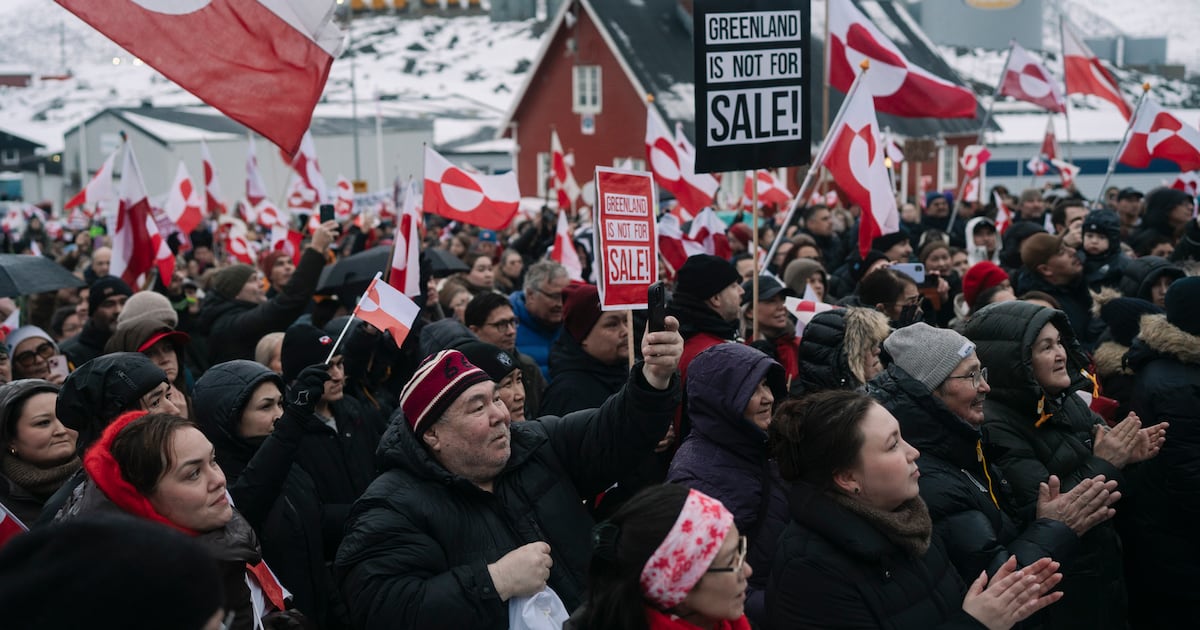
US president Donald Trump’s abrupt climbdown on using tariffs as a weapon to seize Greenland brought relief on Thursday, but left uncertainty on ending a standoff that has risked the deepest rupture in transatlantic ties in decades.
Mr Trump on Wednesday stepped back from the threat of imposing tariffs on countries opposing his plans and ruled out using force, suggesting instead that a framework deal over the Arctic island was in sight.
His ambition to wrest sovereignty over Greenland from fellow Nato member Denmark has threatened to rupture the alliance that underpinned western security since the end of the second World War, and reignite a trade war with Europe.
After meeting with Nato secretary general Mark Rutte, Mr Trump said there could be a deal that satisfies his desire for a missile-defence system and access to critical minerals while blocking what he says are Russia and China’s ambitions in the Arctic. European shares rebounded.
But the exact nature of any deal was not immediately clear and Mr Rutte, who met Mr Trump at the World Economic Forum in Davos, Switzerland, said they had not discussed whether Greenland would remain in Danish hands.
He told a panel on Thursday they had discussed how Nato should best defend the Arctic against Russia and China.
Donald Trump, speaking in Davos, has said that the US needs Greenland for international protection, but he will not use force to get it. Video: Reuters
“One workstream coming out of yesterday … is to make sure when it comes to Greenland, particularly, that we ensure that the Chinese and the Russians will not gain access to the Greenland economy [or] militarily to Greenland,” Mr Rutte said.
Danish prime minister Mette Frederiksen said Denmark and Greenland would continue to engage in constructive talks, provided there was respect for her country’s territorial integrity.
Her defence minister, Troels Lund Poulsen, later said Denmark has established a clear red line in discussions over Greenland, stating the country will not cede sovereignty.
“Following Wednesday’s meeting between NATO Secretary General Mark Rutte and Donald Trump, we are in a much better place today than we were yesterday,” he said on X. “I am very happy about that.”
Germany’s vice chancellor, Lars Klingbeil, however, cautioned against premature optimism about the issue being solved.
“It’s good that they are engaged in dialogue, but we have to wait a bit and not get our hopes up too soon,” Mr Klingbeil told Germany’s ZDF television on Wednesday evening.
Addressing the issue for the first time in public, Russian president Vladimir Putin said on Wednesday that Greenland’s ownership was not Russia’s concern. China’s foreign ministry said on Thursday that “the so-called China threat” to Greenland was groundless.
Mr Trump’s push to seize Greenland has threatened to reignite a trade war with Europe that rattled markets and companies last year and prompted the European Union to threaten retaliation.
There has also been concern that the Greenland issue could cause a dramatic rift in Nato just as Ukraine and its allies needed the US, Nato’s most powerful member, onside to end the war with Russia.
Ukrainian president Volodymyr Zelenskiy is due to meet Mr Trump in Davos on Thursday, leaving behind an energy crisis in Ukraine, where Russian air strikes against electricity infrastructure have left swathes of the capital and other regions without power.
Also speaking in Davos, German chancellor Friedrich Merz welcomed Mr Trump’s move, saying countries should not give up on Nato. “Despite all the frustration and anger of recent months, let us not be too quick to write off the transatlantic partnership,” he added.
Taoiseach Micheál Martin on Wednesday night welcomed the fact that a framework had developed, saying “collectively we need to de-escalate this situation, we need to dial down and engage in those areas that matter”.
[ Donald Trump’s claim that he won’t take Greenland by force is not reassuringOpens in new window ]
Mr Trump gave few further details on the agreement but said talks were continuing concerning a US missile defence shield that would be in part based in Greenland.
According to media reports, the compromise deal could see the US granted sovereignty over small pockets of Greenland where military bases are located, with unnamed officials in the Daily Telegraph comparing the proposal to the UK military’s bases in Cyprus, which are regarded as British territory.
The framework would also potentially allow the US to mine for rare earth minerals, without seeking permission from Denmark, according to the Telegraph. – Reuters/Guardian