
Steps to clean up the shipping industry by removing sulphur from fuels intensified a major coral bleaching event on the Great Barrier Reef by allowing more of the sun’s energy to hit the oceanic wonder, according to a new study.
Sulphur pollution can cause respiratory problems for humans and cause acid rain, but it also has a shading effect and can make clouds brighter, providing more shade to areas underneath.
Dr Robert Ryan, an atmospheric scientist at the University of Melbourne who led the research, said the removal of sulphur from the fuels – which he believes is necessary – had paradoxically caused “a lot of extra sunlight getting on to the reef”.
Corals on the Great Barrier Reef during a 2022 mass bleaching event were subjected to up to 10% more heat stress, the study said, because the thousands of ships in the region were not emitting as much sulphur.
Two years earlier, the UN’s International Maritime Organization introduced regulations to cut the amount of sulphur allowed in fuels from 3.5% to 0.5%
In the early months of 2022, the Great Barrier Reef suffered it’s sixth mass bleaching event and the first to occur in a usually cooler La Niña year.
Ryan and colleagues analysed actual ship data from the region between 18 and 28 February 2022, when heat was building up on the reef. About 5,000 ships were in the area.
Using computer models, Ryan and colleagues looked at the amount of sulphur emissions that would have been released by the ships in scenarios with and without the regulations. They then looked at the weather conditions to see how the sulphur in the air would have moved.
Because the prevailing winds in the region would have blown the sulphur over the reef, Ryan said the study found between 5% and 10% more of the sun’s energy was hitting the reef’s waters, compared with what would have happened without the new regulations.
Quick GuideWhat is coral bleaching?Show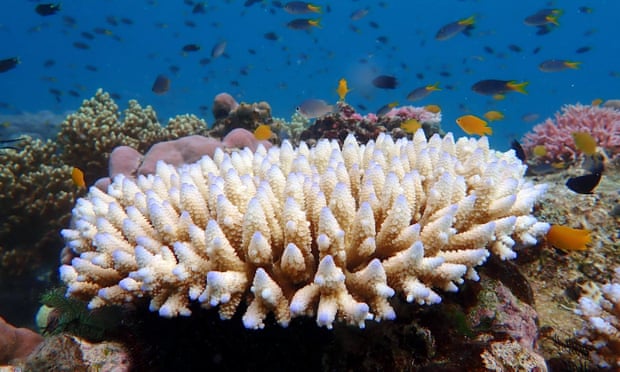
Coral bleaching describes a process whereby the coral animal expels the algae that live in its tissues and give it its colour and much of its nutrients.
Without its algae, a coral’s white skeleton can be seen through its translucent flesh, giving off a bleached appearance.
Mass coral bleaching over large areas, first noticed in the 1980s around the Caribbean, is caused by rising ocean temperatures.
Some corals also display fluorescent colours under stress when they release a pigment that filters light. Sunlight also plays a role in triggering bleaching.
Corals can survive bleaching if temperatures are not too extreme or prolonged. But extreme marine heatwaves can kill corals outright.
Coral bleaching can also have sub-lethal effects, including increased susceptibility to disease and reduced rates of growth and reproduction.
Scientists say the gaps between bleaching events are becoming too short to allow reefs to recover.
Coral reefs are considered one of the planet’s ecosystems most at risk from global heating. Reefs support fisheries that feed hundreds of millions of people, as well as supporting major tourism industries.
The world’s biggest coral reef system – Australia’s Great Barrier Reef – has suffered seven mass bleaching events since 1998, of which five were in the past decade.
Thank you for your feedback.
Global heating, caused mostly by fossil fuels, has raised temperatures in the ocean and driven increasingly frequent and severe coral bleaching episodes over the reef.
Widespread mass bleaching was first seen on the reef in 1998 and happened again in 2002, 2016, 2017, 2020, 2022 and 2024.
Ryan said while emissions of CO2 stay in the atmosphere for a century or more, sulphur emissions only last days before being washed out.
This meant, he said, air pollutants and greenhouse gases needed to be reduced at the same time. “Nothing happens in isolation. There’s no such thing as a free lunch,” he said.
Prof Steven Sherwood, a climate scientist at the University of New South Wales who was not involved in the research, said several studies had shown the removal of sulphur aerosols from shipping had increased global temperatures by, at most, 0.05C.
“This new study points out that while the overall effect on climate is small, the local effect on ocean temperatures in the tropics can be larger. This is because the air pollution absorbs some sunlight in addition to reflection to space,” Sherwood said.
“Thus they find a bigger effect, maybe up to 0.15C, which is enough to increase the heat stress on the corals as reported. This is an important result since it shows the impact on corals might be nontrivial even though the overall global warming impact is pretty small.”
The research was published in the Nature journal Communications Earth & Environment.