
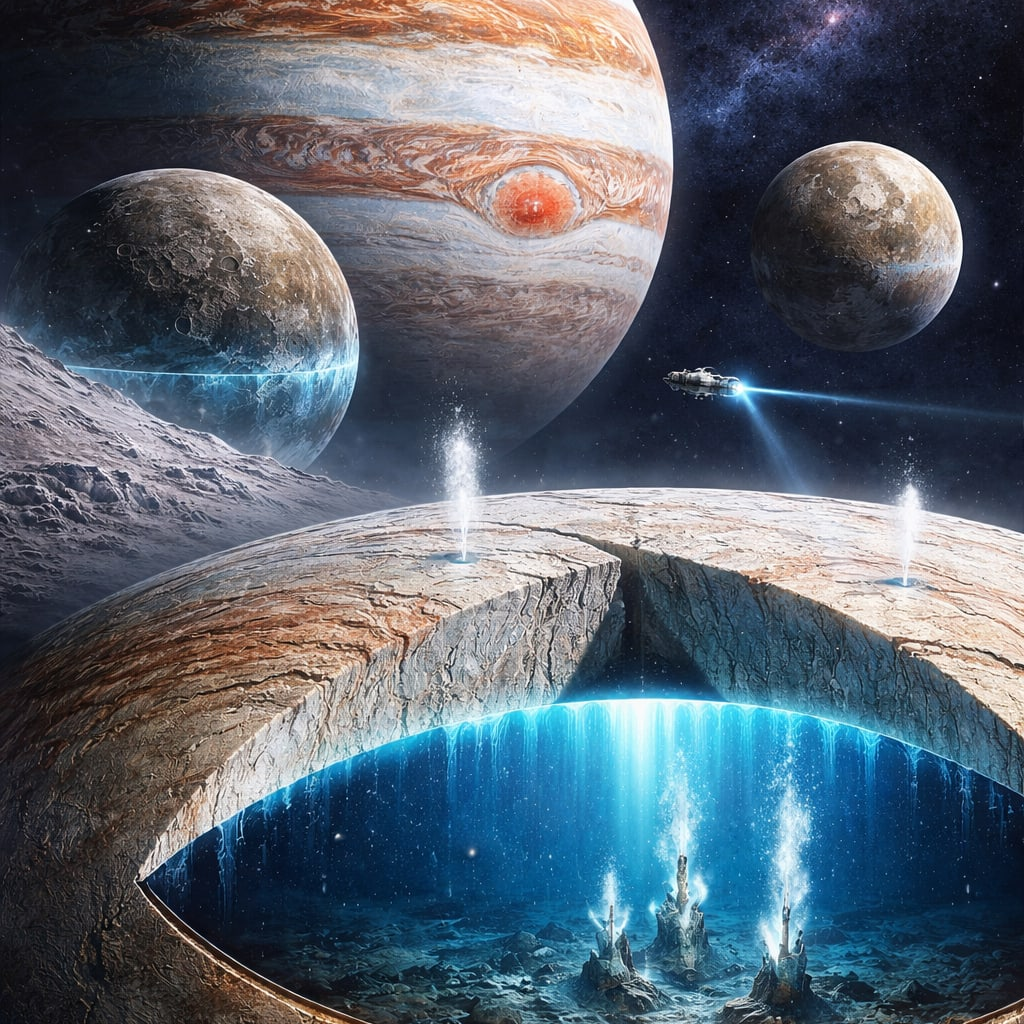
For much of modern astronomy, the search for life beyond Earth focused on planets orbiting within the so-called “habitable zone” of their stars — regions where liquid water could exist on the surface. However, discoveries made over the past few decades have dramatically expanded this view. One of the most profound revelations in planetary science is the discovery of vast subsurface oceans hidden beneath the icy shells of Jupiter’s moons. These concealed oceans have transformed frozen, distant worlds into some of the most promising environments for extraterrestrial life in our Solar System.
Jupiter’s Icy Moons: Hidden Water Worlds
Jupiter, the largest planet in the Solar System, is surrounded by more than 90 known moons. Among them, the Galilean moons — Europa, Ganymede, and Callisto — stand out as particularly intriguing. Despite their cold, ice-covered surfaces, mounting evidence suggests that each of these moons harbors liquid water oceans beneath thick layers of ice.
Europa quickly emerged as the most compelling candidate. Its surface is crisscrossed with long fractures, ridges, and chaotic terrain, with surprisingly few impact craters. This indicates that the surface is geologically young and constantly reshaped — a strong hint that warm, mobile material exists below the ice.
How Scientists Detected Subsurface Oceans
The first major breakthrough came in the 1990s with NASA’s Galileo spacecraft, which orbited Jupiter for nearly eight years. Galileo measured subtle variations in the moons’ gravitational fields and detected unexpected disturbances in Jupiter’s magnetic field near Europa and Ganymede. These anomalies pointed to the presence of electrically conductive layers beneath the surface — most likely salty liquid water.
Later observations strengthened this hypothesis. Surface features on Europa resemble ice rafts floating atop liquid water, similar to pack ice in Earth’s polar oceans. In addition, data from the Hubble Space Telescope revealed plumes of water vapor erupting from Europa’s surface, possibly caused by fractures that connect the ocean below to space above. These geyser-like eruptions provide a rare opportunity to sample subsurface material without drilling through kilometers of ice.
Europa: The Prime Candidate for Life
Europa is now considered one of the most promising places to search for life beyond Earth. Scientists estimate that its ice shell is between 10 and 30 kilometers thick, beneath which lies a global ocean more than 100 kilometers deep — potentially containing twice as much water as all of Earth’s oceans combined.
What makes Europa especially compelling is its energy source. Rather than relying on sunlight, Europa is heated internally by tidal forces. As the moon orbits Jupiter, the planet’s immense gravity continuously stretches and compresses Europa’s interior. This process, known as tidal heating, generates enough heat to keep the subsurface ocean liquid and may even drive hydrothermal activity on the ocean floor.
On Earth, hydrothermal vents support rich ecosystems without sunlight, relying instead on chemical energy. If similar environments exist on Europa, microbial life — or even more complex organisms — could potentially thrive there.
Ganymede and Callisto: Complex Ocean Worlds
Ganymede, the largest moon in the Solar System, presents a more complex picture. Unlike Europa, Ganymede has its own intrinsic magnetic field, a unique feature among moons. Studies suggest that beneath its icy crust lies not a single ocean, but multiple layers of water and ice stacked like a planetary parfait. While this layered structure may limit direct interaction between water and rocky material, it still represents a vast reservoir of liquid water.
Callisto, by contrast, appears less geologically active. Its surface is ancient and heavily cratered, suggesting minimal internal heating. Nevertheless, magnetic data indicate the presence of a deep subsurface ocean. Although Callisto may be less favorable for life, it plays a crucial role in understanding how ocean worlds form and evolve over billions of years.
Why Subsurface Oceans Matter for Astrobiology
The discovery of subsurface oceans has fundamentally reshaped the concept of habitability. Life no longer requires a planet with surface oceans, a mild climate, or direct sunlight. Instead, it may thrive in dark, pressurized environments beneath ice, sustained by internal heat and chemical reactions.
These findings also have implications far beyond Jupiter. If subsurface oceans can exist around a gas giant in our own Solar System, similar ocean worlds may be common around exoplanets throughout the galaxy. Many icy moons could potentially outnumber Earth-like planets, making subsurface oceans one of the most widespread habitats for life in the universe.
Future Missions and the Next Wave of Discovery
The coming decade promises major advances in the exploration of Jupiter’s ocean moons. NASA’s Europa Clipper mission will conduct dozens of close flybys of Europa, using ice-penetrating radar, spectrometers, and magnetometers to analyze the moon’s interior and surface chemistry. Meanwhile, the European Space Agency’s JUICE mission will focus on Ganymede, Callisto, and Europa, providing unprecedented insight into their internal structures.
Looking further ahead, scientists are developing concepts for landers and even cryobots — robotic probes capable of melting through ice to reach the ocean below. While such missions remain technologically challenging, they represent the ultimate goal: directly exploring alien oceans and searching for signs of life.
Conclusion
The discovery of subsurface oceans on Jupiter’s moons marks one of the most important milestones in planetary science. These hidden seas have turned distant, frozen moons into dynamic worlds with the potential to host life. As new missions push deeper into these icy realms, humanity moves closer to answering one of its most profound questions: are we alone, or is life a natural outcome wherever water and energy coexist?