
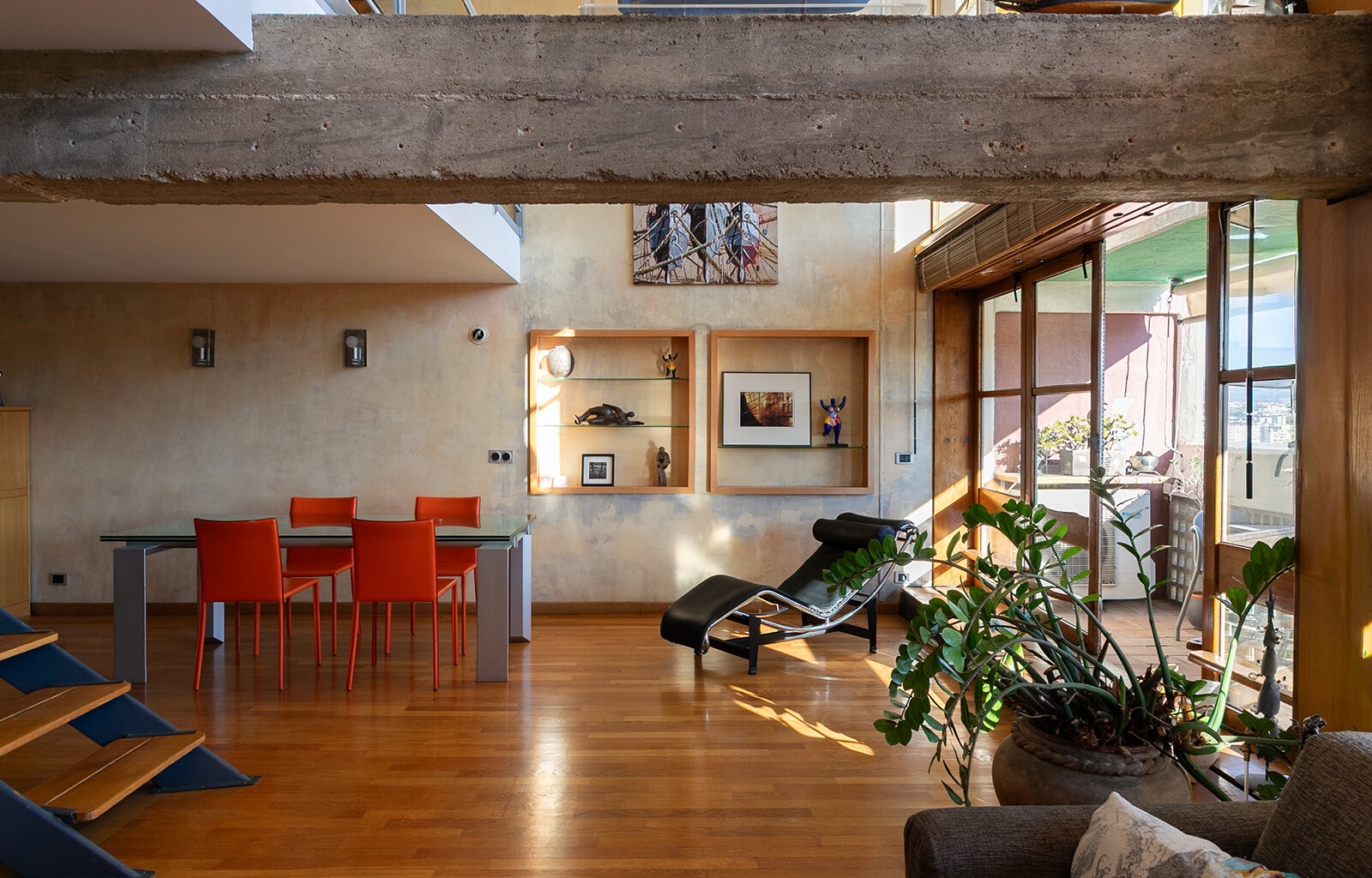
Light is the organising principle of this double Type E duplex, formed in 1966 from the union of two adjacent apartments inside Le Corbusier’s Unité d’Habitation. Set high within the concrete frame, the 200sqm interior is shaped by volume and proportion. A double-height living space draws daylight deep into the plan, where timber floors, exposed béton brut and the rhythm of the original structure establish a calm, measured atmosphere that has changed little since the building’s completion in 1952.

Photography: © Mathilde Lebreuil, FLC – ADAGP 2026.

Photography: © Mathilde Lebreuil, FLC – ADAGP 2026.

Photography: © Mathilde Lebreuil, FLC – ADAGP 2026.

Photography: © Mathilde Lebreuil, FLC – ADAGP 2026.

Photography: © Mathilde Lebreuil, FLC – ADAGP 2026.

Photography: © Mathilde Lebreuil, FLC – ADAGP 2026.
The lower level accommodates the living, dining and library areas, opening onto a doubled loggia that extends the room outward and frames expansive views across Marseille and the surrounding hills. Nearby, the kitchen retains the proportions and intent of the original scheme, designed by Charlotte Perriand and updated in the 1990s with restraint. Upstairs, a bridge-like walkway leads to the private spaces, including a primary suite, two further bedrooms and a study, all organised around light filtered through the double-height glazing. Flexible partitions allow rooms to be opened or closed as needed, maintaining the apartment’s adaptability.
Located within the UNESCO-listed Unité d’Habitation in Marseille’s 8th arrondissement, the building continues to operate as a ‘city within a city’, with shared amenities, roof-level facilities and landscaped grounds. The apartment is listed for €1.4 million with Architecture de Collection.

Photography: © Mathilde Lebreuil, FLC – ADAGP 2026.

Photography: © Mathilde Lebreuil, FLC – ADAGP 2026.
Read next: Sophia Loren and Carlo Ponti shared this villa on the Appian Way
Two properties in Peter Salter’s architectural village hit the market