
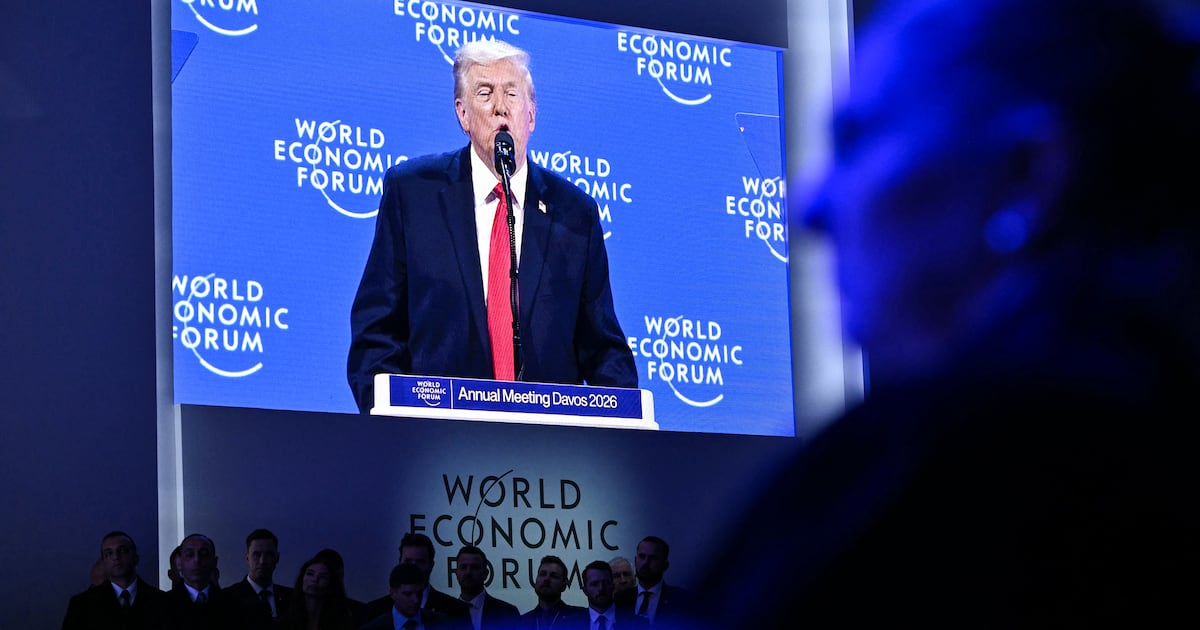
Davos 2026 seemed to collapse into what physicists call a singularity, a point of infinite density from which nothing can escape. Its name was Donald Trump.
There were several crises overshadowing this year’s World Economic Forum (WEF) – Russia’s war in Ukraine, AI bubble fears, revolution in Iran but the US president’s increasingly hostile stance on Greenland subsumed everything.
The possibility that one Nato member might forcibly take another’s territory is anathema to the forum’s vision of a rules-based, multilateral system.
Since his successful military operation in Venezuela at the start of the year, Trump had been ratcheting up the rhetoric on Greenland, hinting at possible military action, threatening tariffs against eight European countries if he didn’t get his way, while deriding Europe as weak and backward.
It provoked the biggest rift in transatlantic relations since the second World War, one that will leave scar tissue.
His attendance at Davos took on monumental importance, a clash between Trump’s world and the old world.
In the end, he Taco-ed (as in Trump always chickens out). Not for the first time, he marched his troops to the top of the hill, triggering a moment of maximum global tension, only to disperse them and leave us all wondering what the hell that was all about.
His Greenland climbdown came hours after a rambling speech, in which he asserted America’s supremacy, confused Greenland with Iceland and claimed only “stupid” people buy wind turbines.
After a meeting with Nato secretary general Mark Rutte, he said he had found a “solution” and was therefore rescinding his tariff threat.
Details are scant, but it seems to involve Denmark ceding sovereignty over small areas of Greenland where the US would build military bases, not dissimilar to the UK’s sovereign bases on Cyprus.
Talk of Trump’s bid to annex Greenland dominated Davos when Europe’s real security threat is in the east, in Ukraine, where resistance is gradually being worn down.
Russia was the “unequivocal winner” in Europe’s rift with the US, said the Republic’s EU commissioner for justice Michael McGrath.
Trump paradoxically claims he needs Greenland to fend off Russia’s security threat, while at the same time, he appears to be sympathetic to Russian war demands in Ukraine and inviting Vladimir Putin to join his proposed Board of Peace for Gaza, which had a launch in Davos on Thursday.
Either way, his designs on the largely self-governing Danish territory have forced Europe to confront an uncomfortable truth: how much it needs Washington’s money and military might.
The grovelling and knee-bending we’ve seen from European leaders over the past year has been cringey and seems only to have fed Trump’s megalomania.
Gavin Newsom, the governor of California, delivered perhaps the biggest rebuke of the European position, claiming leaders on the Continent were complicit in Trump’s wrecking ball agenda because they have failed to stand up to him. European efforts to negotiate with Trump, he said, were not diplomacy but stupidity.
 Old order ‘not coming back’ as Trump overshadows World Economic Forum
“There’s no diplomacy with Donald Trump: he’s a T.rex. You mate with him, or he devours you,” he said.
Newsom, a vocal Trump critic, was barred from entering the US pavilion at Davos, a reflection of the pettiness that now passes for politics in the US.
Judging from the hardening of European rhetoric, there’s an acknowledgment that its fawning approach to Trump has failed and that it must get tougher.
The prospect of money managers in Europe weaponising capital, selling off US treasuries, was raised earlier this week in a note by Deutsche Bank as a way for the bloc to retaliate in the face of Trump’s continued threats.
Ukrainian leader Volodymyr Zelenskiy added to the EU-bashing, claiming EU leaders were stuck in “Greenland mode”
“Europe must learn how to defend itself,” he said. “Sending 14 or 40 soldiers to Greenland – what is that meant to achieve? What message does that send to Putin? To China? And perhaps, most importantly, what message does it send to Denmark?”
But this year’s Davos was a tale of two speeches. If Trump’s represented one side of the geopolitical divide, Canadian prime minister Mark Carney made the case for the other.
He pointed out that US hegemony, up to now, had created an imperfect or false rules-based order where the strongest would exempt themselves when convenient and where trade rules were enforced asymmetrically on the basis of economic and military power.
But this imperfect rules-based order had been “useful”, helping to provide “public goods, open sea lanes, a stable financial system, collective security and support for frameworks for resolving disputes”.
“We participated in the rituals, and we largely avoided calling out the gaps between rhetoric and reality,” Carney said.
“This bargain no longer works. Let me be direct. We are in the midst of a rupture, not a transition.
“In a world of great power rivalry, the countries in between have a choice: compete with each other for favour or to combine to create a third path with impact.
“[We] argue the middle powers must act together because if we’re not at the table, we’re on the menu,” he said.
Speaking at the World Economic Forum in Davos, Canadian prime minister Mark Carney said the old world order is “not coming back”. Video: Reuters
Articulate and politically astute, Carney stole the show.
Tensions between Europe and the US are unlikely to end with a deal on Greenland (there are even doubts over whether that resolves the row).
European Central Bank president Christine Lagarde reportedly walked out of a high-profile Davos dinner, hosted by BlackRock chief Larry Fink, during a speech by US commerce secretary Howard Lutnick, which was heavily critical of Europe, a flash of what European leaders are really feeling behind their Trump’s appeasement noises.
Lutnick was apparently at every gig in town, berating Europe and boasting about America’s superpower economy.
In a Bloomberg interview at the event, he argued that outsourcing to low-cost producers failed workers in Ohio and Michigan, crediting the US administration’s tariffs for GM’s (General Motors) 60 per cent yearly stock jump and similar gains at Ford.
It was a reminder of where Trump’s economic agenda originates.
The US has lost close to five million manufacturing jobs since 2001, the year China joined the World Trade Organisation.
The decline has been unprecedented by US standards and has created, or at least compounded, what’s often referred to as a rust belt from the midwest to the Great Lakes, an area that spans from western New York to Michigan and north Illinois and encompasses states like West Virginia, Ohio and Indiana.
It was once the backbone of US industry, but it has now become synonymous with economic decline, population loss and urban decay.
If Trump’s anti-federalist politicking dominated this year’s Davos, the counternarrative is that he led the largest-ever delegation into the hub of international co-operation and consensus-building.
Even Elon Musk, one of the most outspoken critics of the event, wanted in on the action. He has previously criticised the gathering as elitist, unaccountable and disconnected from ordinary people, but got a speaking slot on Thursday.
Insiders say many US firms are merely playing along with Trump, even sucking up to him, and perhaps using his power to leverage the EU for less regulation, but behind the scenes, they haven’t changed tack and are secretly hoping he will be hobbled in the upcoming US midterm elections. The polls suggest voters have soured on Trump and the Democrats will win big.
Watching Apple boss Tim Cook shower Trump with gifts while announcing big domestic investments gives a false impression of what’s going on, say insiders.
These companies haven’t changed their investment plans, haven’t pulled their offshore operations and haven’t changed course in any meaningful way.
This might explain why, despite all the noise around Trump’s America First agenda, the Irish Government reported record corporate taxes last year while the IDA, the State’s investment agency, supported a record 323 investments, including 78 “new-name” investments, most of them from the US.
On Wednesday, the IDA hosted its annual dinner at the Davos forum, a big set-piece event for the agency to highlight the Republic’s investment credentials.
The invite list was kept confidential so US executives could keep their heads below the parapet.
Taoiseach Micheál Martin gave the keynote address and the following day held bilaterals with several big US tech companies, including Apple, Meta and Microsoft.
He said he had received positive feedback “in terms of the resilience of the Irish economy and the attractiveness of Ireland still as a location for investment”.
He also highlighted that the State had been invited to join Trump’s controversial Gaza peace board but said no decision had yet been made.
The US president is seeking $1 billion from countries for a permanent place on a board of peace aimed at resolving conflicts. The board was originally intended to oversee the rebuilding of Gaza, but the current iteration has broadened it to global conflicts and does not reference Gaza, a move which critics fear is designed to supplant the UN.
Tánaiste Simon Harris said he could not see “any scenario” in which the Republic can participate. Martin, meanwhile, was due to discuss the board at Thursday evening’s emergency meeting of EU leaders.
This year’s Davos was pitched as the last-chance saloon to save the old world order. Before the event, WEF president Børge Brende conceded it was taking place against “the most complicated geopolitical backdrop since the WEF was founded”.
The think tank’s Global Risks Report, published on the eve of the summit, pinpointed trade wars, actual wars and economic disputes as the biggest threats to global stability in 2026, a reflection of the breakdown in consensus-building.
Nonetheless, 56 years after it was founded, its pulling power remains. This year’s event commanded a record attendance with more than 60 heads of state or government, as well as 55 economy and finance ministers, and more than 800 chief executives or chairmen/women of companies. It included a whopping 200 discussion panels.
Geopolitics is fraying, but a lot of the old forces remain, not least Davos itself.