

On Monday Swim Ireland posted a short piece on its website headlined: “We’re stepping away from X.”
It went on to explain that the current implementation of artificial intelligence (AI) tool Grok AI no longer aligns with their values or their approach to transparent, responsible communication.
The decision came after the accumulation of several years of issues and problems with the platform, culminating with Grok. It was the final straw, an AI tool that can turn innocent pictures of competing athletes into nonconsensual, sexualised images.
A few days before, Paralympics Ireland also made the decision to quit X. It also questioned how the platform was performing in the areas of meaningful engagement.
They are not the only Irish sports organisations to reflect deep dissatisfaction with the X platform.
Although the Olympic Federation of Ireland launched an awareness campaign in 2021 called “Don’t Scroll By” urging a zero-tolerance approach to online abuse, discrimination and hate speech, since then anecdotal evidence is that it has been getting worse, not better.
In 2024 following the European Championships in Rome, the then 21-year-old Rhasidat Adeleke arrived home to Ireland after winning silver medals in the 400m, the 4x400m relay and a gold medal in the mixed 4x400m relay, and into a wall of racist abuse.
Such was its toxicity that it drew taoiseach Simon Harris into the conversation. He called out the “online cowards”, while Adeleke’s coach, Edrick Floréal, revealed the Tallaght runner had received similar abuse following the World Athletics Relays the previous month.
 Rhasidat Adeleke. Photograph: Silvia Lore/Getty Images
Before that, in March 2024, England had just beaten Ireland 23-22 at Twickenham in the Six Nations championship. The former Ireland winger Andrew Conway, writing in his Six Nations column, was stunned by the incoming vitriol aimed as his former team-mates.
“Players will say they can switch off from it all, but there’s a certain level of accessibility that’s impossible to avoid in an age when everybody’s on their phone,” said Conway.
“And it’s not just players themselves who are affected, but their families and friends who are often seeing all this. And for what? So this person can tell their friends about their tweet that got a few likes or comments.
“That’s a tough slog of a life … In this new age of social media, there’s a serious line that’s been crossed. Kicking someone when they’re down, social media pile-ons – it’s mind-boggling and I wish it didn’t exist in our society.”
Almost exactly a year ago Leinster Rugby turned off the comments under a post on X and Instagram following their Champions Cup win over Bath at the Aviva Stadium.
Marcus Ó Buachalla, then head of communications and media with Leinster Rugby explained: “For the first time since 2015, we’ve turned comments off some of our posts on Leinster Rugby.
“I would hate to see the reaction if we lost a game. Or if our Head Coach didn’t look after the wellbeing of players under his care in team selection. Anyway. We go again.”
Last summer former England captain Owen Farrell spoke about how he did not understand the social media “poison” that often leeches into top-level sport.
Farrell walked away from international rugby with England after the 2023 World Cup to protect him and his family’s mental health.
Wayne Barnes understands the fears of athletes such as Farrell and Adeleke, and last May the former international referee spoke candidly to Sean Ingle in the Guardian.
Barnes explained that he could handle effigies and abuse, suggesting he should be hanged, but like Farrell it was a different matter when it was directed at family members.
“Misogynistic language aimed at my wife because of her association with me, including comments like ‘You f***ing bitch! You slut! Tell your husband he’s s**t’ and, at times, threats of sexual violence,” said Barnes.
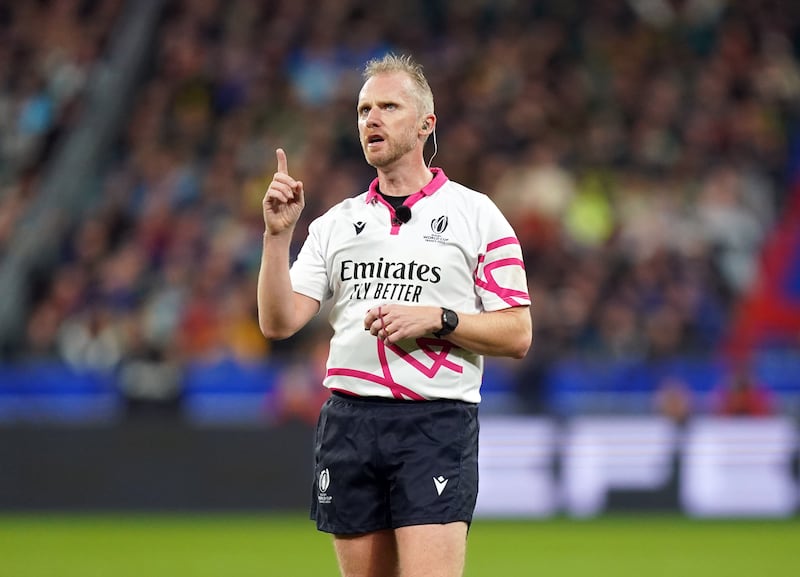 Rugby referee Wayne Barnes, who labelled social media abuse towards him and his family as ‘vile’. Photograph: Mike Egerton/PA
It is a problem that is untreated and festering and now, with Grok AI, sordid. Additionally, the worst kind of abuses are being normalised, as if vile abuse is part of the package sports people sign up for once they ‘get on’ social media.
Such is the lack of consequence, especially on X, that offenders are becoming bolder and smarter, and victims never more helpless.
[ ‘Concerns remain’ around Grok despite X’s assurances, says MinisterOpens in new window ]
X says that it is policed for content by its own systems and external regulators, especially under the EU’s Digital Services Act, and it faces fines for illegal content, hate speech and transparency failures.
You can go down a rabbit hole with this stuff, but Labour Party TD and chairperson of the Oireachtas Arts, Media, Communications, Culture and Sport Committee, Alan Kelly, has taken a harder line and called for more robust legislation. Last week he condemned the platform.
Kelly expressed “deep concern” at the refusal of X to appear before an Oireachtas Committee.
“The manner in which X have operated over the course of this debacle [Grok AI] is disgraceful. An invitation was issued to X to appear at the Oireachtas Committee on February 4th, which they have turned down today. Meanwhile, Google, Meta and TikTok have agreed to attend,” he posted on the Labour Party website.
Irish swimming along with Paralympic sport did the only thing they could do to protect their athletes from the worst excesses on X. In the end they walked. Frustratingly that’s all they could do.