
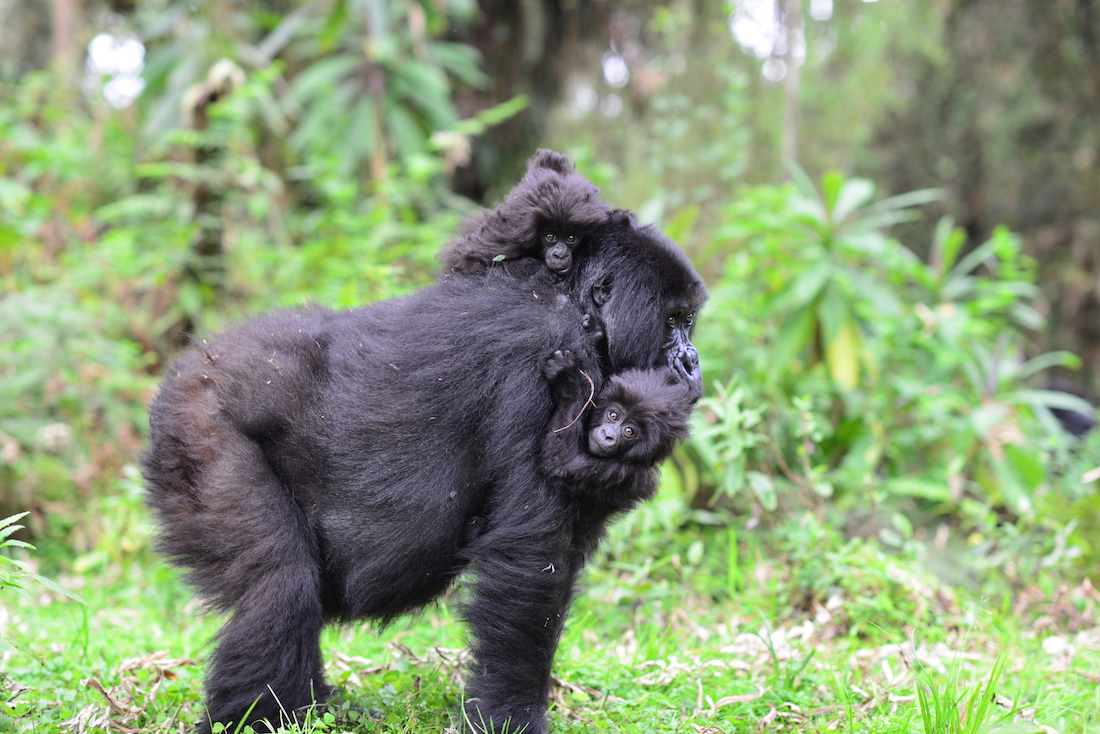
Conservationists around the world and all of us at the Dian Fossey Gorilla Fund are celebrating a rare and encouraging recent event in Virunga National Park in the Democratic Republic of the Congo: the birth of twin mountain gorillas. As reported by park authorities, the twins were born to Mafuko, a seasoned mother, and were discovered by trackers during monitoring of the gorilla population.
Since mountain gorillas are endangered and reproduce slowly, with females not having their first infant until around age 10, and then giving birth only every several years, every birth is cause for celebration. But the arrival of twins is a special occasion given their rarity. Twin births among mountain gorillas are extremely uncommon; from our nearly 60 year database, we know that they occur in less than one percent of births. By comparison, the birth rate of twins in humans is about three percent.
Two infants, more work
Fossey Fund researchers have observed that raising twins places extra physical demands on gorilla mothers.
Carrying, nursing and protecting two infants at once requires exceptional strength and constant vigilance, particularly as gorillas travel long distances through steep forest terrain.
“Gorilla mothers are solely responsible for infant care at this stage, with the infants completely dependent on them,” says Dr. Tara Stoinski, Fossey Fund President & CEO/Chief Scientific Officer. “Not only must the mother carry two infants – which makes walking more difficult particularly in the first few weeks when the infants are not yet clinging well and the mother uses her arm to support them – they must produce more milk, which is energetically very expensive.”
There are only a limited number of documented cases of long-term twin survival in mountain gorillas. In Rwanda’s Volcanoes National Park, six sets of twins have been observed over the approximately the last 60 years. Of these, two sets have survived – one set in the Susa group and another in the Hirwa group – as well as one individual from a pair. Each documented case provides valuable data on maternal investment, infant development and social dynamics, contributing to a deeper scientific understanding that informs evidence-based conservation strategies.
Consistent conservation is critical
For an endangered species once on the brink of extinction and which Dian Fossey thought would be extinct by the year 2000, the birth of these twins is a powerful reminder that consistent conservation works – and that hope for mountain gorillas continues to grow, one or two new lives at a time.