
Canadian prime minister Mark Carney caught the headlines at the World Economic Forum in Davos when he said: “Middle powers must act together because if we’re not at the table, we’re on the menu”. But where lies a small, peripheral country like Ireland, given the “rupture” in the world order that Carney referred to?
The media focus in Ireland on Irish access to the White House will be even more pronounced this year given the upending of international relations by the aggression, insults and discarding of legal norms by US president Donald Trump.
In a recent article in The Irish Times, US ambassador Edward Walsh said that Ireland “with its deep understanding of both American business culture and the political system in Brussels, is uniquely placed to play the role of interpreter and trusted bridge.” He added that “ Ireland’s future is not to choose between America and Europe, but to help both understand each other and to advance shared interests for decades to come.”
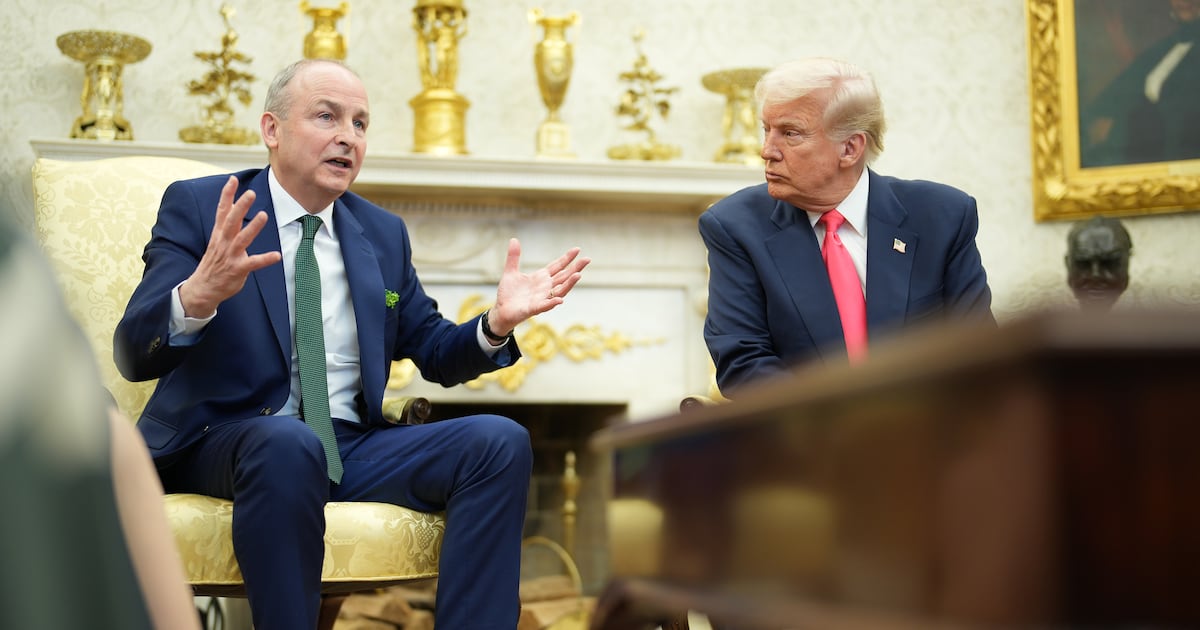
But such optimistic assertions about US-Irish bonds look set to be tested. Nostalgia for the Clinton, Obama and Biden eras and US engagement with the Irish peace process provides no contemporary comfort. Trump’s relentless denigration of the EU is not something that can be sidestepped by Irish political leaders. Taoiseach Micheál Martin may still argue that Ireland can be a transatlantic “bridge”, but that brings with it the danger of appearing sycophantic in the face of American bullying, and of Ireland subjugating the status and unity of the EU to its economic and political self-interest.
Historically, there has been much depth to the Irish-US relationship. The original American struggles against empire inspired the Irish to adopt a similar course. Our ties have been built on centuries of shared historical experience, immigration and trade. But as the Trump administration seeks to rewrite the script in relation to those areas, there are dangers to Ireland which need to be robustly addressed by the Government, not just in the context of our historic connection, but in relation to Ireland holding the presidency of the EU Council in the second half of this year.
Fifty years ago, the Irish historian of foreign policy, Desmond Williams, observed that “two principal points arise for a small state: policy cannot be a single grand design and freedom of action is limited”. Realism about the extent of interdependence and limitations is still needed, but that should not equate to helplessness and equivocation, and we cannot be guided solely by commercial concerns. It is now 30 years since the first White Paper on Irish Foreign Policy was published, where it was stated: “The values we promote abroad are a statement of who we are as a people.” At this critical juncture, it needs to be made clear what those values are.