
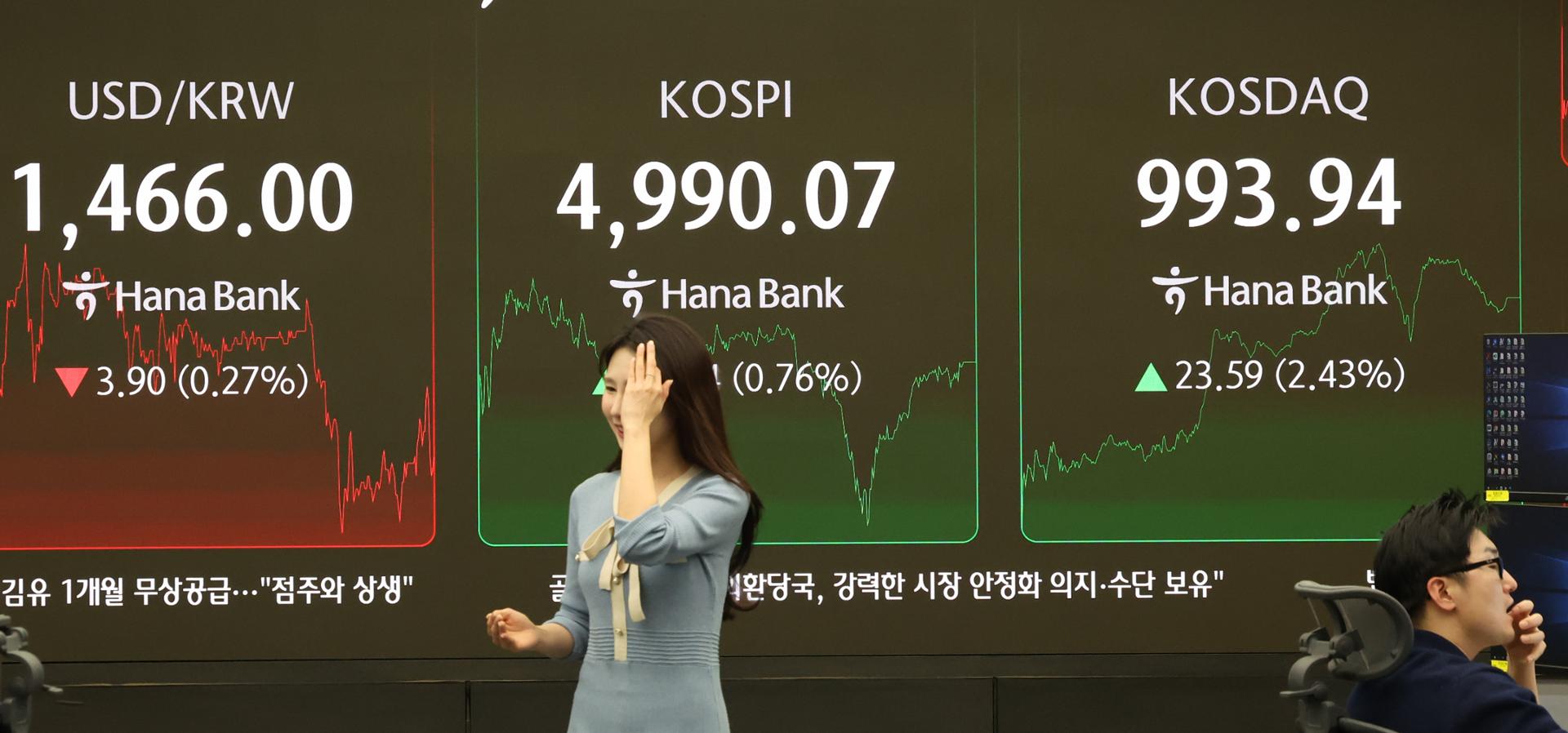
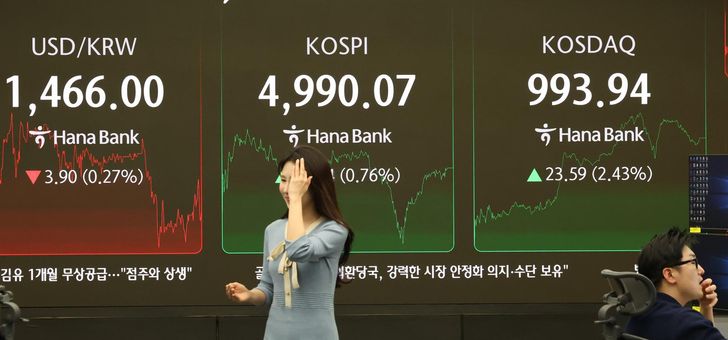
The left side of an electronic trading board at Hana Bank headquarters in central Seoul shows the Korean currency trading at 1,466 won per dollar after onshore trading, Friday. It improved by 4.1 won to close at 1,465.8 won per dollar. Yonhap
The Korean currency needs to recover to the 1,430 won-to-dollar level or stronger, compared with this year’s range of 1,440s to 1,470s, to proceed with the annual $20 billion investment in the United States, analysts said, Friday.
Analysts said the 1,430 mark is reasonable, as the currency traded at around this level on and before Oct. 29, 2025, when the two countries finalized the $350 billion investment package as part of the tariff deal first agreed to on July 30.
The Oct. 29 agreement included $200 billion in cash with an annual $20 billion cap, announced during the second bilateral summit on the occasion of the Asia-Pacific Economic Cooperation leaders’ meeting in Gyeongju, North Gyeongsang Province.
The agreement concluded tariff negotiations that had dragged on for three months, with the first summit on Aug. 25 in Washington, D.C.
However, despite the confirmation of the deal, Korea has not yet determined when to begin the $20 billion installment, fueling speculation that the won’s volatility is holding back the decision, as proceeding could add further pressure to the currency.
A rare verbal intervention by U.S. Treasury Secretary Scott Bessent on Jan. 14 heightened concerns that the won was approaching a risk level that could derail the investment.
“In order to minimize adverse effects on the foreign exchange market, the investment should be implemented when the won-dollar exchange rate recovers to the level around Oct. 29,” Moon Jung-hiu, a KB Kookmin Bank economist, said.
“The two countries must have finalized the details by taking the exchange rate into account back then,” he added, noting that the won traded onshore at 1,431.7 per dollar on Oct. 27, 1,437.7 on Oct. 28, and again at 1,431.7 on Oct. 29.
Suh Jung-hoon, an analyst at Hana Bank, voiced a similar view.
“The Oct. 29 deal was made amid the won’s weakening trend, and the government must have judged that it could bear the annual $20 billion investment if the currency stayed in the 1,430s.” he said.
He referred to the Korean currency’s weakening from 1,383.1 won per dollar on July 30 to 1,384.7 on Aug. 25, followed by further declines afterward.
Regarding efforts to curb the won’s depreciation, analysts welcomed President Lee Jae Myung’s pledge, Wednesday, to deploy all available policy tools to stabilize the Korean currency around 1,400 won per dollar within the next month or two.
“I would say it was a form of verbal intervention that effectively helped the won rebound,” Suh said, referring to the Korean currency snapping a four-day declining streak, Wednesday, when it closed at 1,471.3 won per dollar. It strengthened over the next two days, closing at 1,469.9 won on Thursday and 1,465.8 won on Friday.
Meanwhile, a Ministry of Economy and Finance official said, Friday, that the government has not “set an ideal or optimal exchange rate” for the U.S. investment.
“For now, there are no criteria defining what level would be acceptable or unacceptable,” he added, referring to Minister of Economy and Finance Koo Yun-cheol’s Reuters interview last week.
The minister said that the $350 billion investment is unlikely to begin in the first half of 2026.