
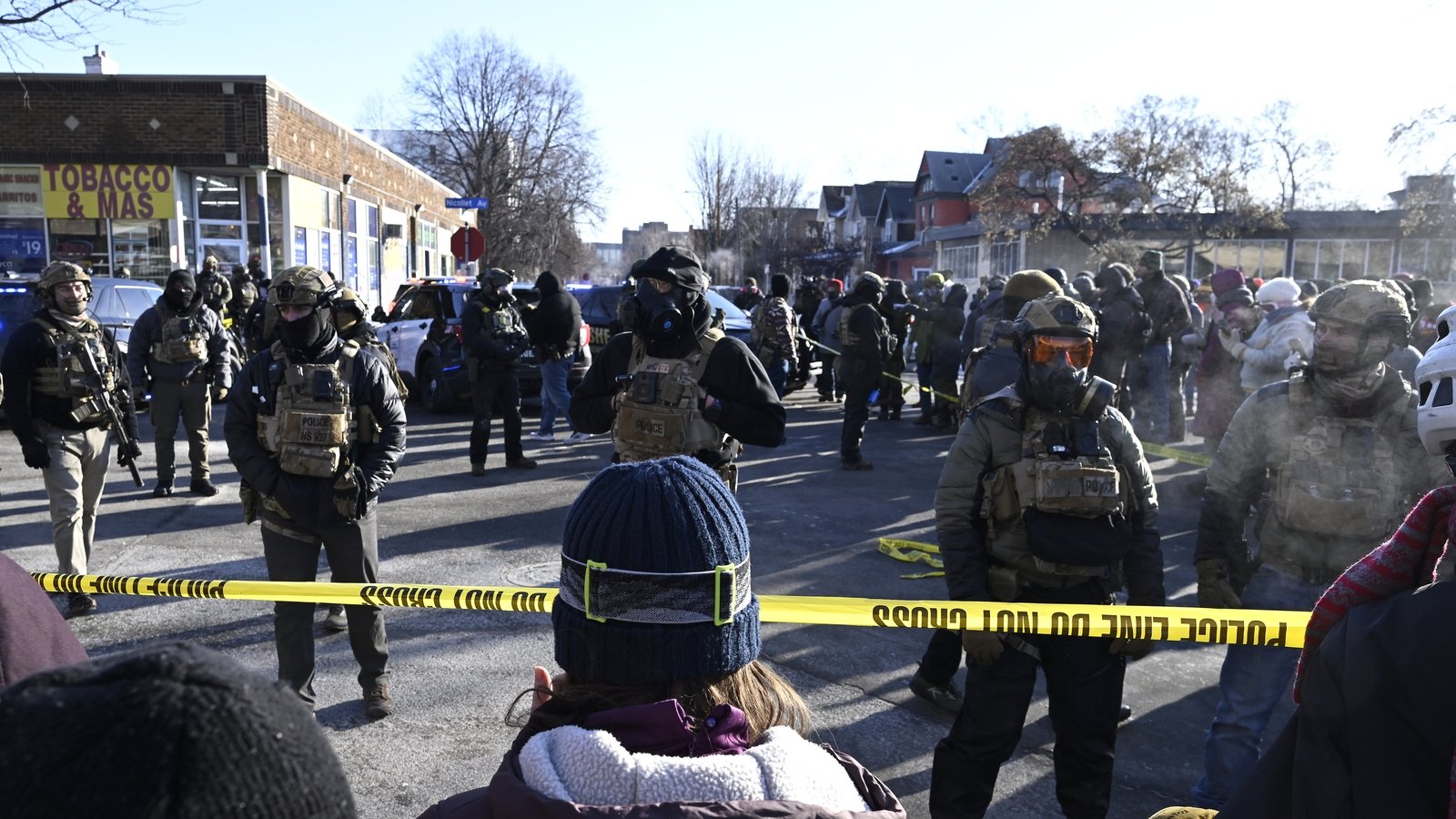
A man shot by federal agents in Minneapolis has died, local and federal officials said, the second fatal shooting involving federal agents this month during a surge in immigration enforcement in the northern US city.
The man, who has not been identified, was armed with a handgun and two magazines, the Department of Homeland Security said in a statement.
Minnesota Governor Tim Walz called for an immediate end to the Trump administration’s immigration enforcement operations in the state.
“I just spoke with the White House after another horrific shooting by federal agents this morning,” Mr Walz wrote on social media platform X.
Watch: Unrest in Minneapolis as man shot dead by federal agents
“This is sickening. The President must end this operation. Pull the thousands of violent, untrained officers out of Minnesota. Now,” he said.
Minneapolis Mayor Jacob Frey called on President Donald Trump to end the sweeping immigration crackdown after the shooting
“I just saw a video of more than six masked agents pummeling one of our constituents and shooting him to death,” Mr Frey told a press conference.
“To President Trump: this is a moment to act like a leader. Put Minneapolis, put America first in this moment — let’s achieve peace. Let’s end this operation.”
Also speaking at the press conference, Minneapolis Chief of Police Brian O’Hara said police believe the man shot and killed was a 37-year-old Minneapolis resident who was a US citizen.
He called on the public to avoid the area of the shooting and for those who are at the scene to leave.
Mr O’Hara also urged people to remain peaceful in the aftermath of the shooting.
He said that it is his understanding that there were multiple officers involved in the shooting.
Mr O’Hara added that the shooting victim was a lawful gun owner with a permit to carry a gun.
The Department of Homeland Security had said earlier that the shooting victim had been carrying a semi-automatic handgun.
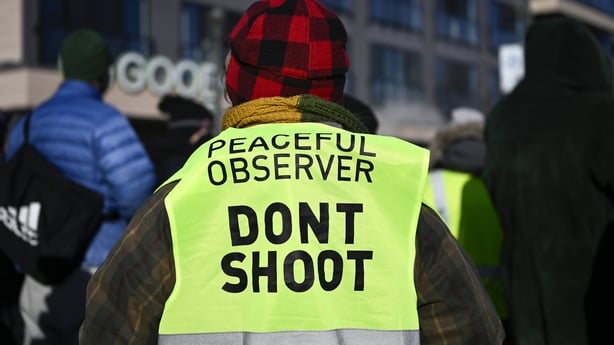
An observer at the scene of the shooting in Minneapolis
Tina Smith, a Democratic US senator from Minnesota, called the shooting “catastrophic”.
Minneapolis officials urged calm as the incident is investigated. Video from the area showed immigration agents deploying tear gas on a growing crowd of onlookers.
“We ask the public to remain calm and avoid the immediate area,” a post by the City of Minneapolis read.
The shooting came after thousands of demonstrators braved bitter cold yesterday to march through the streets of Minneapolis and demand an end to President Donald Trump’s immigration crackdown in their city, part of a wider “ICE OUT!” show of defiance that organisers billed as a general strike.
On a day that started with temperatures as low as -29C, organisers said as many as 50,000 people took to the streets.
Minneapolis police did not give a crowd estimate.
Many demonstrators later gathered indoors at the Target Center, a sports arena with a capacity of 20,000 that was more than half full.
Organisers and participants said scores of businesses across Minnesota closed for the day and workers headed to street protests and marches, which followed weeks of sometimes violent confrontations between US Immigration and Customs Enforcement (ICE) agents and protesters opposed to Mr Trump’s surge.
On Thursday, Vice President JD Vance visited Minneapolis in a demonstration of support for ICE officers and to ask local leaders and activists to reduce tensions, saying ICE was carrying out an important mission to detain immigration violators.
Watch: Thousands brave cold at Minneapolis protest against ICE
In one of the more dramatic protests, local police arrested dozens of clergy members who sang hymns and prayed as they knelt on a road at Minneapolis-Saint Paul International Airport in calling for Mr Trump to withdraw the 3,000 federal law enforcement officers sent to the area.
Organisers said their demands included legal accountability for the ICE agent who shot dead Renée Good, a US citizen, in her car earlier this month as she monitored ICE activities.
They ignored commands to clear the road by officers from local police departments, who arrested and zip-tied dozens of the protesters, who did not resist, before putting them onto buses.
Organisers said about 100 clergy members were arrested.
Faith in Minnesota, a non-profit advocacy group that helped organise the protest, said the clergy were also calling attention to airport and airline workers who they said had been detained by ICE at work.
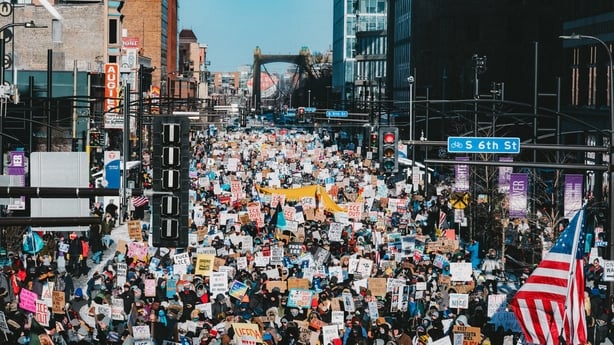
Organisers said around 50,000 people took part in the protest, although police did not give any official figures
The group asked that airline companies “stand with Minnesotans in calling for ICE to immediately end its surge in the state.”
Across the state, bars, restaurants and shops closed yesterday, organisers said, in what was intended to be the largest display yet of opposition to the federal government’s surge.
“Make no mistake, we are facing a full federal occupation by the United States government through the arm of ICE on unceded Dakota land,” Rachel Dionne-Thunder, vice president of the Indigenous Protector Movement, told the arena crowd.
She was one of a series of indigenous, religious, labour and community leaders to speak, calling on ICE to withdraw and for a thorough investigation into Ms Good’s shooting.
“We’ve seen an agency that seems to have no guardrails, as they have caused this pain and suffering all across Minnesota,” said Lizz Winstead, a comedian and abortion rights advocate who served as host.
Mr Trump, a Republican, was elected in 2024 largely on his platform of enforcing immigration laws with a promise to crack down on violent criminals, saying Democratic President Joe Biden was too lax in border security.
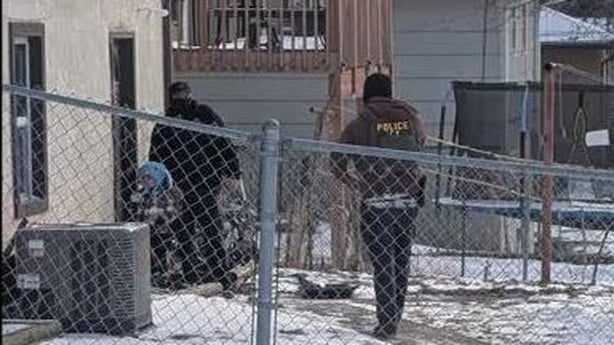
Five-year-old Liam Ramos seen with police officers at his home in Columbia Heights (Pic: Ali Daniels)
But Mr Trump’s aggressive deployment of federal law enforcement into Democratic-led cities and states has further fuelled the US’s political polarisation, especially since the shooting of Ms Good, the detention of a US citizen who was taken from his home in his underwear, and the detention of school children including a five-year-old boy.
Miguel Hernandez, a community organiser who closed his business Lito’s Bakery for the day, put on four layers, wool socks and a parka before heading out to protest.
“If this were any other time, no one would’ve gone out,” he said, bracing for the weather. “For us, it’s a message of solidarity with our community, that we see the pain and misery that’s going on in the streets, and it’s a message to our politicians that they have to do more than grandstand on the news.”
The numerous Fortune 500 companies that call Minnesota home have refrained from public statements about the immigration raids.
Minneapolis-based Target TGT.N, which has come under fire in the last year for retreating from its public commitment to diversity policies, has faced more criticism for not speaking out about activity at its stores.
State politicians have pressed the company for details of its guidance to employees if and when ICE officers show up at stores.
“The silence from the corporations in the state is deafening,” Ms Winstead told the arena crowd.