
By Bhanvi Satija /
Reuters, LONDON
Sweeping policy changes under US Secretary of Health and Human Services Robert F. Kennedy Jr are having a chilling effect on vaccine makers as anti-vaccine rhetoric has turned into concrete changes in inoculation schedules and recommendations, investors and executives said.
The administration of US President Donald Trump has in the past year upended vaccine recommendations, with the country last month ending its longstanding guidance that all children receive inoculations against flu, hepatitis A and other diseases.
The unprecedented changes have led to diminished vaccine usage, hurt the investment case for some biotechs, and created a drag that would likely dent revenues and raise costs for companies in the coming years, investors and analysts said.
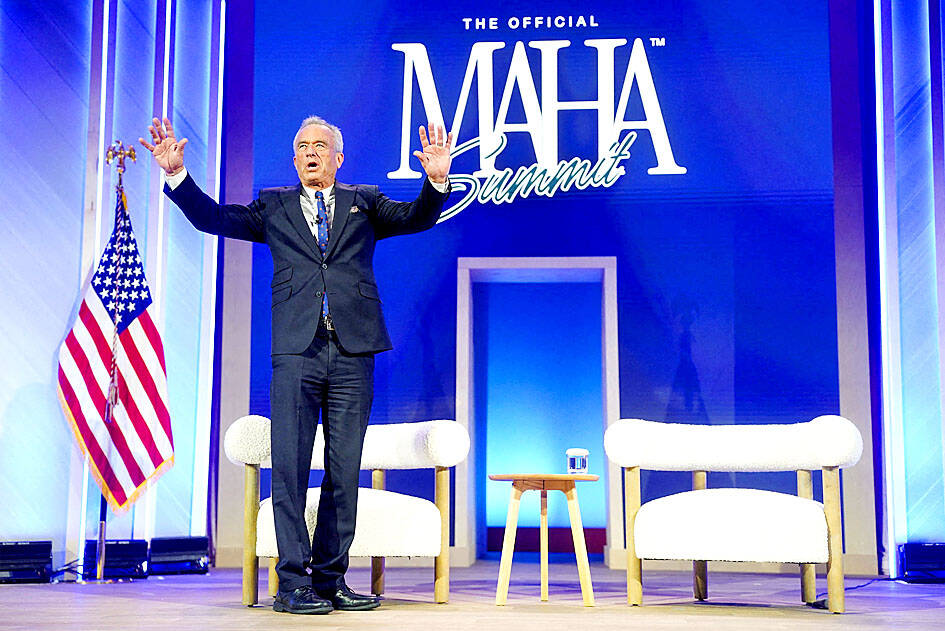
Photo: Reuters
“Vaccines will not be a growth area under the current administration,” ING global pharma and healthcare lead Stephen Farrelly said, signaling a potential drag on the sector through 2028.
Kennedy, a longtime anti-vaccine activist who has cast doubt on the safety and efficacy of vaccines contrary to scientific evidence, has moved quickly since taking over the health department.
He fired a panel of independent expert advisers, replacing them with members who share his anti-vaccine views, and dropped broad COVID-19 vaccine recommendations for pregnant women and children.
He also revived research into a long-ago debunked claim linking vaccines to autism, and adopted new reduced childhood vaccine schedules without the long-standing practice of involving a broad group of outside experts.
Investors are concerned the impact of Kennedy’s policies would be hard to reverse, echoing public health experts’ worries, who also said they would lead to preventable illnesses and deaths.
Kennedy said the changes aim to improve safety and bring US vaccine policy in line with other peer nations.
The striking policy changes have begun to prompt some rare public rebukes from industry leaders.
Pfizer CEO Albert Bourla and Sanofi CEO Paul Hudson criticized Kennedy’s rhetoric at a major healthcare conference last week, with Hudson citing “all the… misinformation that is going around.”
Bourla told reporters it was driving down vaccination rates and increasing disease risk.
“I’m seriously frustrated,” he said. “What is happening has zero scientific merit and is just serving an agenda which is political and antivax.”
The long-term prospects for vaccine makers remains robust, as vaccines are still the most effective tool for preventing disease, investors said, but added that companies were now more beholden to the whims of political leaders.
“Unfortunately, success and failure will rest on the opinions of a few people. It’s not enough to have good science and commercial opportunity,” Clear Street analyst Bill Maughan said. “If you’re a biotech investor, it just seems tough to really get conviction in a vaccine name right now.”
Investors said they would stick by large-cap drugmakers less dependent on vaccine revenue such as GSK, Sanofi, Pfizer and Merck. Smaller players such as Moderna, BioNTech and Novavax face sharper risks.
The effect of US changes are already starting to take hold. GSK and Sanofi reported lower US flu vaccine sales in the third quarter, despite a more severe flu season.
In October last year, Australia’s CSL postponed separating its vaccine unit Seqirus, citing “heightened volatility” and falling US vaccination rates.
Some investors said demand for vaccines and disease prevention would likely rebound.
Outbreaks such as the rising measles cases in South Carolina, or an extended severe flu season, could drive renewed vaccine usage, they said.
The US Centers for Disease Control and Prevention said the 2025-2026 flu season had seen at least 11 million cases and 5,000 deaths reported so far, nearly double last year’s toll.
Medical organizations, including the American Academy of Pediatrics, have challenged Kennedy’s policies in court and it remains to be seen how that would play out.
Investors “often focus on shorter-term time frames, while companies clearly take a far longer-term view,” Candriam senior portfolio manager Linden Thomson said.
“These businesses have been around for decades. They don’t invest on a one- or two-year horizon,” said Matthew Masucci, an analyst for Callodine Capital, which owns GSK and Sanofi shares.
For now, investors might be more cautious.