
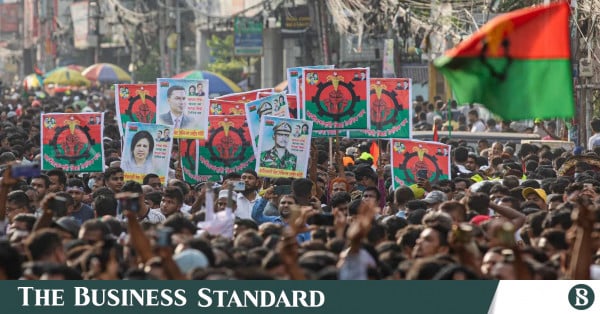
Health has emerged as a central issue in the lead-up to the national election, with political parties placing greater emphasis on public healthcare.
After years of limited investment, both the BNP and Jamaat-e-Islami are promising higher public spending, free treatment, and steps toward universal coverage.
The current budget allocates Tk41,908 crore to health, equivalent to 5.3% of the national budget but just 0.67% of GDP, with full utilisation remaining a recurring challenge.
For years, experts and citizens have called for greater public spending on health, as a very high proportion of costs – around 68-73% – are paid directly by households, leaving nearly three‑quarters of healthcare expenses to out-of-pocket payments.

Keep updated, follow The Business Standard’s Google news channel
Acknowledging the urgent need, the BNP has pledged a universal healthcare system modelled on the UK’s National Health Service.
The commitments include allocating more than 5% of GDP to health, providing free primary treatment for every citizen, and bringing all hospitals and health centres under accountability mechanisms.
The party has also promised a 24-hour helpline, strengthen district and specialised hospitals, expand access to complex treatments through public-private partnerships, and recruit 1 lakh health workers.
Jamaat has announced that, if elected, it would allocate between 6% and 8% of GDP to health, alongside free healthcare for citizens over 60 and children under five.
The party has also pledged to establish specialised hospitals in all 64 districts and ensure health and nutrition security for mothers and children from pregnancy until a child reaches two years of age.
Experts described the pledges as ambitious but broadly positive.
However, they warned that just allocating 5% of GDP to health would mean spending roughly Tk3.13 lakh crore. Besides, the interim government is planning a 104% average salary increase for government employees, requiring an additional Tk1.06 lakh crore.
Combined with party promises, the next government would face a substantial fiscal burden, experts said, raising questions about the feasibility of fully funding these ambitious pledges.
They advised that making these pledges achievable will require structural reforms, phased implementation, curbing corruption, and clear explanations of how the commitments would be carried out.
‘Reforms must be achieved gradually’
Professor Dr Syed Akram Hossain, a member of the health sector reform commission, said the commission had also recommended allocating 5% of GDP to health, a position now reflected in political pledges.
He said achieving universal health coverage would ultimately require health spending to reach 5% of GDP, which would mean raising the sector’s share to nearly 25% of the total budget.
“However, that is not feasible for the state at this moment,” he said, adding that proposals to allocate 6-8% of GDP were even more ambitious under the current fiscal structure.
Dr Akram said the target should be pursued gradually, possibly over five years, supported by alternative revenue sources such as tobacco taxes and improved spending capacity.
“Without structural reforms in health administration, effectively utilising such a large allocation would remain unrealistic,” he added.
Commenting on Jamaat-e-Islami’s pledges of free healthcare and specialised hospitals, Dr Akram said these reflected commendable aspirations for the state.
He noted that the commission had recommended making primary healthcare legally free and modernising district hospitals to provide comprehensive services, which alone would significantly benefit citizens.
“If universal health coverage is achieved, separate promises for mothers, children or older people become unnecessary, as everyone would be covered,” he said.
Dr Akram added that proposals from political parties are broadly consistent with the commission’s recommendations. “All reforms would need to be implemented gradually.”
‘Little clarity on how health pledges would be implemented’
Dr Shafiun Shimul, director of Health Economics at Dhaka University, said political parties have outlined broad directions but offered little clarity on how their health pledges would be implemented.
He said it remains unclear whether parties intend to move towards an insurance-based model or simply expand the existing health financing system.
Dr Shimul said prioritising health in election manifestos is a positive step, but without clarity on funding sources, spending structures, and the scope of coverage, the promises will be difficult to realise.
“We are still unable to effectively spend even 1% of GDP. In that context, questions remain about how 6% or more would be utilised,” he said.
He added that coverage for mental health, elderly care, and non-communicable diseases remains weak in Bangladesh, and expanding these areas would inevitably raise costs.
“The problem is not increasing the budget, but the failure to reform flawed spending structures and internal allocation systems,” he said.
He further said party proposals suggest limited adjustments or expansion of the existing system rather than a comprehensive restructuring of the health sector.
“In effect, there appears to be a greater focus on expanding the current system rather than building a fully integrated and restructured healthcare framework,” he said.