
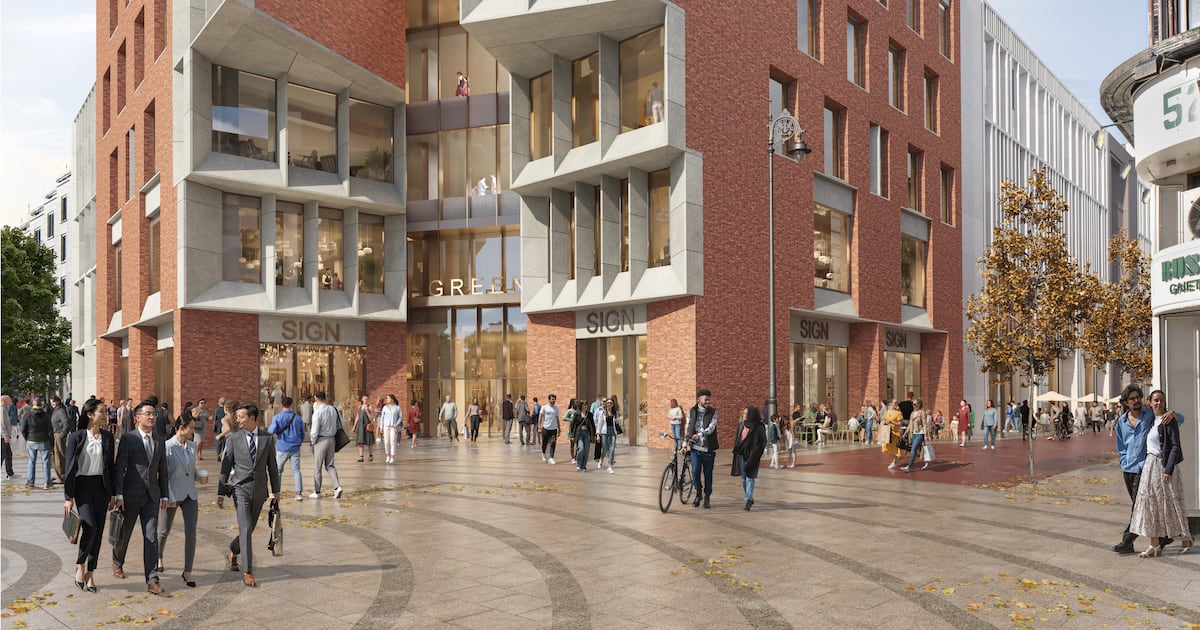
Frank Gehry might have smiled knowingly at the latest proposal for Stephen’s Green Shopping Centre and the face it would present to one of the best-known corners of Dublin, between the Fusiliers’ Arch and the top of Grafton Street. This is because it is essentially an exercise in deconstruction, the architectural trend that the late designer championed so successfully for decades.
In this revised plan by the award-winning architects O’Donnell+Tuomey, the shopping centre “surrenders some of its internal floor area” to make way for “a sculpturally eroded corner … at this critical juncture in the mental map of the city”.
The aim, they say, is to create “a civic space to enhance the visual connection from Grafton Street to Stephen’s Green”.
The 1988 building, with its multifaceted dome and decorative facades, has been the focus of controversial “rejuvenation” plans by DTDL Ltd, a British Virgin Islands company linked to the billionaires JP McManus and John Magnier, since January 2023. In July 2025 An Coimisiún Pleanála refused permission for a revised scheme, saying it “lacks a strong sense of original aesthetic”.
BKD Architects had proposed a layered glass box projecting over an enormous void that would have been the same height as the Fusiliers’ Arch. They described the three-storey box as “a dramatic floating form”, but I likened the entrance beneath it to the “architectural equivalent of Jaws” in an appeal against Dublin City Council’s decision to grant permission.
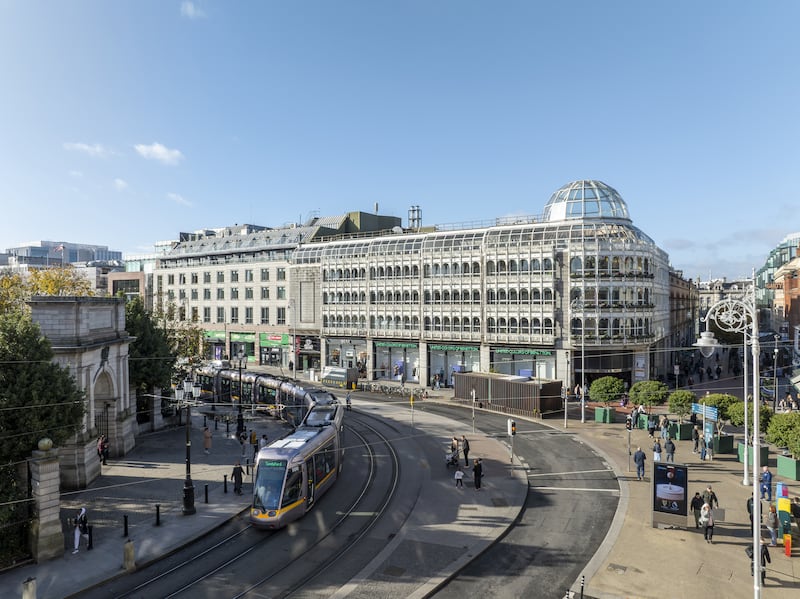 Stephen’s Green Shopping Centre: the Dublin mall as it currently looks. Photograph: Visual Labs
DTDL’s agent David Goddard, who is chief executive of the property company Lanthorn – formerly Davy Real Estate – decided that a new approach was needed to get its big project over the line. While retaining BKD in charge of every other aspect of the overall scheme, he called in John Tuomey and commissioned him to reimagine the corner and its flanking facades on St Stephen’s Green and South King Street.
What’s now proposed is more considered and restrained than the razzle-dazzle scheme rejected six months ago, although it is still problematic in several respects
This was a clever strategic move. O’Donnell+Tuomey – Tuomey runs it with his equally acclaimed wife, Sheila O’Donnell – are home-grown starchitects of international standing, garlanded with numerous awards, notably Britain’s Royal Gold Medal (in 2015). Recent cultural projects include Sadler’s Wells Dance Theatre and V&A East Storehouse, both located at Queen Elizabeth Olympic Park, in Stratford, east London.
Their involvement in DTDL’s shopping-centre project, at least in dressing its external appearance, has apparently found favour with the senior Dublin City Council planners Brian Keaney and Garrett Hughes. (Farther along the west side of St Stephen’s Green is the Henry J Lyons firm’s unapologetically cubist-style building for the Royal College of Surgeons in Ireland, which Hughes hailed for its “distinctive contemporary design”.)
[ ‘Startling’: First look behind the RCSI’s new ‘front door’ on St Stephen’s GreenOpens in new window ]
An Coimisiún Pleanála’s rejection of the proposed shopping-centre “rejuvenation” scheme was narrowly focused on the facade treatment of its northeastern corner, with an unusually large seven-member board concluding that what BKD had proposed “would not achieve a sufficiently high standard of placemaking, urban design and architecture at this key city centre location”.
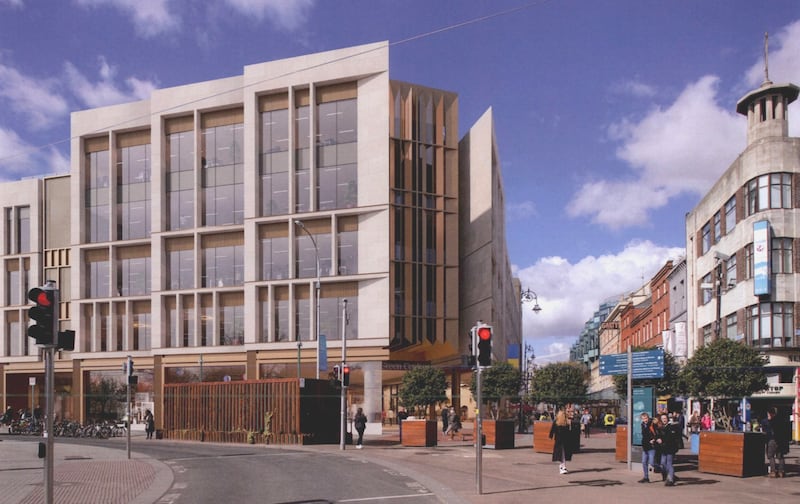 Stephen’s Green Shopping Centre: version 1 of the redesigned Dublin mall, designed by BKD Architects. Illustration: Model Works
The commission left the door wide open for DTDL to come back with a new proposal by explicitly stating that its members did not share the view of the senior planning inspector Irené McCormack that the existing shopping centre “represents an exemplar twentieth century building”, and that it could be replaced “subject to an appropriately high quality design solution” being found.
O’Donnell+Tuomey’s revised design is therefore is “in direct response” to the commission’s decision, as Tuomey says. He believes it would “deliver a strong architectural identity, a contextually rooted placemaking response, and an exemplar standard of urban design appropriate to its prominent setting”, drawing inspiration from “the character of Dublin’s historic fabric”.
What’s now proposed is more considered and restrained than the razzle-dazzle scheme rejected six months ago, although it is still problematic in several respects. There is also something very unusual about a firm of architects being called in to put their own front on a building designed by another firm. Frequently, interiors may be done by different architects, but almost never facades.
O’Donnell+Tuomey say that much of their work has involved “the meaningful integration of new structures into historically significant contexts, often involving the radical transformation of existing buildings. A strategic understanding of place and a careful interpretation of context allows an architecture to emerge, an architecture which can unlock the latent potential of the situation.”
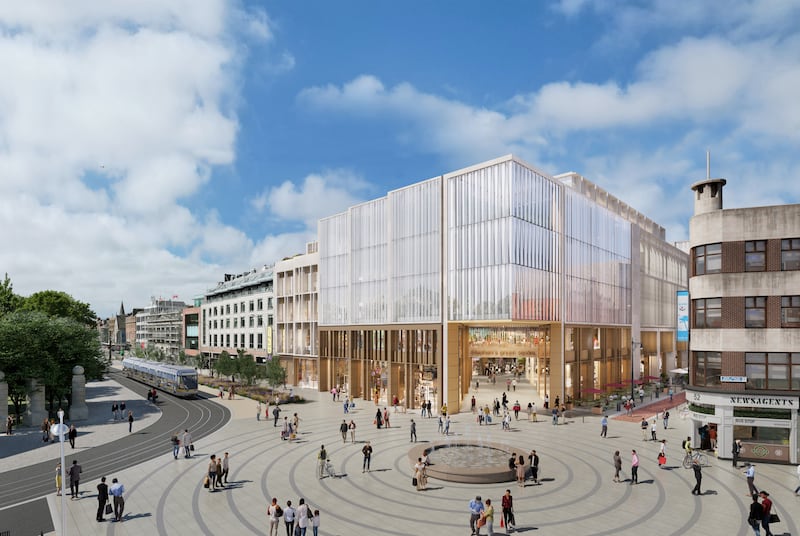 Stephen’s Green Shopping Centre: the rejected version 2 of the redesigned Dublin mall, by BKD Architects. This view incorporates Dublin City Council’s proposed public-realm improvements at the top of Grafton Street. Illustration: Model Works
Tuomey says that, after getting Goddard’s unusual request, he “walked around Stephen’s Green several times, thinking about this”, and noted the eccentric arrangement of windows in early-1740s buildings on its south side, which have what Dublin Civic Trust describes as “stranded” gable windows at second-floor level, indicating that they were originally “Dutch Billy” houses.
Having decided to introduce red brick into the shopping-centre facade to form what would appear as “two new house-like blocks” flanking the scooped-out corner – one on St Stephen’s Green, the other on South King Street – “I said, let’s take our brick facades and make them with stranded windows, symmetrical in themselves, but offset so you get a rhythm going”, Tuomey says.
These “house-like blocks” are clearly intended to give variety to the facades, and they cover a mix of uses: retail on the ground and first floors, open-plan offices on the second and third floors, and a restaurant/cafe on the fourth floor. The brickwork would rise to a parapet height of nearly 25m, well over double the modest domestic scale of 98-99 St Stephen’s Green: reordered Dutch Billys on steroids, in effect.
The arrangement of the windows is also odd, in that openings at the uppermost level on both elevations are taller than their single-pane glazing. This stone “fringe” treatment is repeated on the first floor, where splayed granite window sills would sit right on top of the fascias of retail units. Almost all of the windows are also devoid of the thin reveals so characteristic of Georgian Dublin.
Alongside the brick wall, on St Stephen’s Green West, sharply cut granite has been used for the facade treatment – “a new stone palace type, giving a distinctive and contemporary architectural expression to the office component of the project and defining an independent entrance to the office accommodation”, according to the architectural design statement submitted to Dublin City Council.
There is no precedent for this stone typology on St Stephen’s Green, or in Dublin. Tuomey admits that O’Donnell+Tuomey “just took the stone detailing that we have in the CEU” – Central European University – “in Budapest” and applied it to the facade, as a counterpoint to the brick. The brick and stone of the former Kildare Street Club (now Alliance Française) by Deane and Woodward was also an inspiration.
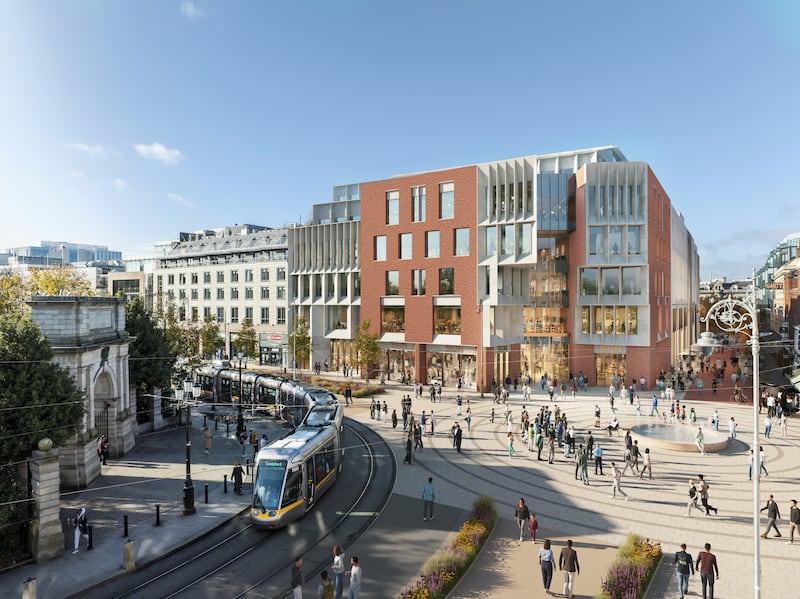 Stephen’s Green Shopping Centre: O’Donnell+Tuomey’s design, in a view incorporating Dublin City Council’s proposed public-realm improvements at the top of Grafton Street. Illustration: Visual Labs
The cutaway corner contains stone-clad elements cantilevered at third-floor level, each with a two-storey blank-brick gable, while the floors beneath evoke medieval overhangs rising from brick bases. Tuomey says its dimensions reference the well-known turreted art-deco corner building at the top of Grafton Street, by Robinson & Keefe. Indeed, it would fit snugly into O’Donnell+Tuomey’s proposed cavern.
There would be views down Grafton Street from one set of projecting windows within the “eroded” corner, and across the north side of St Stephen’s Green from the others. “It could be amazing up there,” Tuomey says. On the other hand, the view from Grafton Street would be radically altered, with the existing dome replaced by a red-brick wall punctuated by tall top-floor windows.
As for the behemoth commercial development that the new facade treatment would partially cloak – six or seven floors of offices stacked on top of a truncated two-storey shopping mall, interspersed with three atriums – Tuomey says, “This is not my world. I’m not really looking at any of this.”
The Save Stephen’s Green Campaign has been vigorously opposing plans to demolish all but part of the structure of the existing shopping centre
O’Donnell+Tuomey’s role, as one naysayer says, has been limited to “putting lipstick on the gorilla”.
Graham Hickey, chief executive of Dublin Civic Trust, describes the new design as “a confused amalgam of two strands of the Dublin building tradition: modest bricked streetscape and stone-faced public buildings. In attempting to marry the two, the bricked component has been pumped up to the point of parody to align with the large commercial frame lurking behind. It’s very unsatisfying.”
Irrespective of its facade treatment, the sheer scale of what’s proposed for this highly sensitive site at the edge of St Stephen’s Green park – a national monument in its own right – needs to be reconsidered by Dublin City Council, whose planners really should seek a large-scale model of the scheme in its context, and by An Coimisiún Pleanála after whatever decision the council makes is appealed.
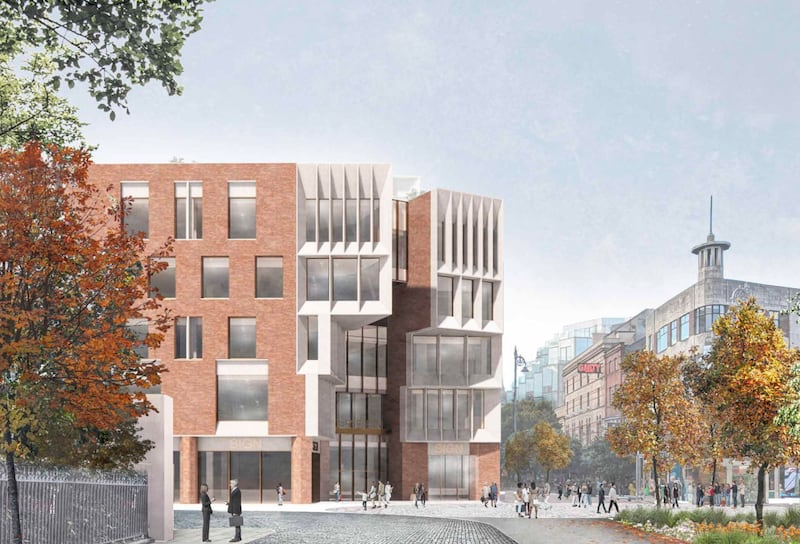 Stephen’s Green Shopping Centre: O’Donnell+Tuomey’s design. Illustration: Visual Labs
Another planning inspector might take a different view to McCormack, who said she was “satisfied” that the provision of a lot of office space – 29,000sq m – was “justified” at this location, that the recessed upper floors would reduce its visual impact and that the site “has the capacity to accommodate increased building height” due to the “tiered design approach”.
Nevertheless, she regarded the way in which the 1988 building addresses St Stephen’s Green and Grafton Street – “the most prominent and nationally recognised section of the site” – as “stylistically original and innovative”, and she shared the concerns of many third-party objectors about the loss of this “unique facade”, particularly its trellis detailing and dome.
Hickey describes it as “a delightfully effervescent and enormously popular example of late-1980s commercial design. It represents not just an exemplar of its period but also a marker of the cultural and social zeitgeist in Dublin that decisively swung away from the brutal assaults on the historic fabric of the city in previous decades. This is absolutely fundamental to its significance.”
The Save Stephen’s Green Campaign has been vigorously opposing plans to demolish all but part of the structure of the existing shopping centre. Its co-ordinator, a University College Dublin architecture student named Yusuf Alraqi, says the new facade treatment is “certainly less monolithic and the massing of the entrance is somewhat improved”, but he is disappointed by “this surface-level approach”.
He suggests that if O’Donnell+Tuomey “had more time and were able to take a holistic approach” to the entire scheme, perhaps they would have produced something as coherent as their student centre at London School of Economics. “However, it’s immediately obvious that this design is a mishmash of previous work and references pulled from their catalogue and does little to acknowledge its surroundings”.
Coincidentally, the latest planning application to redevelop Stephen’s Green Shopping Centre was lodged on December 17th, 2025, just 12 days after Gehry’s death, at the age of 96. What the architect of the sensational Guggenheim Museum in Bilbao would have made of its deconstructed corner and brick-and-stone facades is anybody’s guess. But it’s clear that his influence lives on.