
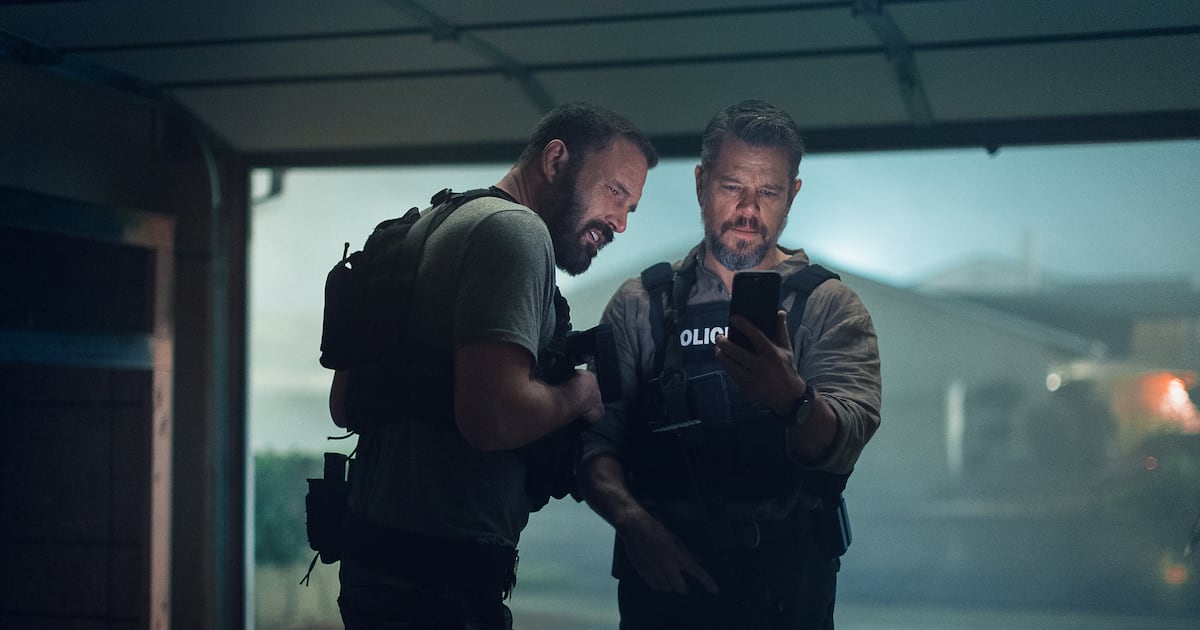
Matt Damon has put forward further evidence that we are all idiots. Well, that’s not quite right. He has implicitly argued that we are being treated like idiots.
On the promotional tour for Joe Carnahan’s tolerable action thriller The Rip, the American actor relayed advice that Netflix’s overlords had put the film-makers’ way. “It wouldn’t be terrible if you reiterated the plot three or four times in the dialogue, because people are on their phones while they’re watching,” he told Joe Rogan.
This is not entirely new information. The phrase “second-screening” has been doing the rounds for a good few years. The notion is that the average punter is incapable of sitting through an hour’s TV without a bit of doom scrolling.
A full three years ago, YouGov, the influential market-research firm, announced the practice was already “over a decade old”. There are young adults who barely remember television being watched without a seasoning of iPhone. In 17 international markets, most viewers said they accessed their mobile devices “very or fairly” often when watching television.
Nor is this the first time suggestions have been made that programmemakers are facilitating our addiction to distraction. In 2023, Justine Bateman, a writer, director and producer, told the Hollywood Reporter she had heard of showrunners being told “this isn’t second-screen enough”. It is now assumed (by some) that scripted dramas expect about only a third of our attention.
Imagine if William Shakespeare felt a similar urge to indulge the famously rowdy groundlings in the audience of the Globe Theatre. Maybe he did. Perhaps that’s why the witches keep popping up throughout Macbeth. If you missed 20 minutes when buying a meat pie, fret not. The Weird Sisters will soon be back to fill in a few murderous gaps.
The “theatrical aside” has long been used to alert audiences to nuances they may have missed. Complex detective novels – even those by masters of the art – will often allow the protagonist a few moments to talk through the evidence established thus far. “So we know Dr Godling was in the greenhouse, but Mrs Sparrow believes she saw someone wearing his overcoat descending into the basement. And what about the open window at the first-floor balcony?” That sort of thing.
The difference now is the assumption that such recaps are required because we expect the viewer to be constantly connecting with another electronic medium. The writer is being invited to help create an ambient work that can be experienced while the viewer is paying least as much attention to something else.
Isn’t that what happens with music? Well, yes. But this is rather as if composers should expect their music to compete with more music. People are watching TikTok at the same time as they are barely watching Matt Damon in The Rip. We are happily indulging in a mighty audiovisual discordance.
So, yes, the industry has gone to hell. We are compliant in the hollowing out of our own sodden brains. Just as we have got used to the notion of nobody being capable of reading a book, we must cope with the news that nobody can properly watch a film or series on the telly. What next? Will we soon be incapable of holding a simple conversation. Will the spoken word give way to animal grunts?
Calm down, everyone. Yes, Matt Damon does not bring happy news. “It’s going to really start to infringe on how we’re telling these stories,” he said of those streamers’ notes. But television has always functioned as a class of undemanding visual Muzak.
From its mainstream arrival in the 1950s, punters have allowed the set to play all day while they do the dusting, iron the shirts and snooze on the couch. The notion of half-watching telly is as old as the medium. That is what gameshows are for. That is what chatshows are for. That, ultimately, is how reality TV came to be watched.
It is depressing that narrative television is now being manoeuvred into that same category of undemanding wallpaper. But it is plainly not the case that all drama and comedy has been mindlessly dumbed down.
Twelve months ago, viewers sought out the little-heralded Adolescence and made it into a ratings sensation on Netflix. Neither Severance nor Slow Horses, hits on Apple TV, treat the viewer as any sort of moron.
“Hand on heart, nobody puts any pressure on us from Netflix to make anything simplistic,” Danny Brocklehurst, writer of Fool Me Once, told the Guardian a year ago.
Any cursory glance at the material available on streamers (and linear TV for that matter) will confirm that a rainbow of differing attention spans is still catered for. Still, you can understand why Matt was worried.