
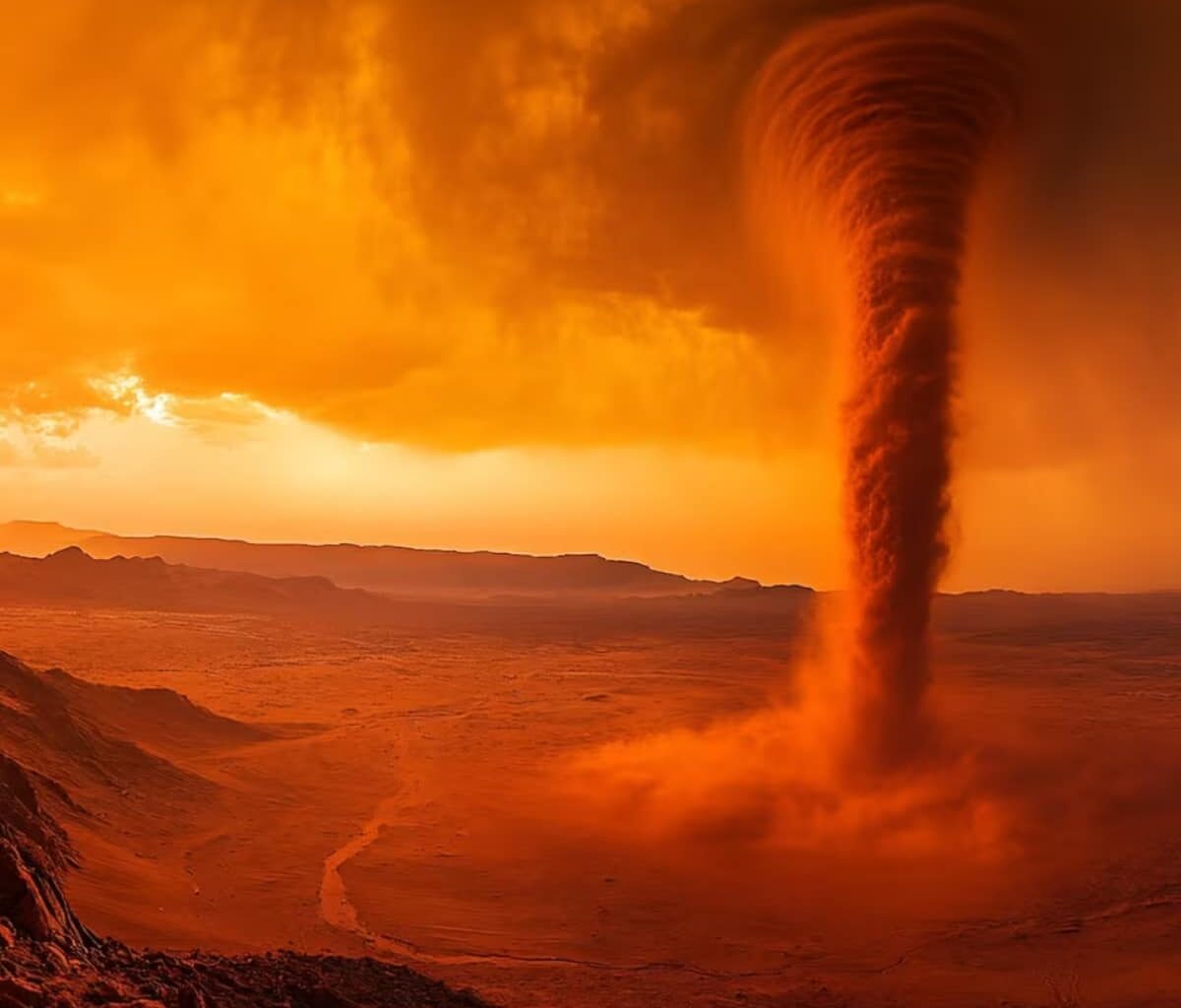
On Mars, dust devils — those whirling towers of hot air that sweep across the surface — are surprisingly common. These miniature Martian tornadoes lift clouds of fine dust as they spiral upward, creating mesmerizing but fleeting spectacles. Astronomers first spotted them in the 1970s thanks to NASA’s Viking orbiters, and in 2021, the Perseverance rover even managed to record the eerie sounds they make.
Still, photographing one of these elusive formations is largely a matter of luck — no one can predict exactly when or where they’ll appear. That’s why the footage captured by NASA’s Perseverance rover at the end of January is so extraordinary: it shows a massive dust devil engulfing a smaller one.
These dust devils may look strong, but not to worry: In the thin atmosphere of Mars, it feels more like a gust of wind.
Studying these phenomena can teach my team about the Martian climate: https://t.co/ilmSSfkh4U pic.twitter.com/azI0wcqrez
— ARCHIVED – NASA’s Perseverance Mars Rover (@NASAPersevere) April 3, 2025
Why studying dust devils matters
Perseverance was positioned about a kilometer from the scene, near the edge of Jezero Crater. The larger dust devil spanned roughly 65 meters in diameter, while the smaller measured around five. In the video, it’s actually the little one that seems to rush headlong into its own demise. But don’t feel too sorry — on the Red Planet, these swirling columns of dust rarely last more than ten minutes.
Beyond the breathtaking visuals, these events are scientifically invaluable. By observing dust devils, researchers can track wind direction and speed, helping them better understand the Martian atmosphere and its weather dynamics. Scientists also note that these swirling storms are responsible for about half of all the fine dust floating in Mars’s thin atmosphere — a key factor in its ever-changing climate.

Nathalie Mayer
Journalist
Born in Lorraine on a freezing winter night, storytelling has always inspired me, first through my grandmother’s tales and later Stephen King’s imagination. A physicist turned science communicator, I’ve collaborated with institutions like CEA, Total, Engie, and Futura. Today, I focus on unraveling Earth’s complex environmental and energy challenges, blending science with storytelling to illuminate solutions.