
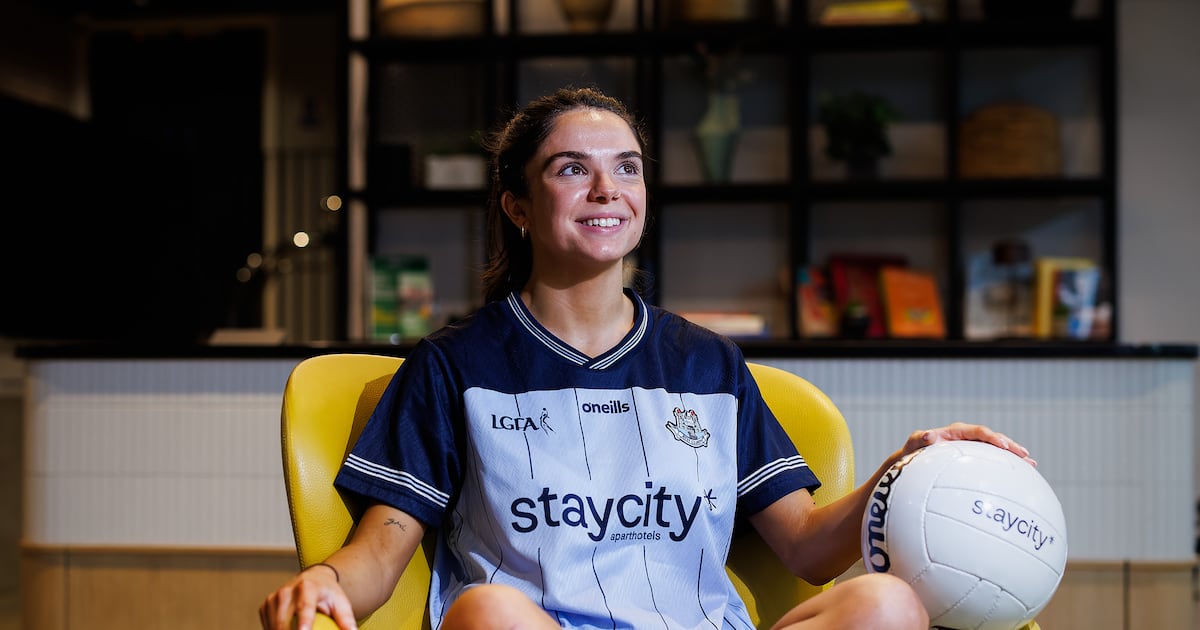
Niamh Crowley has no difficulty whatsoever in articulating on the raft of new challenges in women’s Gaelic football. Which is both refreshing and remarkable, given the 21-year-old spent parts of her late childhood learning how to speak all over again.
Crowley is already a two-time All-Ireland winner with Dublin, first tasting success in her debut season in 2023 before helping Dublin win back the title again last August.
She has also come a long way. As an eight-year-old, not long after joining her club Fingallians, she was diagnosed with Landau-Kleffner Syndrome, an extremely rare childhood epilepsy which also robbed her of almost all her communication skills and ability to express herself.
It’s thought to impact on just one in a million people. Crowley has only recently come to understood how rare it is, and last year became an ambassador for the I Am Number 17 campaign, which raises awareness around rare diseases in Ireland.
“My aspect to that was having a rare form of epilepsy when I was younger,” she says. “It’s one in a million.
“They reckon it [Landau-Kleffner Syndrome] went on from when I was about six up until 10. I would have experienced seizures, specifically nocturnal seizures.
“I was kind of lucky, I was still able to play football the whole way through, it never interfered with my football. But it would have affected my expressive and receptive language. So all the language I had learned up until the age of eight, all my vocabulary and speech, had kind of deteriorated and kind of disappeared over a while.
“I spent lots of time doing speech therapy, in and out of Temple Street. And of course an endless amount of hours at the kitchen table with my dad, going over vocab, and trying to learn all that language again.”
 Niamh Crowley (left) and Niamh Donlon after Dublin’s win over Meath in last year’s All-Ireland final. Photograph: Ramsey Cardy/Sportsfile
Speaking at an event organised by Dublin GAA sponsors Staycity, Crowley has clearly regained all her confidence too, parts of which she also lost to Landau-Kleffner Syndrome..
“It would have been really frustrating, because in my head I knew what I wanted to say, but I just had no vocabulary, and I had to learn how to speak again.
“It was really embarrassing because you’re in school and you’re nine, 10, and you’re stuttering and you can’t explain yourself, and people are kind of looking at you.
“Luckily I’m now 12 years seizure-free, and I’d say the key to that was the early diagnosis, and the fact that my speech therapist had come across one of these cases when she was working in England. It was gradual, but through all that work I was able to regain all my skills.”
The I am Number 17 campaign, also supported by former Dublin footballer James McCarthy, is naturally close to her heart.
“If you’re in a coffee shop and there are 17 people there, one of those people will have a rare disease at some point in their life. I didn’t really realise that until I came on board with the campaign, and how many rare diseases there are.
“The idea behind it is to bring as much awareness as possible, and within that we can build a community of people who have rare diseases, or know anything, so we can spread more knowledge and assist those people who have rare diseases.
“Because it can range from emotional needs to physical needs. The more knowledgeable we become about them, the more we can help these people.”
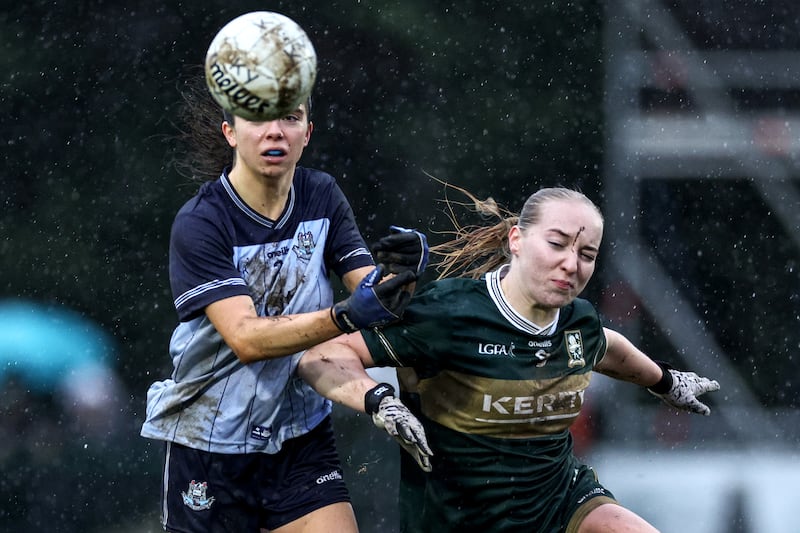 Dublin’s Niamh Crowley in action against Kerry’s Caoimhe Evans during last weekend’s NFL Division 1 fixture. Photograph: Andrew Conan/Inpho
Crowley is busy on several other fronts, the defender also playing O’Connor Cup football with DCU, where she’s studying for a master’s in post-primary teaching.
She featured in Dublin’s opening league defeat to Kerry last Saturday, the first to be played under the 12 new rule enhancements which, like those introduced in the men’s game last year, are designed to encourage faster, more open, higher-scoring games.
Six of the 12 changes mirror the FRC rules – including the two-point scoring arc, the solo-and-go, and mandatory three-up attacking. The other rules looking specifically at the women’s game, including the tackle, which intends to allow controlled contact with a player.
Dublin next take on rivals Meath in the league at Stamullen (Monday, 2pm – live on TG4). It’s a repeat of last year’s All-Ireland final, which Dublin won by 12 points, completing a rollercoaster of a season.
“We’ve been practising them for a while now,” says Crowley of the new rules, “but we’ll need another few weeks to get the grasp of it. I think we’ll see a faster game. We’ll see more of the players’ skills. It’ll be more physical.
“I think the main thing was the blanket defence, and I was a bit sceptical of the two-point arc, but we’ve seen it a few times in training, and it also gives you the incentive to go out and practice
“We’re all really excited. I know last year was quite successful, as in we achieved our end goal which was winning the Brendan Martin Cup. But it’s a new year, new squad, new rules.”
Crowley is also feeling a lot more comfortable about her place and role in the Dublin defence.
“When I first joined the squad in 2023, I’d say the whole entire year I experienced impostor syndrome. Every training session I was like, ‘God, what am I doing here?’ I thought I didn’t really have a clue what I was doing.”
She certainly does now.