
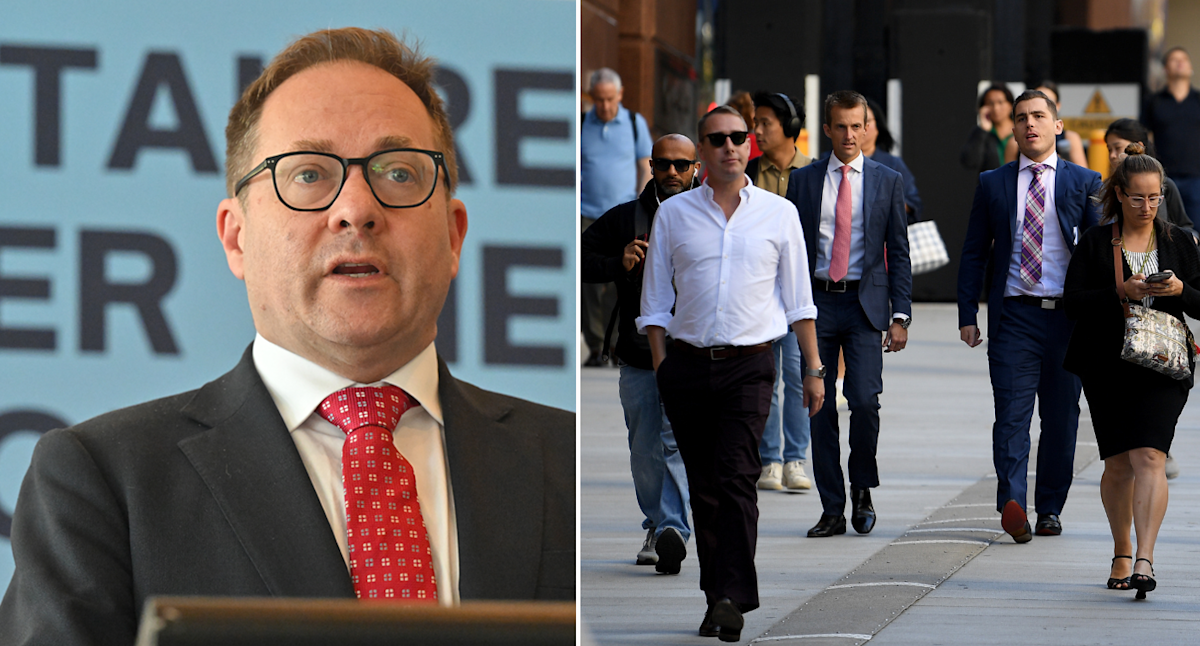
 Assistant Treasurer Daniel Mulino is reportedly eyeing new rules governing the movement of superannuation funds. (Source: AAP/Getty)
The federal government is considering introducing fresh guardrails to help prevent the hasty movement of workers’ large super balances to lesser known products and funds after the high profile collapse of two superannuation funds.
About 12,000 Aussies lost an estimated $1 billion when the First Guardian Master Fund and the Shield Master Fund collapsed in 2024. A battle subsequently erupted about how victims would be compensated, with the $4.3 trillion superannuation sector dragged into to help fund the payouts to victims of bad financial advice.
The federal government is requiring industry and retail super funds to chip in $47.3 million as a special levy this year to fill a shortfall in the funding for the Compensation Scheme of Last Resort (CSLR). It is the first time super funds, that oversee the retirement savings of ordinary workers, have had to contribute to the scheme which is funded by an annual levy on financial advisers, banks, other lenders, as well as stock and mortgage brokers.
RELATED
While some victims have already received compensation, the federal government is continuing to work through the issue and is reportedly consulting with the industry on a range of measures to better protect workers from being advised into risky funds.
“We want consumers to be protected from being pushed to make quick decisions before moving what are now large superannuation balances,” Assistant Treasurer Daniel Mulino told The Australian Financial Review this week.
“Finding ways to give them more time before switching their superannuation is critical to that.”
It is expected that transfers between major super products and well known, established funds could be exempt from the cooling off period.
Some early victim cases have been resolved by the Australian Financial Complaints Authority (AFCA), with those affected being compensated for the gains they missed out on had they stayed in their original fund.
In one case, a woman was awarded a total compensation of just over $196,000, which included the capital loss of $123,738 plus “the foregone return of $72,511.12 on the investment she exited” after she agreed to move her retirement savings into a self-managed super fund which was heavily invested in the now collapsed fund.
In an overview of the decision, the AFCA explained it calculated the loss “by comparing the financial outcome of the inappropriate advice with the estimated financial outcome of appropriate advice had the financial firm provided it.”
The lead decision will colour future compensation claims by complainants as many more are worked through this year. The lead ombudsman with AFCA, Shail Singh, explained the decision in a video published on Friday.
“The advisor didn’t properly inquire into their circumstances, didn’t explain the high risk investments they were being placed into and couldn’t show any benefits for switching their super, especially given the higher fees,” he said.
“Now that we’ve issued this lead decision … along with the other lead decisions relating to Shield and First Guardian, we can move more quickly and consistently through the remaining complaints,” he added. “This will help us provide timely, fair outcomes for impacted investors using the consistent approach set out in our lead decisions.”
The CEO of the country’s peak superannuation body ASFA last month described the decision to include APRA-regulated super funds in the Compensation Scheme of Last Resort as a “dangerous precedent”.
“It risks treating retirement savings as a convenient pot of money for solving problems, rather than keeping super focused on providing a dignified post-working life for Australia’s retirees,” ASFA CEO Mary Delahunty said.
Get the latest Yahoo Finance news – follow us on Facebook, LinkedIn and Instagram.