
Unlock the White House Watch newsletter for free
Your guide to what Trump’s second term means for Washington, business and the world
Marking the first anniversary of his return to the White House last week, Donald Trump boasted that his agenda was delivering for ordinary Americans. The US economy has grown rapidly, though the president’s falling approval ratings suggest many voters, grappling with affordability problems, feel otherwise. Workers’ share of GDP dropped to its lowest on record in the third quarter of 2025, indicating many of the economic gains are going into profits. Indeed, the clearest winners from Trump’s second administration appear to be those close to the president — in what increasingly resembles an “insider” economy.
Close ties between business and previous administrations have long fuelled a sense that America’s free market tilts towards well-connected elites. But this administration has normalised case-by-case dealmaking as a basis for policy and regulation. Under Trump’s transactional leadership, the returns to presidential access have rarely been higher.
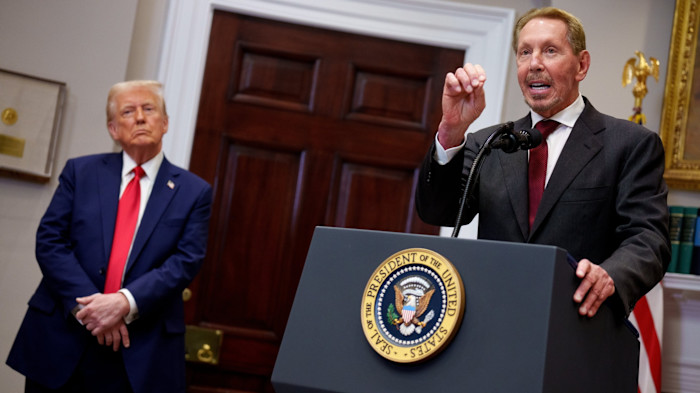
This insider economy takes several forms. Those on good terms with the president over time tend to be first in line for deals. A high-profile example is the agreement Trump helped to broker last week to split out the US operations of the short-video app, TikTok. Oracle — whose chair Larry Ellison has hosted Republican fundraisers and provided advice to Trump — garnered a key stake in the new US entity. The technology firm Palantir, whose co-founder Peter Thiel was an early Trump backer, has won a series of state contracts; its third-quarter US government revenues jumped 52 per cent year on year.
Others have found they need to scurry to placate the president to secure favourable treatment, or avoid his ire. Last August, the Apple boss Tim Cook boosted an existing pledge to invest in US manufacturing by $100bn, helping the iPhone producer to secure a carve-out from new tariffs. The Nvidia chief Jensen Huang in late 2025 finalised what is widely seen as a “pay-to-play” agreement, allowing his chipmaker to export its advanced H200 chips to China in return for a 25 per cent fee, despite concerns in US security circles. Months earlier, Nvidia’s struggling rival Intel allowed the US government to take a 10 per cent stake — shortly after Trump demanded the resignation of its CEO, Lip-Bu Tan, who remains in the post.
A third group to have benefited is the Trump clan itself. The president and his relatives have received more than $1.8bn in crypto gains and gifts since the 2024 election, according to estimates from the Center for American Progress. A light-touch approach to regulation has boosted the value of the Trumps’ digital asset holdings through their crypto ventures.
The president appears to envy Chinese economic interventionism — but in China, the authorities tend to set the parameters and allow companies to compete vigorously. The overt US turn towards favouritism and quid pro quo governance risks undermining US economic foundations by reshaping incentives across markets and regulation. When capital flows primarily to those with access and connections, competition becomes distorted, inequality deepens and policymaking weakens. The most productive or innovative businesses could get sidelined.
Trump has turned his attention to affordability ahead of this year’s midterm elections, with measures intended to reduce housing costs and credit card interest rates. Here, too, however, the instinct is one of direct intervention, often with specific companies. It is too early to know if this shift will become permanent. In the near term, those best positioned to ingratiate themselves with Trump will benefit handsomely. But, the longer the insider economy endures, the more it will sap the competitive motor and openness on which US economic success has been built.