
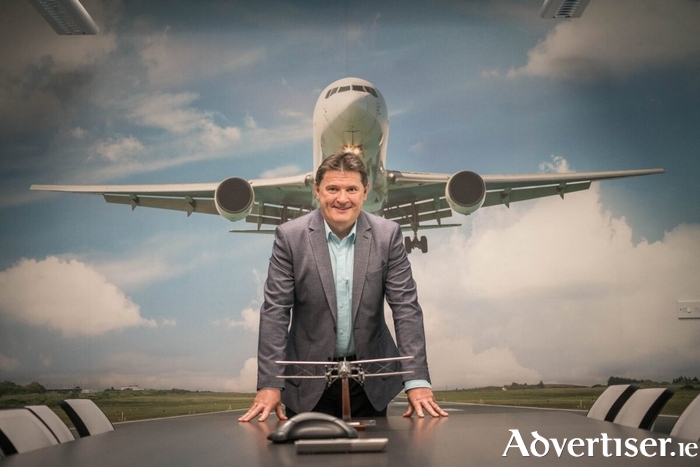
There is something quietly reassuring about Ireland West Airport Knock. For all its growth, its international reach and its record-breaking numbers, it remains an airport that feels human in scale and familiar in spirit. It is a place where journeys begin without stress, where arrivals are met with relief rather than exhaustion, and where the act of travel still carries a sense of possibility. As the airport celebrates its 40th anniversary in 2026, that balance between success and simplicity has never been more important.
Claremorris native Joe Gilmore, Managing Director of Ireland West Airport Knock, reflects on a year that surpassed even the airport’s own optimistic expectations. Passenger numbers reached 946,381 in 2025, making it the busiest year in the airport’s history and positioning it as Ireland’s fastest-growing airport.
“We knew we were looking at growth,” Joe says, “but we didn’t expect the demand to be as strong as it was. The additional capacity put on by Ryanair in particular, across UK and European routes, was met with an incredible response. UK traffic was up 10%, European routes up 28%, and overall growth was more than 13%. That tells you something very important about how people want to travel.”
What it tells him, he explains, is that people are increasingly choosing airports like Knock because they value convenience, proximity and ease. In a world of congestion and complexity, Ireland West Airport offers something refreshingly straightforward.
“People want to avoid the bigger, more congested airports if they can,” he says. “If they can get the flight, and if the price is right, they’ll choose an airport like this every time. It’s not rocket science. It’s about making travel easy.”
But the story of the airport’s success goes far beyond numbers. At its heart is a deeper shift in how people see their lives and their time. Joe believes that attitudes to travel have changed permanently since the pandemic.
“I thought after Covid there would be a bounce and then it would pull back,” he says. “But it hasn’t. People’s perspectives have changed. They value leisure time as much as work time now. If they have the means, they’re trying to travel more, to take breaks, to experience life. Travel has moved right up the agenda.”
Ireland West Airport Knock has become a facilitator of that shift – a gateway not just to destinations, but to the idea that life is meant to be lived as well as worked. From short breaks to Spain or Portugal, to winter sun in the Canaries, to quick hops across the Irish Sea, the airport has opened up opportunities that once felt out of reach for many in the west and northwest.
And yet, despite serving 21 international destinations and working with three major European airlines, the experience remains remarkably personal. One of the airport’s greatest strengths, Joe notes, is the ease of moving through it.
“You can arrive, sit down for a coffee or breakfast, check in a few minutes later, and be through the airport without hassle,” he says. “That’s something people really value. Our own research shows that 91% of passengers choose Knock because of the convenience of the location.”
That sense of ease extends to the moment people return home.
“When they land back here, they’re straight out,” Joe says. “No navigating motorways or queues or long journeys after a flight. That relief when you arrive home – that’s a huge part of the experience.”
Recent investments, including the new sheltered passenger walkway and covered aircraft steps, have enhanced comfort without compromising the airport’s character.
“We’re still flying from the top of a mountain in the west of Ireland,” Joe smiles. “The sun doesn’t always shine. The walkway works as a sunshade when it does, and shelter when it doesn’t. The feedback has been very positive. These are practical improvements that make a real difference.”
As the airport marks 40 years since its official opening in May 1986, it is impossible to reflect on its journey without acknowledging the vision of Monsignor James Horan. His determination to build an airport in the west transformed not only regional connectivity but the emotional landscape of emigration and return.
“The biggest contribution the airport has made,” Joe says, “has been to the diaspora, particularly to the UK. People take it for granted now, but it has been life-changing.”
He recalls a time when travel between the west of Ireland and Britain involved long, expensive, exhausting journeys.
“It could have cost three or four hundred pounds. Buses, trains, boats – it was a nightmare. Now people can fly over for a weekend. They can come home for family events, for work, for whatever they need. That has changed everything.”
The airport has altered the very nature of emigration. Where once departures were marked by tears and the fear of long separation, today many people commute weekly or fortnightly between Mayo, Galway and the UK.
“We have people who use the airport every week for work,” Joe says. “They have cars parked here year-round. They’re back on a Thursday or a Sunday, managing businesses in the UK while living here. It’s a completely different model of migration.”
This seamless connectivity has strengthened families, sustained rural communities and supported economic life on both sides of the Irish Sea. London remains the airport’s largest market, followed closely by other major UK cities such as Manchester, Birmingham, Liverpool and Edinburgh.
“We’re deeply connected to those population centres,” Joe explains. “Business, tourism, family life – it all flows through those routes.”
While the airport’s roots are firmly in Mayo, its reach extends across the wider west. Joe is consistently generous in acknowledging the support of Galway City and County Councils, both shareholders in the airport, and the wider Galway business and civic community.
“Galway has always been incredibly supportive,” he says. “The local authorities, Galway Chamber, the media – they all recognise the airport as part of the region’s transport infrastructure. It supports jobs, tourism and enterprise, not just in Mayo, but right across Connacht.”
That regional mindset will be crucial as the airport looks ahead to the next decade. Passenger numbers are expected to exceed 950,000 in 2026, edging closer to the one-million mark, with additional capacity planned on key routes.
At the same time, the airport continues to invest in sustainability, safety and community engagement. Almost €8 million was invested in infrastructure in 2025, including the commencement of a new 1.5MW solar farm and the maintenance of Level 3 ‘Optimisation’ accreditation for CO? reduction.
Community remains central. In 2025, airport staff raised a record €54,000 for six local charities, a reflection of an organisation that sees itself as part of the social fabric of the west.
The 40th anniversary celebrations will reflect that sense of gratitude and belonging. A major public gala event is planned for May 28, marking the exact date of the airport’s official opening, with music, remembrance and celebration.
“We want to acknowledge where the airport came from and the people who made it happen,” Joe says. “That’s really important to us.”
There will also be events aimed at the diaspora, particularly in the UK, recognising those for whom the airport has been a constant presence in their lives for decades.
As Ireland West Airport Knock enters its fifth decade, its success is measured not just in passenger numbers or destinations, but in moments: a family reunited, a commuter heading home, a first holiday taken, a life made broader by the freedom to travel.
In staying true to Monsignor Horan’s vision – connection, accessibility and humanity – the airport has achieved something rare. It has grown without losing its soul.