
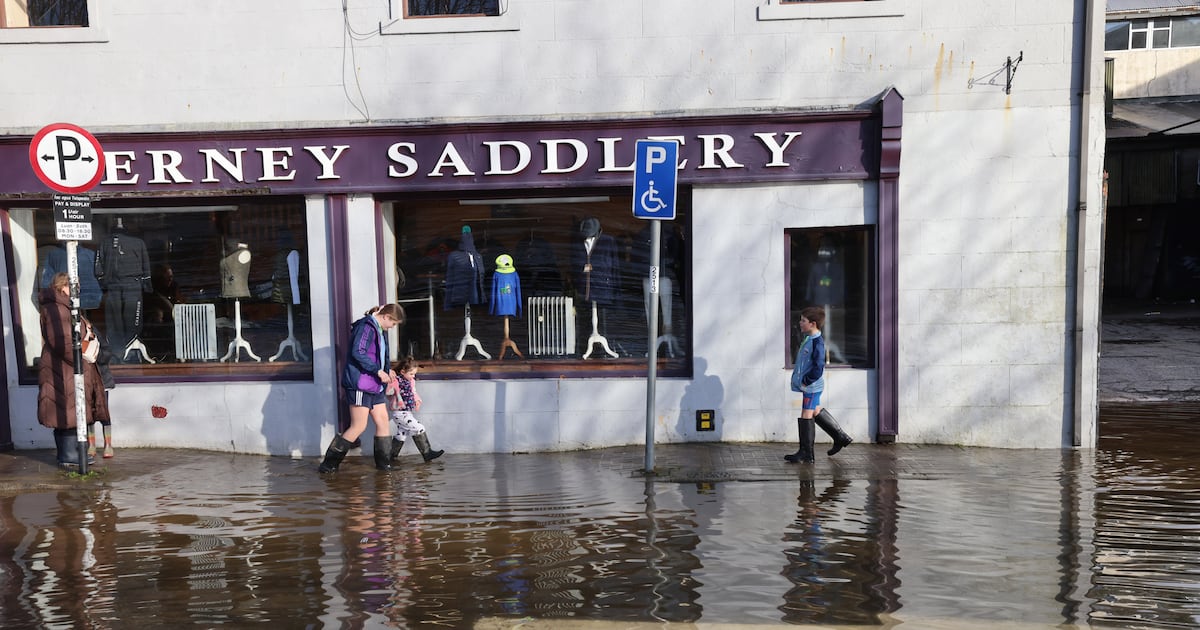
Communities in the south and east of the State already hit by heavy flooding are bracing for more heavy rain over the coming days.
A status yellow weather warning is due to take effect for Wexford, Wicklow, Waterford, Carlow, Dublin and Kilkenny, all counties already badly affected by flooding from Storm Chandra.
The warning is in place for all day Thursday.
Met Éireann is forecasting more rain on Friday with localised flooding in places where the ground is already saturated.
There could be between 40mm and 50mm of rain on higher ground on the Wicklow and Blackstairs mountains with low-lying places getting between 25mm and 35mm of rain.
Enniscorthy remains the worst-affected town, with mounting anger that a local flood-defence scheme, first proposed in 2010, has not been built.
Wexford-based Fine Gael senator Cathal Byrne said it was “simply unacceptable that we are still awaiting planning permission never mind construction on this project after years of delays”.
The levels of the Slaney river dropped on Wednesday, allowing business and homeowners to assess the damage.
Minister for Housing James Browne criticised Met Éireann for its communication before Storm Chandra hit. Mr Browne, whose Wexford constituency was worst affected by the storm, said Met Éireann would be brought before an Oireachtas committee to explain its messaging ahead of the storm.
“I think we will be bringing Met Éireann in and saying that there needs to be an understanding here that information is not to be guarded. Information is to be put out there and we need to do a much better job of communication,” the Enniscorthy TD said on South East Radio.
He said he had asked the forecaster to look at how it determines its yellow, orange and red warnings.
“It’s based on a mathematical formula, whereas in other countries they use the mathematical formula but then they also make a judgment call,” said Mr Browne, adding that there needs to be “a greater use of that judgment call”.
Met Éireann said it was focused on its role of monitoring, analysing and predicting Ireland’s weather, climate and flooding, and supporting emergency planning responses to weather events such as Storm Chandra.
“As such, our services, operations and engagement with all stakeholders are always evolving to meet current and future needs.”
Mr Browne’s comments drew criticism from Opposition TDs, with Labour’s climate spokesman Ciarán Ahern saying Mr Browne had attempted to shirk blame for communication failures ahead of Storm Chandra.
Mr Ahern described the comments as “extraordinary” and aimed to “distract and deflect” from the Government’s failure to prepare properly for extreme weather events.
“The failure lies clearly at the Government’s door. We don’t have a national flood warning system in place, a glaring oversight in the face of worsening storms and rising sea levels,” he said.
Minister for Transport and Climate Darragh O’Brien has warned that work on flood-relief and storm-mitigation measures “will never be completed”.
Mr O’Brien told RTÉ that there was a need for continued investment in “adaptation-mitigation measures”.
“I think that the flood forecasting, particularly around our rivers, is something that does need to be deployed sooner. I have seen preliminary work on that over the last year or two … It should be deployed sooner, much sooner rather than later and I wouldn’t accept that it would take a further 10 years.”
The Department of Social Protection has announced that the emergency response payment is now available to provide support to people living in properties directly affected by Storm Chandra.
National Emergency Co-ordination Group director Keith Leonard said immediate needs repayments would be made to those affected by flooding.
“It will also provide for the replacement of white goods and, where people aren’t insured, it will provide for structural repair as well,” he said.