
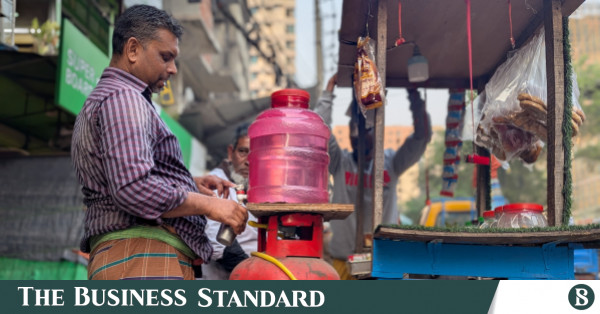
Mohammad Nur Alam runs a small tea stall at Hatirpool market. Two similar stalls operate right beside his one. Each of them requires at least three LPG cylinders every month. Yet in six years of running the business, they say they have never seen a situation like this — within just three weeks, prices of gas cylinders have nearly doubled.
The ongoing gas shortage has pushed small business owners like Nur Alam into severe difficulty. On the one hand, they are being forced to purchase gas at inflated prices; on the other hand, there is no assurance of getting cylinders when needed.
Amid the uncertainty, many have had to shut their shops repeatedly. Some, meanwhile, are being compelled to look for alternative sources of fuel.

Keep updated, follow The Business Standard’s Google news channel
Just a month ago, a 12kg LPG cylinder was priced at Tk1,250. Last week, Nur Alam had to pay Tk2,200 for a cylinder of the same capacity. By his calculation, a single cylinder now consumes nearly two days’ worth of profits.
When asked about the state of his business, he could not conceal his frustration and despair. “I’m paying the price of two cylinders to buy one,” he said. “When prices go up, it’s we who bear the losses. A rise of Tk100 or Tk200 would have been understandable, but how am I supposed to run my business if I have to pay Tk1,000 more for gas?”
Just a month ago, Mohammad Russell started a fast-food business from a food cart at the capital’s Kathalbagan. Though he began the venture with big dreams, he has already been dealt an early setback. In search of gas, he went around Hatirpool, Moghbazar and Karwan Bazar, but could not find a single cylinder anywhere.
“I went to many places hoping to get it at a lower price. Everywhere I was told there was no gas. Even where it was available, the price was high, and they kept asking me to wait,” Russell said. “In the end, I managed to buy a cylinder for Tk1,800 through an acquaintance. For now, I’m somehow managing to keep things running.”
Other food vendors operating beside footpaths are facing somewhat the same situation. Tea seller Mohammad Dulal at Karwan Bazar; Manik Mia, who runs a food stall at Chankharpul; and Billal Bepari, a haleem vendor in Kathalbagan, all tell a similar story — rising gas prices have sharply eroded their profits.
Adding to the strain is the uncertainty over whether gas will be available at all in the coming days. Without a steady supply, they fear their businesses could be thrown into jeopardy.
If prolonged, burden will shift to ordinary consumers
A group of friends jointly run a small tea stall, which is more of a passion project, at Hakim Chattar of Dhaka University. The ongoing gas shortage has left them struggling as well; on one occasion, they were even forced to keep the shop closed for a day. They later purchased a 12kg LPG cylinder for Tk2,400 from Anandabazar.
Although they have not raised food prices yet, the stall’s entrepreneurs say they will have little choice if the crisis drags on. “If the situation continues like this, we will have to increase prices, at least to some extent,” said Miraz Hossain, one of the founders.
In the Hatirpool area, Mohammad Joni needs nearly 30 gas cylinders a month across his two shops. By his calculations, profits are shrinking day by day. “We don’t want to raise prices. If food costs go up, people won’t buy it. But when the cost of gas eats up all the profit, you have no choice,” he said.
Meanwhile, reports have emerged of tea prices rising in some Dhaka University residential halls. At the same time, Mohammad Monsur, who recently opened a tea stall in Kathalbagan, has yet to buy a gas stove. He had planned to purchase one this month, but it has not been possible. For now, he is brewing tea using a clay stove and firewood, and he is also considering raising prices.
At present, the main pressure is on small business owners. However, everyone agrees that if the crisis persists, ordinary consumers will eventually feel the pinch as well. They fear the effects of this gas shortage will gradually become visible in the simple cup of tea that people drink every day.
What gas distributors are saying
One of the major LPG distributors in the Hatirpool–Bata Signal area is Anan Enterprise. But due to the supply crunch, cylinders are no longer available at the usual prices. The company’s manager, Mohammad Ashraf, said they now have to sell gas at significantly higher rates.
He explained that although the government-set price for a 12kg LPG cylinder is Tk1,306, no company is supplying cylinders at that rate.
“Even if we buy stock, no company issues a money receipt. We have to return cylinders to our regular customers because there is no gas anywhere. Previously, a truck used to deliver 280 cylinders; now, for the same transport cost, we get only 120,” Ashraf said.
According to him, even if empty cylinders pile up at the shop, no company is currently providing refills.
The crisis is not limited to the retail level; it has become acute in the wholesale market as well. Mohammad Monir, manager of Messrs Janata Traders, a wholesale supplier in Karwan Bazar, told TBS, “We need 300 cylinders daily. But some days we get only 50, some days 70, and other days 100. This is hitting our business hard.”
Asked why prices are so high, Monir said they are selling 12kg cylinders at Tk1,450 at the wholesale level. Retailers across various areas source their cylinders from these supplies. However, he alleged that many retailers are taking advantage of the shortage to sell cylinders at inflated prices.
He added that the situation has reached a point where orders now have to be placed two to three days in advance. Only then is it possible to deliver cylinders, in limited quantities, to customers.
However, many customers are unwilling to take the distributors’ and wholesalers’ statements at face value. They allege that a powerful syndicate in the LPG market deliberately creates an artificial shortage.
Tea seller Nur Islam said that even under normal circumstances, supply is manipulated to push up prices. And when a real shortage occurs, the cycle worsens, driven by the hope of extra profit. “How does gas suddenly vanish like this? They say there’s no stock, but if you pay more, it’s available,” he said.
When will the crisis ease?
“We are being told that the situation will not improve before the elections. The companies say stock is on the way, but in reality, it never arrives. I can’t say when things will get back to normal,” said Mohammad Monir.
Meanwhile, LPG operators have announced plans to import large quantities of gas in January and February. According to industry sources and media reports, 12 companies involved in the LPG business have collectively pledged to import 167,600 tonnes in January and 184,100 tonnes in February. Stakeholders hope that this additional supply will gradually ease the shortage and help stabilise prices to some extent.
The government has also signaled active steps to address the LPG crisis. Ahead of the national elections and the upcoming Ramadan, the energy adviser has directed all relevant parties to make every effort to ensure there is no shortage of LPG.
He stated that the import commitments made by operators for January and February must be realised, and that the government will provide all necessary support to make this happen.
Measures have also been decided to resolve financial hurdles in LPG imports. The energy division will instruct Bangladesh Bank not to impose any limits on LPG imports. At the same time, operators and relevant departments have been given guidance on how to expedite imports to meet market demand.
Meanwhile, the interim government has drafted the Energy and Power Sector Master Plan 2025, a new 25-year strategy. The plan’s main objectives are to reduce import dependence, increase domestic gas exploration, and prioritise sustainable green energy.
Small business owners and ordinary consumers are hopeful that these multi-pronged government measures will gradually boost supply in the market. At the same time, there is broad optimism that the long-term plan will have a positive impact on the LPG sector.