
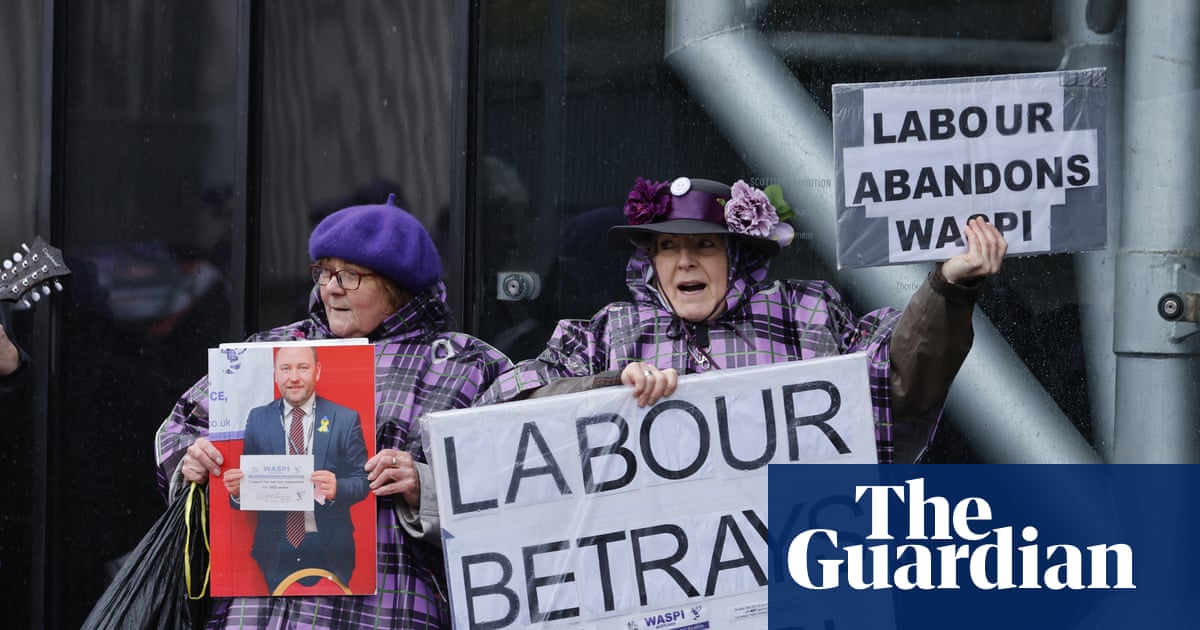
Millions of “Waspi women” will not receive any compensation, the government has again decided in its latest ruling on the case – but campaigners say they will fight on to secure the justice they say they have been “shamefully denied”.
As many as 3.6 million women born in the 1950s are said to have lost out because of government failings in the way changes to the state pension age were made, prompting the launch in 2015 of the Waspi (Women Against State Pension Inequality) campaign.
Just over a year ago, ministers prompted an outcry when they said they were denying compensation to any of the women in this category, despite the Parliamentary and Health Service Ombudsman (PHSO) having ruled in March 2024 that those affected should be compensated.
Then in November last year, just weeks before a potentially bruising high court legal challenge was due to begin, those affected were given fresh hope that they might receive payouts when the government said it would reconsider the decision.
However, the work and pensions secretary, Pat McFadden, announced that after reviewing the evidence, the government had come to the same conclusion as in December 2024, and none of those affected would get a payout.
He said a flat-rate compensation scheme that paid out to all women born in the 1950s would cost up to £10.3bn and “would simply not be right or fair”, as most of the women had been aware of the pension changes. He argued “it would not be practical” to set up a targeted scheme identifying only those who suffered injustice.
The number of individuals affected by the pension age changes could be up to 3.6 million if every woman born in the 1950s and the first three months of 1960 were included.
Campaigners claim this group had their retirement plans “plunged into chaos”, with many left thousands of pounds out of pocket, after the Department for Work and Pensions (DWP) increased the state pension age from 60 to 65, and then to 66.
Angela Madden, the chair of Waspi, said the group was now taking legal advice and “all options remain on the table. We stand ready to pursue every avenue in parliament and in the courts to secure the justice that has been so shamefully denied.”
The two-day high court hearing planned for December last year was called off to allow the original decision to be reviewed, and Waspi will now consider bringing a new legal case based on the latest decision.
Madden added: “Ministers have demonstrated their utter contempt for 1950s-born women, for parliament and for the parliamentary ombudsman. The government has kicked the can down the road for months, only to arrive at exactly the same conclusion it has always wanted to.
“This is a disgraceful political choice by a small group of very powerful people who have decided the harm and injustice suffered by millions of ordinary women simply does not matter.”
For decades the state pension age for women was 60. An increase to 65 to match that of men – phased in between 2010 and 2020 – was included in 1995 legislation, but in 2011 the coalition government sped up the process. As a result, the state pension age for women increased to 65 by November 2018 and to 66 by October 2020.
Waspi and others have claimed for years that large numbers of older women were penalised financially as a result and are now struggling with living costs because of the way the decision to raise the state pension age was made.
Many said they had always expected to receive their pension at 60 and had made their financial plans on that basis. Some said they discovered their state pension age had increased by several years only after giving up work.