
Key Takeaways
Argonne researchers used the Argonne Tandem Hall Laser Beamline for Atom and Ion Spectroscopy (ATLANTIS) apparatus to make precise measurements of unstable ruthenium nuclei.These findings are a significant milestone in nuclear physics because they help validate sophisticated models that can advance our understanding of nuclear properties and the early universe.Innovative technologies and techniques at Argonne, including collinear laser spectroscopy, enable accurate studies of rare isotopes. These advancements pave the way for future collaborations and groundbreaking discoveries.
A novel apparatus at the U.S. Department of Energy’s (DOE) Argonne National Laboratory has made extremely precise measurements of unstable ruthenium nuclei. The measurements are a significant milestone in nuclear physics because they closely match predictions made by sophisticated nuclear models.
“It’s very difficult for theoretical models to predict the properties of complex, unstable nuclei,” said Bernhard Maass, an assistant physicist at Argonne and the study’s lead author. “We have demonstrated that a class of advanced models can do this accurately. Our results help to validate the models.”
Validating the models can build trust in their predictions about astrophysical processes. These include the formation, evolution and explosions of stars where elements are created.
The study was published in Physical Review Letters.
A need to validate theoretical models
Nuclear physicists are developing more advanced theoretical models to precisely predict the properties of unstable atomic nuclei with complicated structures, shapes and forces. Such models have potential to deepen our understanding of the inner workings of atomic nuclei.
However, it is essential to demonstrate the accuracy of these models before they can be used to push the frontiers of science. This requires the difficult task of collecting precise, real-world measurements of complex nuclei and comparing the measurements with the models’ predictions.
Ruthenium is an ideal element to validate advanced theoretical models. This rare metal has isotopes — atoms of the same element with a different number of neutrons and varying stability — known to have nuclei with complex structures and shapes. There are a series of unstable, radioactive ruthenium isotopes believed to have a triaxial shape, similar to an almond or coffee bean.
Measuring the properties of ruthenium
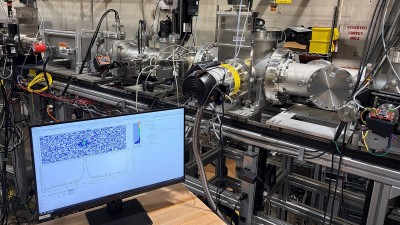
The research team used the Argonne Tandem Hall Laser Beamline for Atom and Ion Spectroscopy (ATLANTIS) apparatus to measure nine radioactive ruthenium isotopes. This new device was recently installed at the Argonne Tandem Linac Accelerator System (ATLAS). ATLAS is a DOE user facility at Argonne with a superconducting linear accelerator designed to study the properties of nuclei.
The researchers gained access to radioactive ruthenium isotopes from another ATLAS instrument, the Californium Rare Isotope Breeder Upgrade (CARIBU). CARIBU can deliver radioactive ruthenium through fission of a small amount of californium — a rare, highly radioactive element.
“The ruthenium isotopes that we studied last only a second before decaying into other elements,” said Maass. “ATLANTIS performs a technique called collinear laser spectroscopy. It allows us to collect measurements on very small amounts of these isotopes in less than a second.”
Using ATLANTIS, the researchers directed a laser beam along the same path as a beam of ruthenium atoms. At certain laser frequencies, the atoms were excited and started to fluoresce, indicating that light photons were emitted. The team identified the laser frequencies at which photon emissions peaked. This process was repeated for the nine ruthenium isotopes. For each isotope, the emission peak shifted to a slightly different frequency.
“We can use this isotope shift to derive the differences in the isotopes’ nuclear sizes,” said Maass.
The team compared these size changes with predictions from Brussels-Skyrme-on-a-Grid (BSkG) models, which are among the world’s most advanced for nuclear structure. Unlike older, traditional nuclear models, they account for the specific forces and interactions among all the neutrons and protons in a nucleus.
The researchers found excellent agreement between their results and predictions from BSkG models, pointing to the models’ robustness.
Notably, in trying to enable precise measurements, the team also advanced collinear laser spectroscopy technology. Specifically, they developed and implemented effective new techniques that neutralize the atom beam and “bunch” it into pulses.
Implications for astrophysics
The study showed that BSkG models can make predictions of unstable, triaxial nuclei with remarkable accuracy. Such powerful models may help astrophysicists shed light on how the universe works.
“Astrophysicists know that unstable, radioactive nuclei play an important role in the formation of stars and elements in the universe,” said Maass. “To better understand our universe, we need to know how nuclei are structured and how they interact. We need to be able to predict properties of exotic nuclei that cannot be produced in modern particle accelerators.”
Three of the study’s authors developed the BSkG models: Wouter Ryssens and Guilherme Grams, both from the Université libre de Bruxelles in Belgium, and Michael Bender from the Institut de Physique des 2 Infinis de Lyon in France.
In addition to Maass, Ryssens, Grams and Bender, the experiments and construction of ATLANTIS were a collaboration among researchers from Argonne (Daniel Burdette, Jason Clark, Peter Mueller, Daniel Santiago-Gonzalez, Guy Savard and Adrian Valverde), the Technical University of Darmstadt in Germany and the Facility for Rare Isotope Beams at Michigan State University.
The research was supported by the German Research Foundation, DOE’s Office of Nuclear Physics and Office of Science, the German Federal Ministry for Education and Research, Fonds de la Recherche Scientifique and Fonds Wetenschappelijk Onderzoek–Vlaanderen.
ATLANTIS is available for collaborating institutions to perform collinear laser spectroscopy measurements for a variety of research needs. To explore collaboration opportunities, contact Maass.
Argonne Tandem Linac Accelerator System
This material is based upon work supported by the U.S. Department of Energy (DOE), Office of Science, Office of Nuclear Physics, under contract number DE‐AC02‐06CH11357. This research used resources of the Argonne Tandem Linac Accelerator System (ATLAS), a DOE Office of Science User Facility.
Argonne National Laboratory seeks solutions to pressing national problems in science and technology by conducting leading-edge basic and applied research in virtually every scientific discipline. Argonne is managed by UChicago Argonne, LLC for the U.S. Department of Energy’s Office of Science.
The U.S. Department of Energy’s Office of Science is the single largest supporter of basic research in the physical sciences in the United States and is working to address some of the most pressing challenges of our time. For more information, visit https://energy.gov/science.