
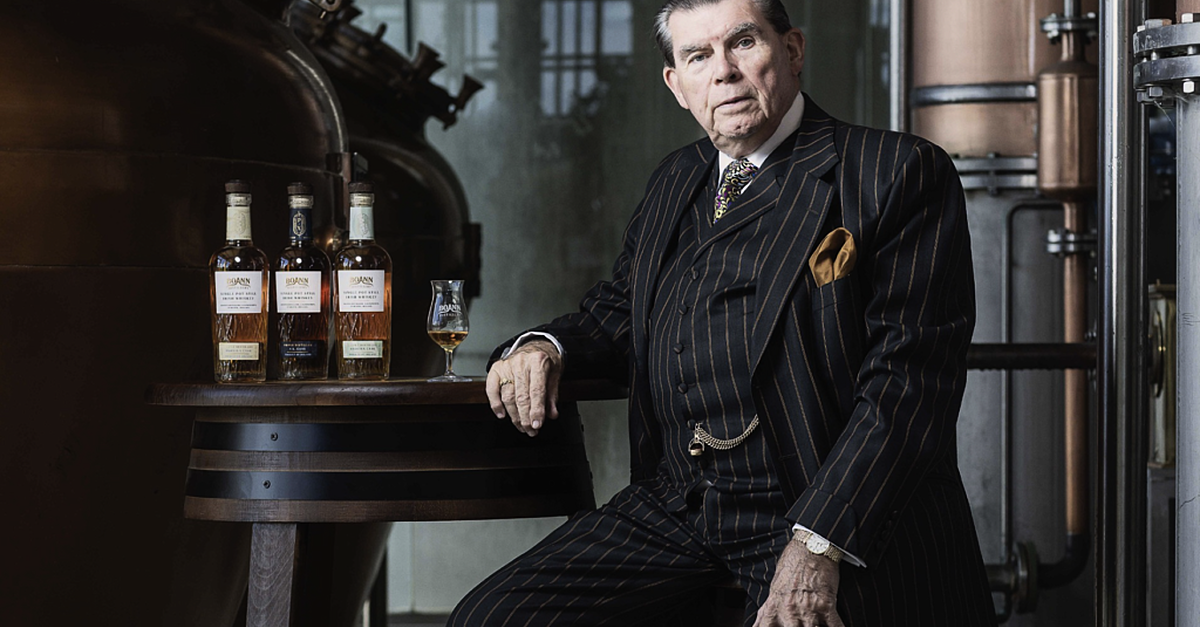
In the heart of the Boyne Valley, where Ireland’s ancient history meets some of its most fertile farmland, the Cooney family is quietly building one of the country’s most ambitious whiskey businesses.
Behind the glass façade of a converted car showroom in Drogheda — now home to Boann Distillery, and possibly the only distillery in the world with a marble floor — copper stills hum, casks rest in oak-lined warehouses, and two generations of one family are working side by side.
For founder Pat Cooney, the distillery is not a late-life hobby or vanity project. It is the culmination of more than 50 years in the drinks trade — and a carefully calculated bet on premium Irish whiskey finding drinkers far beyond Ireland’s shores.
Long before Boann, Cooney spent decades growing the Gleeson Group from a small bottler into a major drinks and distribution business. Over 35 years it became Ireland’s largest wine importer and a major player in cider, soft drinks and liqueurs, with a nationwide logistics network.
“I always wanted to go into business on my own,” says Cooney. “My brother and I bought a small wholesale operation in Tipperary and built it over 35 years into a €300 million drinks and distribution business with over 750 people.
“We were the biggest wine importer, made cider, soft drinks, cream liqueurs, and ran ten depots with 150 trucks. Eventually we sold it in 2013. I kept the export-focused parts, including a cream liqueur company, and then finally did what I’d always wanted to do — build a distillery.”
A Family Operation
Boann is a family operation in the truest sense. Pat and his wife Marie run the company alongside their children — Sally-Anne, Celestine, Peter, Patrick and James — whose roles span sales, hospitality, finance and production. Even the family farm feeds into the brand: Marie keeps bees and manages orchards that supply honey for the distillery’s award-winning honey liqueur.
Unlike many new Irish distilleries chasing scale, Boann has positioned itself firmly at the craft, super-premium end of the market. Its distinctive nano-copper pot stills and oak cask warehouses are designed to prioritise character over quantity. The focus is Irish pot still whiskey — the historic, spice-led style once synonymous with Ireland.
“When Irish whiskey had 75% of the world market, it was pot still,” Cooney says. “Then the industry nearly disappeared. Most new distilleries today are malt. We wanted to do something different. We make malt here as well. A pot still distillery can do malt, but a malt distillery can’t do pot still. I’m really a pot still fan.”
Working with whiskey historian Fionnán O’Connor, the team has revived old mash bills from long-lost distilleries. Recipes often use five grains — malt, green barley, oats, wheat and rye — sometimes tailored to individual casks.
The approach has delivered promising early results. Though only distilling for a few years, Boann has already collected international awards, including Double Gold and 99 points at the San Francisco World Spirits Competition for a PX-aged pot still release.
International Ambition
“We’re not trying to make mass whiskey,” Cooney says. “It has to be quality, super-premium and have a story.”
Craft, however, is only half the equation. Cooney’s decades in distribution have shaped a clear-eyed export strategy. From the outset, Boann was built for international markets. Today it ships to 67 markets — from obvious destinations to less conventional ones such as Mongolia, Kazakhstan and Suriname — with a target of 100 by 2027.
“Getting into a market is half the battle,” says Cooney. “There are legal requirements, health certificates, labelling rules, bureaucracy — every country is different. There’s always a learning curve. But once you’re in, you get to understand it, and you can build from there.”
That global diversification wasn’t just ambition — it was risk management. Political shifts and tariffs can quickly unsettle even established markets. The US, long central to Irish whiskey growth, has become less predictable.
“The US has become a difficult place to do business because of tariffs and uncertainty. When Mr. Trump came in, tariffs moved all over the place — 10%, then 25%, then back down. Alcohol never got the zero-zero deal that was talked about. It just made exporting harder and more unpredictable.
“So we’ve had to find new partners, and India is hugely important in that context. It’s the biggest whisky market in the world — about 400 million cases. That’s four times the size of the entire Scotch industry.”
‘Absolutely Huge’
Until now, however, a 150% tariff has effectively locked most Irish producers out, making imported whiskey several times more expensive than local alternatives.
The proposed EU–India trade agreement could change that dramatically, cutting tariffs first to 75% and potentially to 40%.
“India has 1.4 billion people and around 600 million middle- and upper-middle-class consumers with serious spending power. If tariffs come down to realistic levels, we can compete on price while offering superior quality.
“Because the market is so big, even a tiny share becomes a large export opportunity for us. It could transform volumes for Irish producers very quickly.
Cooney adds, “For Irish whiskey, it’s huge. Absolutely huge.”
The Long Game
Whiskey, of course, demands patience. Spirit laid down today may not generate revenue for years, tying up millions in maturing stock. Boann currently sells some casks to fund that cycle, adding €4–5 million worth of inventory annually.
I ask Cooney how Boann Distillery balances scaling internationally while protecting the craft credentials of the brand. “It’s not really a conflict because we’re not chasing mass volume — we’re chasing quality,” says Cooney.
“Our main brands, of course, are Boann, Sigelage, Patisil Whiskey and the Whistler range. Beyond that, we produce a wide portfolio of cream liqueurs, as well as our honey liqueur, so it keeps us very busy. We’re constantly innovating and bringing new ideas to the table.
“I’m fortunate to have a fantastic team, both here and in Clonmel, where our bottling plant is based. That support is crucial — no business succeeds without a strong team behind it. Having the family involved as well makes the journey doubly rewarding.”
Success Is Straightforward
Success, Cooney says, is straightforward. “Selling all the whiskey we make. If we get to the stage where we don’t need to sell casks and everything goes out as bottled whiskey, I’d be a very happy man.”
After half a century in business, Cooney remains energised rather than reflective. “The best decision I ever made was going into business for myself,” he says. “Once you cross that threshold, there’s no going back. You either move forward or you’re out. I’ve been running my own businesses since 1974, so over 50 years now. It hasn’t been easy, but it’s incredibly satisfying.”
I ask him what he likes to do when he is not working. “I play a bit of golf, drink a bit of wine and whiskey, and meet friends. I’m actually off to South Africa on holiday — we’ve had a house there for years. It’s sunny, there’s no time difference, and the food and wine are great.”
For some reason, however, I don’t get the impression that Cooney will be retiring into the sunshine anytime soon.
“It’s like riding a bike down a hill,” he says laughing. “You can’t take your hands off the handlebars. But it’s enjoyable. You get great satisfaction out of it.”
In the Boyne Valley, that satisfaction is now aging quietly in thousands of oak casks — waiting to take on the world.