
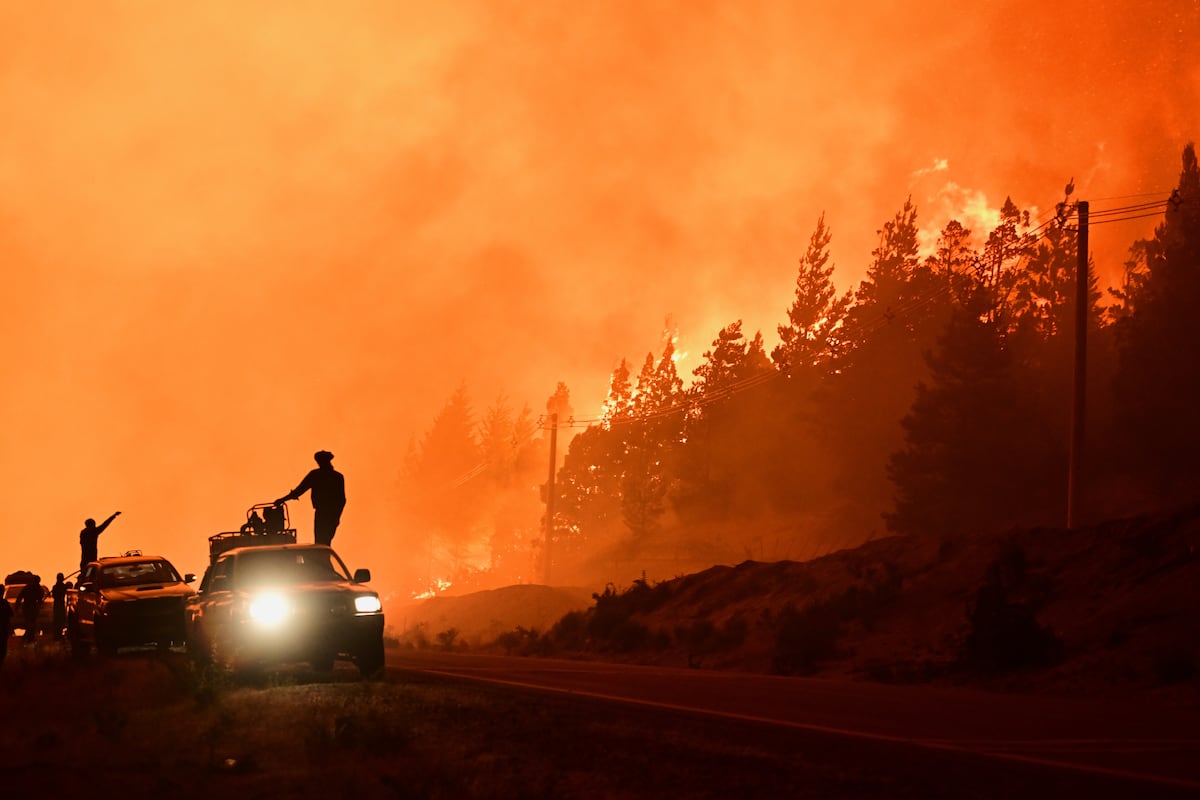
The fires that began in early January and appeared to be contained in the province of Chubut, in Argentine Patagonia, have reignited in recent days and are advancing rapidly through native forests, plantations, and peri-urban areas. The town of Cholila, in the northwest of the province and just over 1,000 miles from Buenos Aires, is surrounded by fire: it is besieged to the south by the blaze that started in Los Alerces National Park and to the north by the one that began in Puerto Patriada. This situation has led to road closures and a state of high alert among residents, who have organized themselves into volunteer brigades to defend their homes.
On January 15, the governor of Chubut, Ignacio Torres, announced that the fires were “contained” after two days of rain that were crucial in suppressing the flames. However, subsequent weather conditions reignited the blazes: the rain stopped, and there were days on which temperatures exceeded 30 degrees Celsius, accompanied by strong winds.
“Today the fire is behaving violently, advancing at an enormous rate, increasing the area burned by more than 50% since the initial outbreak,” notes Mariano Amoroso of the Institute for Research on Natural Resources, Agroecology, and Rural Development (IRAD), speaking from the area. “While there are no official figures and it’s difficult to estimate from the images alone, it’s estimated to be at least 35,000 hectares. That’s a huge amount for a single year and a summer season that’s only halfway through,” he adds. This is the most-damaging blaze in at least the last six summers, more than doubling (130%) the nearly 15,400 hectares burned in the previous record.
“Right now, Cholila is completely surrounded. The national government isn’t providing resources, and the official firefighters are overwhelmed. It’s just the volunteers from the town and other nearby communities who are coming to stop this because the fire is coming. It’s going to engulf our town if we don’t do something now,” warns Agustín Naula, who lives in Cholila and works as a forest restorer for the ReforestArg Foundation. Like many other residents in this area, which has around 3,000 homes, he put his usual routine aside 25 days ago to dedicate himself to the most urgent battle. “Today we were creating firebreaks, clearing brush, cooling down the vegetation,” he explains, adding, “People aren’t eating, they aren’t sleeping, they’re arriving home terrified.”
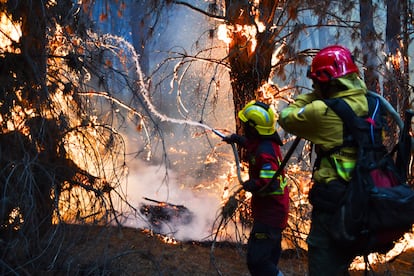 Firefighters battle flames as wildfires blaze in Epuyen, Patagonia, Argentina, Sunday, January 11, 2026.Nicolas Palacios (AP)
While wildfires have always existed in Patagonia, the phenomenon has worsened in the last 20 years. The fires are not only more frequent, but also more virulent and explosive. They are “firestorms” that create clouds of ash, hot air, and embers that fly and ignite other secondary fires. Climate change is contributing to this situation due to droughts, which make vegetation more prone to burning, and the increase in fires caused by lightning, resulting from a greater frequency of thunderstorms.
Due to the recurrence of these types of fires — which have been happening almost every summer for the past decade and are now threatening not only the densest forests but also populated areas — the community itself has begun to organize volunteer brigades to defend their homes. While state resources for fire prevention and management are dwindling, the number of neighborhood groups participating in — and even leading in some places — the effort is growing.
Some brigades are experienced and trained, while others are newer and less experienced. Some work in conjunction with firefighters from official institutions, who accompany or coordinate them, while others act independently, sometimes creating tension. “It’s a risk because some brigades have training in the subject and adequate equipment, but they are in the minority,” explains Amoroso. “Often, due to a lack of experience, the actions of these brigades have even compromised the work of official institutions, while on other occasions they have reached places where official aid has not arrived.”
Sign up for our weekly newsletter to get more English-language news coverage from EL PAÍS USA Edition