
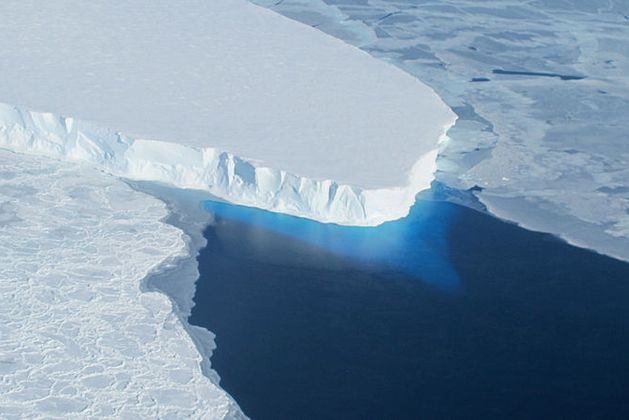
The collapse of the Thwaites Glacier, a huge mass of ice up to 2,000 metres thick which covers an area nearly as large as the UK, would lead global sea levels to rise by 65 centimetres, researchers say.
Scientists will now drill into one of the most difficult to access and least-understood areas of the glacier, in order to observe the processes which cause warm ocean water to melt the ice above.
Dr Peter Davis, a physical oceanographer at British Antarctic Survey (BAS), said the project is an “extremely challenging mission” taking place on “one of the most important and unstable glaciers on the planet”.
Over the next two weeks, a team from the BAS and the Korea Polar Research Institute (KOPRI) will use a hot water drill to bore through the ice before sending down instruments which will send data to the researchers above.
The researchers will be looking into so-called underwater tsunamis which can span from 10 to hundreds of metres, researchers told Sky News Australia.
“These big underwater waves, with amplitudes of 10s to possibly hundreds of metres, what that can do is mix deep water with water closer to the surface. We have to understand that in order to make those better predictions about sea ice melt,” BAS oceanographer Dr Alex Brearley told the broadcaster.
Dr Davis said that “for the first time” scientists will be “watching, in near real time, what warm ocean water is doing to the ice 1,000 metres below the surface”.
“This has only recently become possible – and it’s critical for understanding how fast sea levels could rise.”
Previous research into the Thwaites Glacier has focused on more stable areas, but the upcoming research will take place on the glacier’s main trunk, which has been largely unexplored because of its crevassed nature.
“This is polar science in the extreme,” said Dr Won Sang Lee, principal research scientist at KOPRI.
“We made this epic journey with no guarantee we’d even be able to make it on to the ice, so to be on the glacier and getting ready to deploy these instruments is testament to the skills and expertise of everyone involved from KOPRI and BAS.” (© The Independent)