
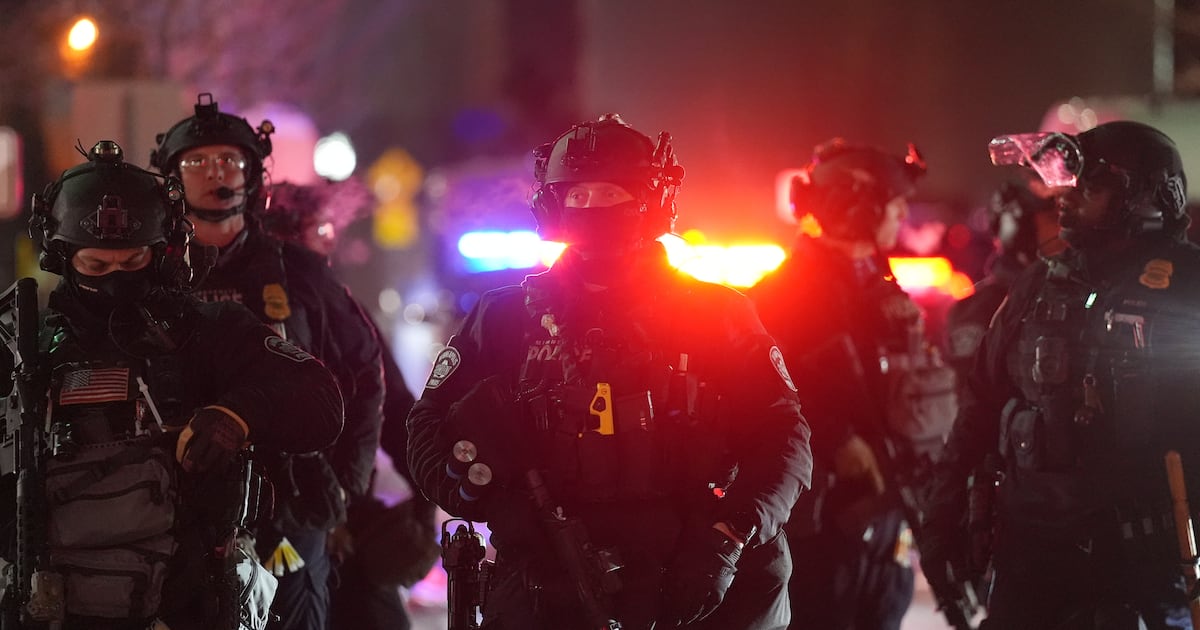
That morning, an Immigration and Customs Enforcement (Ice) team appeared on her street. They stopped a car they had been trailing and within seconds removed the driver, bundled him into one of their vehicles and drove away, right outside Katie Cashman’s apartment window. All of this happened on a residential street – flower pots, stoops, bikes, the usual paraphernalia of city urban living – within seconds, and in silence. By the time Cashman got outside, the patrol had already vanished, leaving behind the man’s car, unlocked and simply abandoned in the street. A neighbour had to call a tow-company to have it removed, just so other traffic could get by. Cashman had no idea who the civilian was.
“The first thing we do if we see an abduction is to shout: ‘what is your name?’” she says.
“So we can contact their family and so they can hire a lawyer. Otherwise, they are gone. They could be in Texas the next morning and not heard from again.”
That same morning, information came through on Cashman’s Signal group that someone had been shot, just a few blocks away on Portman Avenue. She rushed down there and by then the Signal chats confirmed that the person was dead. It turned out to be Renee Good. “And it had felt so violent for weeks that I wasn’t even that shocked that they’d … murdered someone. My first thought was: of course they did.”
Cashman spent the remainder of that day, January 7th, patrolling. Good’s death became worldwide news within the hour. In Minneapolis, people felt nauseated and angry but were still determined to persist with their form of peaceful but vocal resistance. It seemed as though Greg Bovino, the military-coated, shorn-headed commander of the Minneapolis immigration operation, was on full parade that day. “Just being around, being arrogant, all over south Minneapolis,” Cashman remembers.
She ended up following Bovino’s cavalcade when it stopped in a Speedway petrol station. When she stood in front of Bovino’s car, outside the forecourt, the agents shouted an arrest warning. Then they pulled away, drove for a short distance before, confusingly, pulling into another Speedway station. Cashman realised then that Bovino and his crew must have been looking for a restroom.
“So, I got in line before them,” she says.
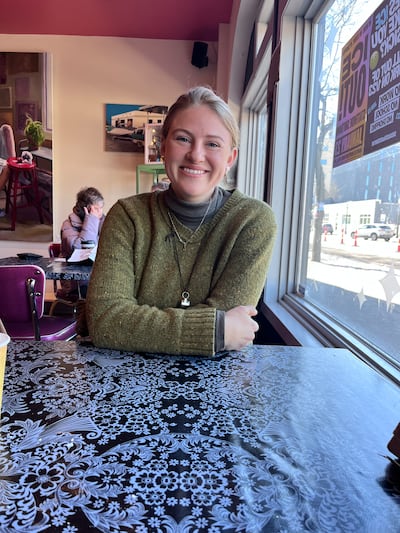 Katie Cashman in Glam Doll Donuts in Minneapolis. Photograph: Keith Duggan
“And inside, an attendant told me that the restroom was actually out of order. I stayed anyway pretending like I was waiting outside to use it. And then Bovino came in and they were like, where’s the bathroom. And I was knocking on the door saying, hey hurry up. I knew it was out of order. But they didn’t know that. So we stood there. And I wasted 15 minutes of their time. When at least they couldn’t arrest or lift anyone. And when they eventually realised what was going on, they were furious and started shouting, “You knew that it was out of use, you knew the whole time. And we were saying, ‘That’s right! No shits for you! Get out of my city!’ I was so angry that day that I was just doing anything I could to slow them down. And they actually ended going back to their base in Whipple.”
Bleak as that day was, something about the act of frustrating this Bovino, then at the apex of his sinister ridiculousness, was cheering. But when night fell, Good was still dead and in homes throughout the sprawling, low-rise neighbourhoods of Minneapolis and St Paul, thousands of immigrants went to sleep under a cloud of constant dread.
This week, that has worsened. Many potential immigration enforcement targets have stopped sending children to school. Some no longer go to work. Volunteers buy and deliver groceries to them, usually at night time. Churches admit only known worshippers. Teachers have the impossible task of explaining to four- and five-year-olds why these masked people are here, taking such-and-such’s mum or dad.
I met Cashman in Glam Doll Donuts, a popular coffee shop on the edge of the “Eat Street” section of Nicolett Avenue, a long artery that runs from the business hub of downtown. It’s also directly across the street from where Alex Pretti was gunned down last Saturday morning. In fact, the Customs and Border Patrol officers who shot Pretti had minutes before assembled outside Glam Dolls last Saturday with the intention of arresting an immigrant, or immigrants. Now, a huge ribbon of packed ice forms a slope on the spot where Pretti died. The kerbside has been transformed into a memorial strewn with flowers, messages, candles and emblems. Television crews from around the world have taken up residence but at a distance: the atmosphere around the makeshift shrine is very sombre, warm and respectful.
On this Thursday, the sky is huge and clear and sunny and it is minus 19 degrees, cold enough for gloved hands to turn painful and then numb within minutes. Even Minneapolitans, who pride themselves on all-weather toughness, seem rather impressed by this blast of January cold. Still, people linger for a long time around the floral tribute. There’s hugging among locals, some tears, strangers coming to leave flowers and messages. A bearded priest kneels on a cushion he has placed on the iced pavement and prays for a long time. Later, a television reporter asks him what he feels. “The truth is,” the priest says, “my heart is broken.” That phrase has become commonplace but something about the man’s voice, so choked up and small, seems to catch the mood on Nicolett, and across the city.
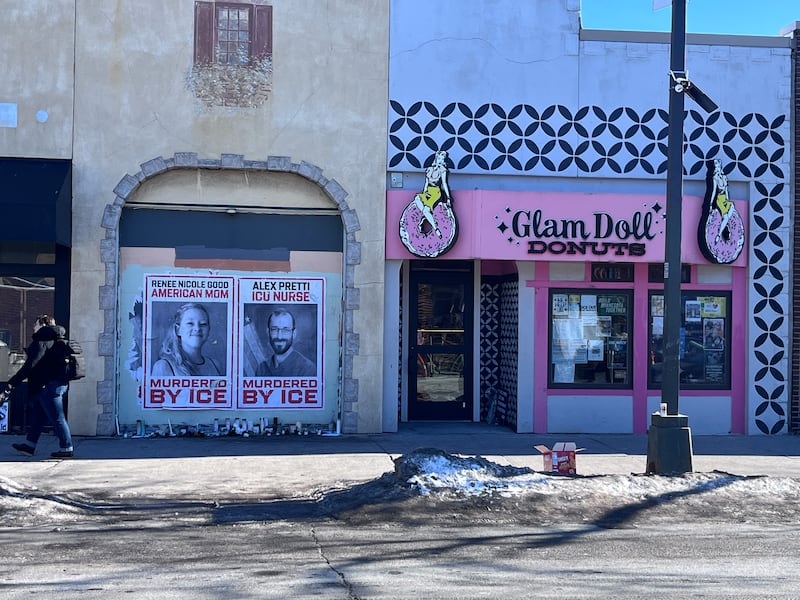 Posters commemorating Renee Good and Alex Pretti on Nicollet Avenue in Minneapolis. Photograph: Keith Duggan
In December, Cashman’s term as a Minneapolis city councillor ended after she narrowly lost her seat in the city elections. When we spoke then, she was inundated with inquiries from the Somali community, the original target of the surging Ice presence in the city. Now, the fear has spread to all immigrant communities. Cashman is job hunting. But before 10am on Thursday, she spent her morning raising $2,600 (€2,180) to pay the rent of an immigrant family she’d heard about. She sent out requests through Signal. People could contribute through Venmo. It took just two hours to raise the sum.
“It’s collectivism,” she explains.
“I don’t have $2,600. But I have $100. And so do 26 other people and at least that one family can stay in their home and know that Minneapolis wants them here. Even though those f**kers are trying to get them out.”
In Glam Doll Donuts, customers arrive to find coffees and the gloriously decadent display of doughnuts already paid for: strangers keep buying gift vouchers and leaving them behind the counter for other strangers to enjoy. And the coffee is free to all. That morning, the neighbourhood committee is meeting down the back to decide whether to apply to make the section of Nicollett where Pretti died pedestrian-only, so people can pay their respects safely. Just a few doors down, the owners of Good Grocery had thrown open their doors for a morning of free food and music.
“Being a place of business here right in the epicentre of what happened, we love this community and we wanted a way to collectively engage in an act of … love,” Jeanette Vickman says. She runs the business with her husband.
“It was just to open up our doors and have food and art and music and a place for people to gather and give hugs. What I noticed the last two days, being in the store, is that people just want to be together and they want to believe in hope and that there are good people.”
Vickman didn’t personally know Pretti. Some of the staff believed they recognised him as a customer who popped in and out. But then, Minneapolis isn’t exactly short of slender, bearded white guys. Those who did know Pretti personally have spoken out with vital, passionate honesty about who he was. The facts, again, quickly zipped through the global communications firmament: an ICU nurse, a carer, a biker, a pleasant neighbour. Over the past few nights, a short essay by Kristen Radtke, a creative director with The Verge who had been best friends with Pretti during their childhood in Green Bay before they lost touch, gained traction. It floored many readers with its gorgeous directness:
“We built palatial forts in the snowdrifts after the plows went through. Lawn sprinklers in summers became portals to different realms and time periods: we ran through the strands of water with towels tied around our necks as capes. He loved mandarin oranges and macaroni and cheese, and we agreed it was especially pleasing when all the food on our plates was orange.”
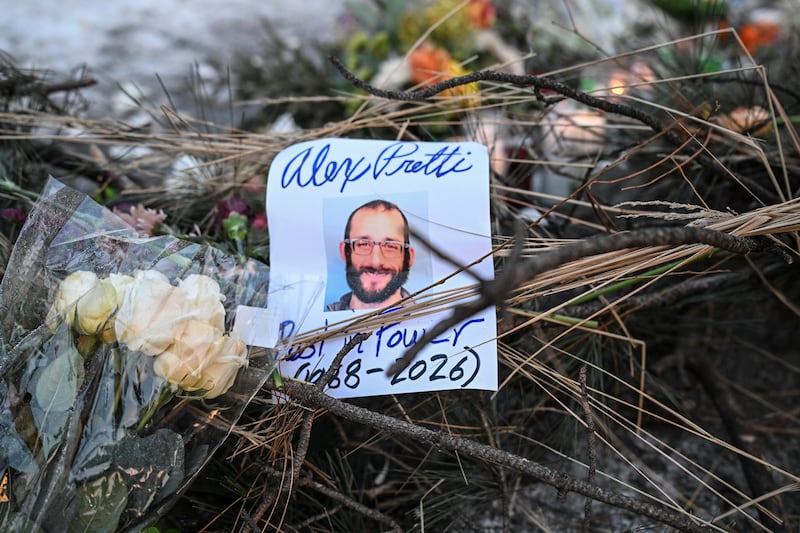 A photograph of Alex Pretti at a makeshift memorial at the site in Minneapolis where he was shot and killed by federal immigration agents. Photograph: Victor J Blue/The New York Times
And then this sentence.
“There is something destabilizing about having known someone only as a child and then hearing they were gunned down in the street. The person you see in your mind lying in that street is still a child.”
On Wednesday, footage emerged showing Pretti in a separate altercation from two weeks ago in which he spat at an Ice vehicle and kicked out a tail light. He was tackled to the ground by Ice agents and released. It was quickly seized upon by the right as proof of the administration’s original, despicable portrayal of the dead man – “a would-be assassin” (Stephen Miller); “arrived to kill law enforcement” (Kristi Noem). But ultimately, Pretti’s behaviour that day, unquestionably disorderly, just magnified his passivity on the day they shot him. His final act on earth had been to try to shield a woman who had been tossed to the ground by a Customs and Border Patrol agent.
Have you read history? … What’s happening now isn’t surprising.”
— Minneapolis resident Katie Cashman
Near the mural, I meet two women walking gingerly across the icy road. One is carrying flowers. Tracey O’Brien and Jennifer Shea are friends.
“I’m a nurse,” O’ Brien says. “We stick together. He did absolutely what any nurse would have done that day.”
You don’t have to spend very long on Nicollett Avenue to understand what sort of community this is, in normal times. And there is something unique about Minneapolis that soon gets under the skin: a sort of trippy friendliness that is genuine rather than performative. Architecturally, Minneapolis is like many Midwestern cities: stoic, expansive and built with the chutzpah of the promise of the 20th-century business model, with high rises and conferences centres downtown.
Stephen Loveland grew up in St Paul. We meet out at the Mall of America, the fascinatingly vast three-level consumer emporium on the edge of the city. Minneapolis all but invented the American mall. Loveland, a 90s kid, grew up when the mall-rate lifestyle was at his zenith. He’s a musician and a teacher and loves the outdoors but has an amusing devotion to the cult and lore of his city’s malls. He shows me what is the single coolest feature of the Mall of America: a brass plaque in the ground to mark where the home plate in the Metropolitan Stadium had been when the Twins played from 1961 to 1981. “The Old Met” stood abandoned for several years and was razed before the Mall of America was dreamed up and built in 1992. “On Saturdays in winter this is where everyone comes,” he says brightly.
Loveland spends his free hours among the vast community of volunteers locating Ice raids so they can arrive, blow whistles and alert the vulnerable. In recent months, several disparate and distinct immigrant interest and neighbourhood watch groups have coalesced to deal with the surge of Ice activity and the 3,000 agents who have flooded the city. Organisation is tight. People are asked about the risk level for which they are prepared. High risk means willingness to be arrested, to be gassed, to have car windows smashed in.
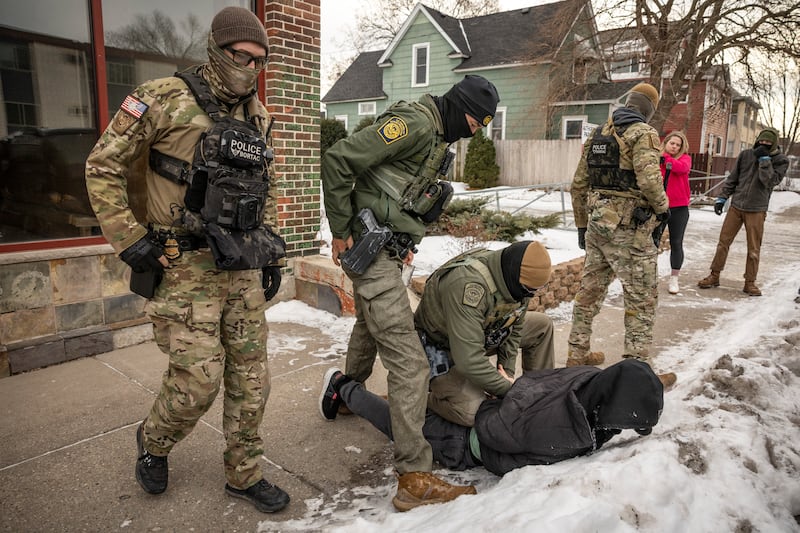 Federal agents detain a man after a foot chase in Minneapolis earlier this month. Photograph: David Guttenfelder/The New York Times
“I’ve only been gassed once, unlike many people around me. We were following an Ice caravan. Once they get out of their vehicles the energy changes and you have to decide what you are going to do. My job that day was to video and they threw gas. It’s not just that they are guys with guns. I’ve been in the army and around guys with guns. I’m a gun owner myself. But these guys are masked. There is something about their being masked that is extra intimidating where they are like this invisible goon squad. The tactic of intimidation is a big part of it. To say we are fearless – I don’t know if that’s accurate. We’re afraid. But we are doing it anyway. We had a neighbourhood meeting recently and it’s not hyperbole to say that everyone – everyone – showed up. Nobody wants to sit on their hands.”
On Thursday morning, at 7am, Tom Homan, the border tsar gave his first news conference since arriving in the city during the week. Bovino had been suddenly banished, as though Trump had fully noticed him for the first time and quickly absorbed how kooky and disturbing he was. “He’s good … but he’s a pretty out-there guy,” he said doubtfully.
Homan, a veteran of several administrations and nobody’s idea of cuddly, spoke with low-key authority and vowed to restore order and to return to the old immigration tactic of targeted arrests rather than the indiscriminate sweeps of old. But that’s not what the local communities here care about. They want to hear that Ice will go after known criminals only and leave their more vulnerable neighbours alone. The persistent message from the administration – that the Minneapolis protests are driven by paid agitators – is regarded as a sinister joke.
“Awh man. I think that’s a shocking statement,” says Vickman.
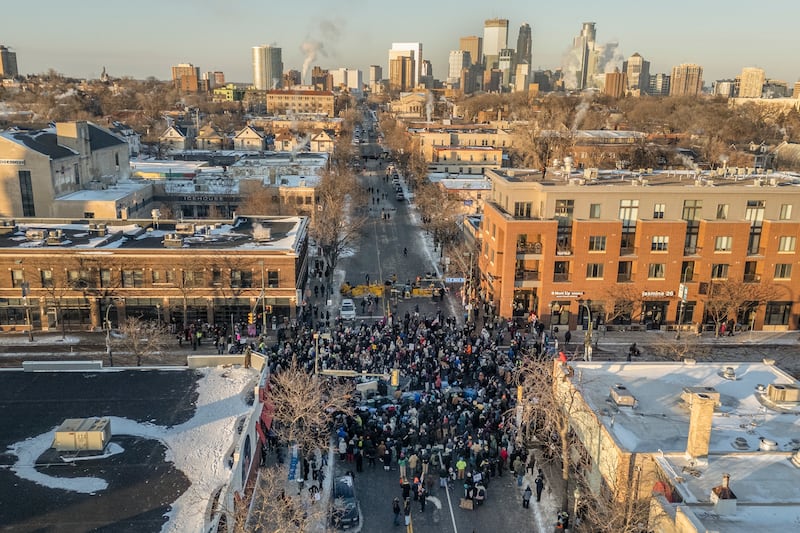 Protesters gather near the site in Minneapolis where Alex Pretti was shot and killed by federal immigration agents earlier this month. Photograph: David Guttenfelder/The New York Times
“In my experience people are standing up for what is right. People are being peaceful. We saw unpeaceful protests here in 2020. This is different. So, I have not seen that. What people call ‘agitators’ are people standing up for what is right. I am sure there are some. But the collective? These are our neighbours standing up for neighbours who are walking through the processes of citizenship and the rules have changed on them overnight. That is not okay. Everybody – everybody – is for arresting the criminals. Absolutely. That is the logical thing to do. But what we are seeing is the illogical – arresting decent, hardworking people who contribute to our society.”
Cashman hadn’t seen the Homan speech and doesn’t think it will change anything. But like everyone I speak with, she is adamant in her belief that Minneapolis can’t fold: that a persistent, peaceful, steadfast, vocal opposition to federal attempts to lift people out of their cars, their homes, their lives, must persist.
On the televisions, in distant Washington, the politicians argue over the meaning of Minneapolis. It all seems like a pageant, with everyone, from Trump down, playing their given roles. On Monday, a host of Democrats called for the impeachment of Noem, the secretary of homeland security. But how long did that last? By Thursday, a deal was struck to avoid another government shutdown. That evening, the news talkshows weighed in on what happens next. Decisions taken in Washington do, of course, have a profound impact on what happens in streets such as Nicolett.
But there is a difference between careers and roles – even presidential roles – and ordinary lives. As we chatted for a while, Cashman reflected on her lifetime as an American. She is one of the generation for whom 9/11 represents a first formative childhood memory. The century so far has been tumultuous and uncertain. I ask if, when she speaks to Americans who lived through the 1980s and fabled 1990s, when the country was boozier, smokier and allegedly happier, she feels a sense of envy or wonder.
“No,” she says decidedly.
“I don’t think that era was actually really great. It was great for white people. I would rather grow up in a more pluralistic and informed reality than that. I think those generations are having a harder time accepting what is happening than we are. This whole thing of: ‘I can’t believe the US would be fascist or violent’. Have you read history? This isn’t new. The Native Americans suffered a genocide; slavery went on long beyond other countries. What’s happening now isn’t surprising.”
And something about that rejection of the grand illusions of the past gets to the very core of the invisible struggle taking place in America, and to a street truth that the commentariat insisting that the United States has taken a definitive turn to the authoritarian right can easily miss. Yes, a narrow cohort with extraordinary influence, led by Donald Trump and steered by Miller and other ideologues, dominates its policies. But they are always going to come up against the collective will of many millions of Americans such as Cashman. And unlike those starring in the official pageant, those anonymous have nothing to gain for themselves apart from the sense that they are helping their neighbours.
The United States that Miller wishes to engineer – that ethnonationalist model that hearkens back to a vanished past and rigid orthodoxies – is intended to guarantee the success of white, college-educated Americans. But in Minneapolis, that very demographic is saying by the hundreds of thousands – in their polite, Midwestern way – no thanks. That if it is to be at the exclusion of the new communities who had enhanced their lives, then, as mayor Jacob Frey said, get the f**k out of our city. It was a specific message to Ice and Bovino, but also to the Trumpian ideology.
This weekend, more marches are planned. More Ice watches will be organised. And life goes on, too. Cashman has her sister’s bachelorette party to organise. Celebration and joy can’t be ignored.
“We are fighting for a beautiful life here,” she says.
“We have to live it too.”