
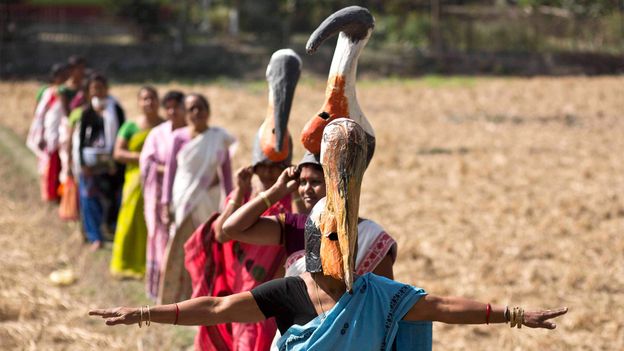
Barman began to form small community groups, seeking out women from the villages who could sew, paying them to weave the hargila’s image onto hand woven sarees, cushion covers, quilts and shawls. Cooking competitions followed.
In this way, the all-female conservation initiative started slowly, with just a few women in the earlier days, Barman says. But support for the hargila from local women soon grew and then began to snowball. Today, the Hargila Army includes 20,000 women from 47 villages – all of whom have signed a pledge to protect the bird, she says.
Women were not previously active in public spaces, says Rajbongshi, but activities of the army attracted them and soon they began to use the hargila to express themselves in creative ways. “In protecting the birds, the local women found their own sense of identity and livelihoods too,” she says.
Lavita Baishya, a 41-year-old mother who lives in Dadara, joined the Hargila Army’s community groups in 2017. “We were taught folk songs that told us how to respect the bird, even revere it,” she says.
It was also here among her peers that she discovered her love for sewing and embroidery. With the proceeds from her sewing, she eventually bought two sewing machines and opened her own tailoring centre in 2023, where she now trains other women, specialising in making hargila-themed textile merchandise. The Hargila Army now has a mobile cart that regularly sells themed merchandise door to door. There’s a retail outlet that opened in 2023 in Deepor Beel, a freshwater lake and wetland on the outskirts of Guwahati in Assam, and an online store. All proceeds from these sales go to the women.