
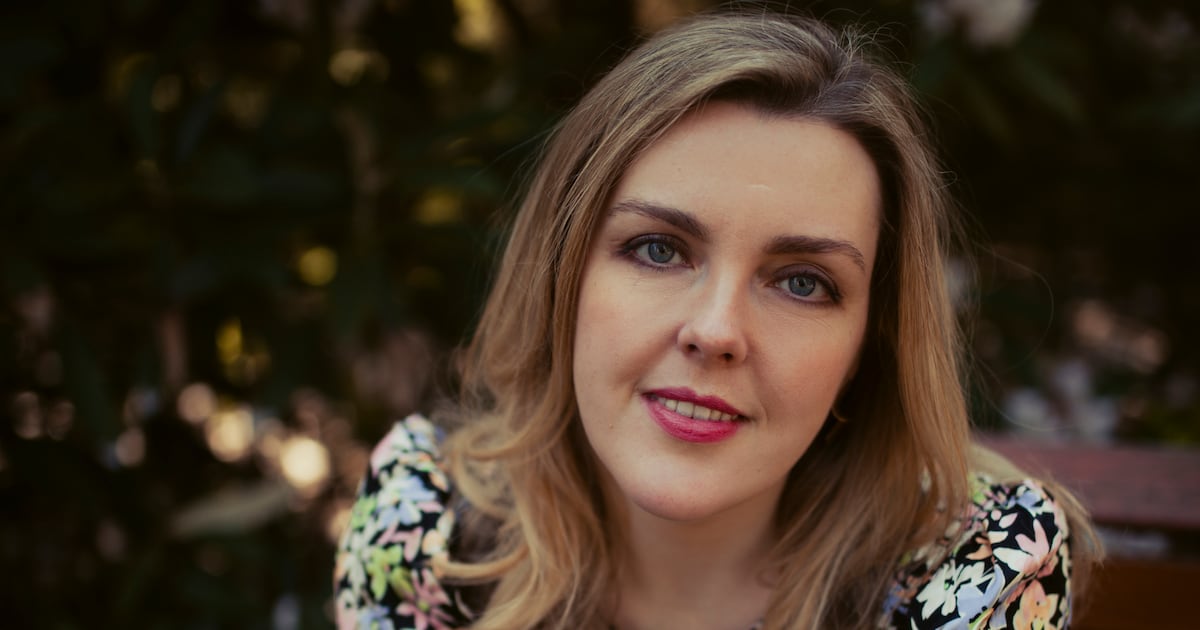
I was born and raised in Derry. I lived there until I was 18, and then I moved to Belfast to go to university where I did a four-year degree in law and French.
Through my degree I got to go on Erasmus and live in Bordeaux for a year. In France, when they find out that you just speak English, but you’re not English, things sometimes tend to warm up a little bit.
I grew up with a noncomplex relationship with Irishness and identity. I just felt that I was Irish, probably in the same way that someone from the South would. It was just kind of a baseline fact; in the same way you might have brown hair and blue eyes and you live in Derry – you’re Irish. All of those facts would have had equal weight for me.
It was only in later life that I started to realise, “Gosh, actually one of those things can be provocative”. Three of those things: brown hair, blue eyes, living in Derry are where the conversation ends. Whereas one of them can bring up a lot of stuff for other people.
Although I am an author, I am also still a lawyer to this day. People ask how I do it, and I’m just wrecked all the time. I am lucky that I’m more developed in my law career now. I have more autonomy. I think lots of us now in our jobs have a bit more autonomy, post Covid, where we need to get our jobs done, but if we want to do a bit of work in the evening instead, or catch up at weekends, there is a bit of flexibility there. But there are no two ways about it: I am pretty busy.
My area of law is quite specific – I work in film and television. I review mainly documentary films for issues like defamation and invasion of privacy and inflection of emotional distress and anything that could be copyright infringement, anything that could get the producers in trouble.
Pre-Covid I had a really fun roster through the year where I would go to the Berlin Film Festival, Cannes and maybe Sundance or Tribeca. I remember once going to the Havana Film Festival and lots of different ones throughout the years in Toronto. A nice part of that brief was taking those opportunities to go and celebrate and watch the film.
My first book, Twelve Days in May, is a love story set in Cannes, inspired by my time there. Although none of that stuff has happened to me, I don’t think I would have written that book had I not had the experience of going to Cannes every year and realising what a little bubble it is. Thousands of film people come into this small French town for a period of 12 days and that struck me as a nice ticking-clock kind of scenario, and provided an intensity for storytelling.
I remember when the commission for Derry Girls was announced at the Edinburgh TV Festival. All these TV people were up from London, and they just heard that Channel 4 had commissioned this new comedy set in Derry and they kind of just clapped politely. My mind was just boggled, I remember thinking, This show had better be good.
The series was first broadcast on Channel 4 but it was picked up in December that year by Netflix. I remember then, in January, being at a networking event at the Sundance Film Festival and normally, when people say, “Where are you from?”, I would say I’m from Ireland.
If they kind of dig into it I would probably say, “Oh, I’m, you know, it’s about two hours from Belfast”, or I might say it’s about four hours from Dublin. I remember saying some version of all of that to this girl. And she said, “Oh, my God, have you seen the show Derry Girls?”
I went directly to LA and I met all these new friends who just wanted to talk about Derry, and about the show. Having had a long time of either people having no context for Derry, or, in some cases, them having a context that felt quite inaccurate and skewed negative, Derry Girls has been brilliant.
I think there’s a world in which that show could have been really popular nationally and internationally, but people in Derry could have hated it. There’s also a world in which people in Derry might have loved it, but it didn’t really travel. So to manage to do both is really impressive.
In conversation with Niamh Browne
Niamh Hargan’s third novel, Nothing Good Happens After 2am follows a love affair behind an unmarked door of a speakeasy called Love and Death in east London, and is published by HarperCollins.