
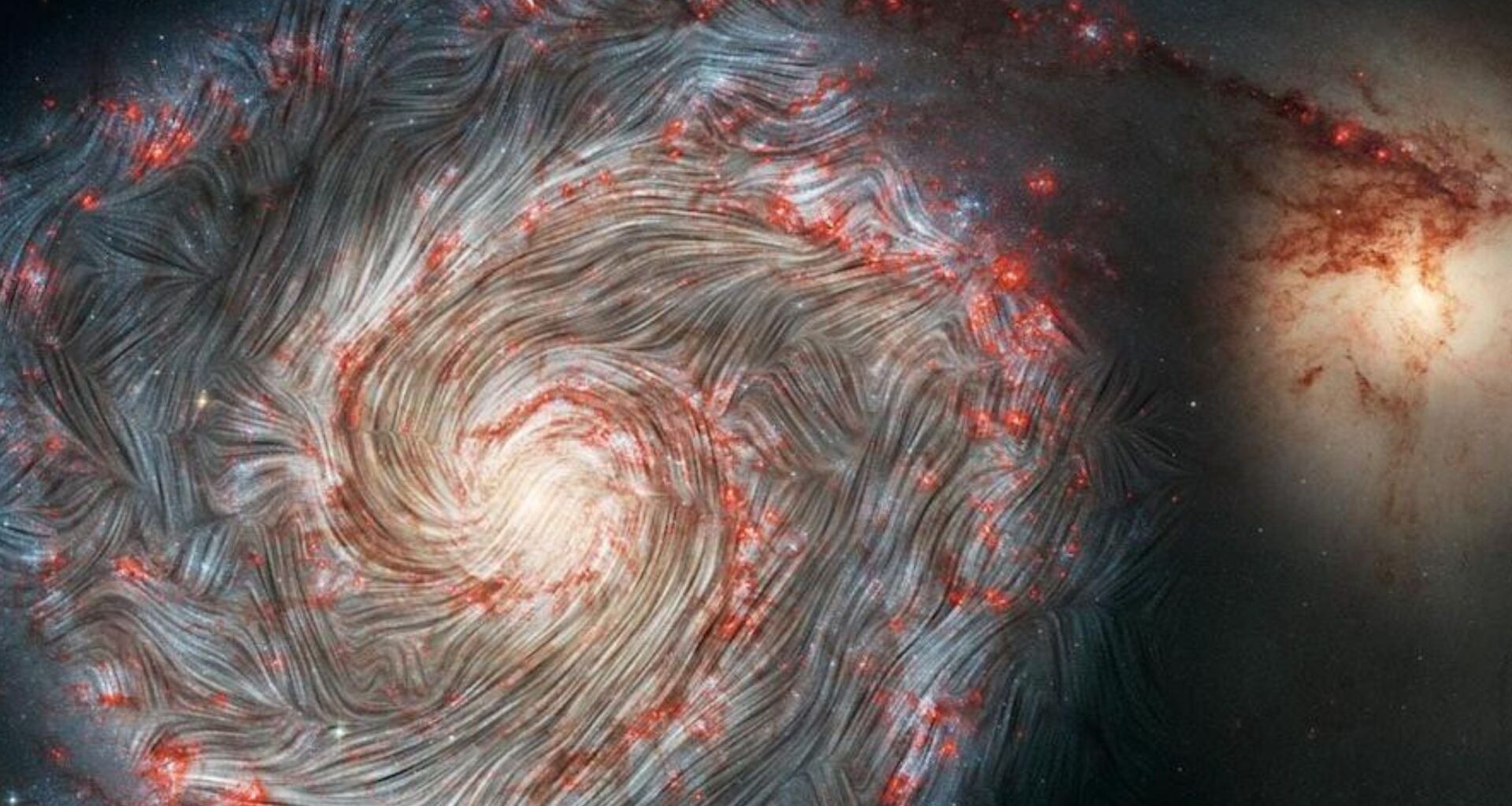
Order can arise from turbulent motion in space, forming magnetic field patterns that remain stable across stars, planets, and galaxies.
New research explains how those large-scale magnetic fields take shape, pointing to a specific kind of motion that may help clarify how solar activity develops and affects Earth.
When turbulence makes order

Across stars and galaxies, small magnetic knots stay messy, yet broad bands of magnetism look smooth and patterned.
At the University of Wisconsin-Madison (UW-Madison), a team ran simulations to chase that mismatch directly.
The work was led by Bindesh Tripathi, Ph.D., whose research focuses on turbulent magnetic fields.
Their story turns on one detail that earlier models often let fade – a steady speed difference across layers.
Speed differences matter
Keeping that speed difference in place supported the magnetic field’s large pattern, even while turbulence broke down smaller motions.
Physicists call it a velocity gradient, a change in speed across distance, and the team kept replenishing it.
The distinction is important because turbulence tends to drain large-scale flow, leaving swirling fragments that twist magnetic lines into tangles.
When the driving stopped and the gradient decayed, the simulations built only short-lived, chaotic fields with no stable structure.
Computing the long game
Capturing that slow turn from noise to structure required time, because early turbulence hid the later pattern.
The paper followed three-dimensional flows on 137 billion grid points and used nearly 100 million processor hours.
Across about 90 runs, the team stored about 0.25 petabytes of output, then watched fields organize over time.
Even so, the model simplified reality by keeping density fixed in plasma, an electrically charged gas that carries current.
Jets help align magnetic fields
Within the turbulence, long jets formed and kept the flow aligned along one direction for extended periods.
Those jets moved fluid consistently, so magnetic lines stretched repeatedly in the same direction and began aligning.
Small eddies still twisted the field, but the jets repeatedly restored the larger pattern after each burst.
This dependence on jets sets a boundary, since systems without sustained driving may never form large-scale organizers.
What dynamos usually do
Researchers explained a dynamo, the process by which moving material sustains magnetic fields amid turbulence.
A classic review explained why many dynamos stall at small scales, even when the system keeps stirring.
Decades of work have shown that most models produce magnetic fields that stay tangled and confined to small scales. These fail to match the large-scale patterns seen in space.
Long history makes the new simulations hard to ignore, because they showed a repeatable process that gave rise to large-scale order.
A new organizing effect
“Given that turbulence is known to be a destructive agent, the question remains, how does it create a constructive, large-scale field?” asked Tripathi.
The team’s analysis connected those jets to the mean-vorticity effect, where rotation in the average flow drives magnetic growth.
Because the jets remained stable, that rotational push kept acting in the same direction, and the field grew in bands.
If future work finds environments where rotation never forms stable jets, the effect may weaken or vanish.
Laboratory clues line up
Evidence for this kind of ordering also showed up on Earth, where engineers stirred liquid metal to mimic cosmic flows.
In the Madison Dynamo Experiment, researchers measured a turbulent electrical push that pointed sideways from standard expectations.
The sideways signal hinted that large-scale flow features mattered, and simple turbulence alone should have pushed differently.
The new jet-driven mechanism fits that lab result, but researchers still need broader experiments before calling it universal.
From mergers to signals
The same physics may matter when two neutron stars collide, because the crash creates sharp speed differences and fierce turbulence.
Those mergers produce light and gravitational waves together. Multimessenger astronomy, studies that combine different cosmic signals, depends on both the light and the gravitational wave signals.
“This work has the potential to explain the magnetic dynamics relevant in, for example, neutron star mergers and black hole formation, with direct applications to multimessenger astronomy,” said Tripathi.
Translating that promise into better predictions will require models that connect these jets to radiation, gravity, and real matter.
Solar magnetic behavior
Closer to home, the Sun also runs on layers that slide past each other, and those layers help shape storms.
When magnetic fields reorganize, they can open pathways for charged particles, which can disrupt satellites, power grids, and radios.
“It may also help better understand stellar magnetic fields and predict gas ejections from the Sun toward Earth,” added Tripathi.
Improving forecasts will still take models that fold in the Sun’s changing heat and density, not just magnetic forces.
Where this leaves researchers
The simulations, lab hints, and theory point to sustained speed gradients and jets as linked drivers of cosmic magnetism.
Future tests will need more realistic physics and new experiments, because not every environment can maintain the driving that powers jets.
The study is published in Nature.
—–
Like what you read? Subscribe to our newsletter for engaging articles, exclusive content, and the latest updates.
Check us out on EarthSnap, a free app brought to you by Eric Ralls and Earth.com.
—–