
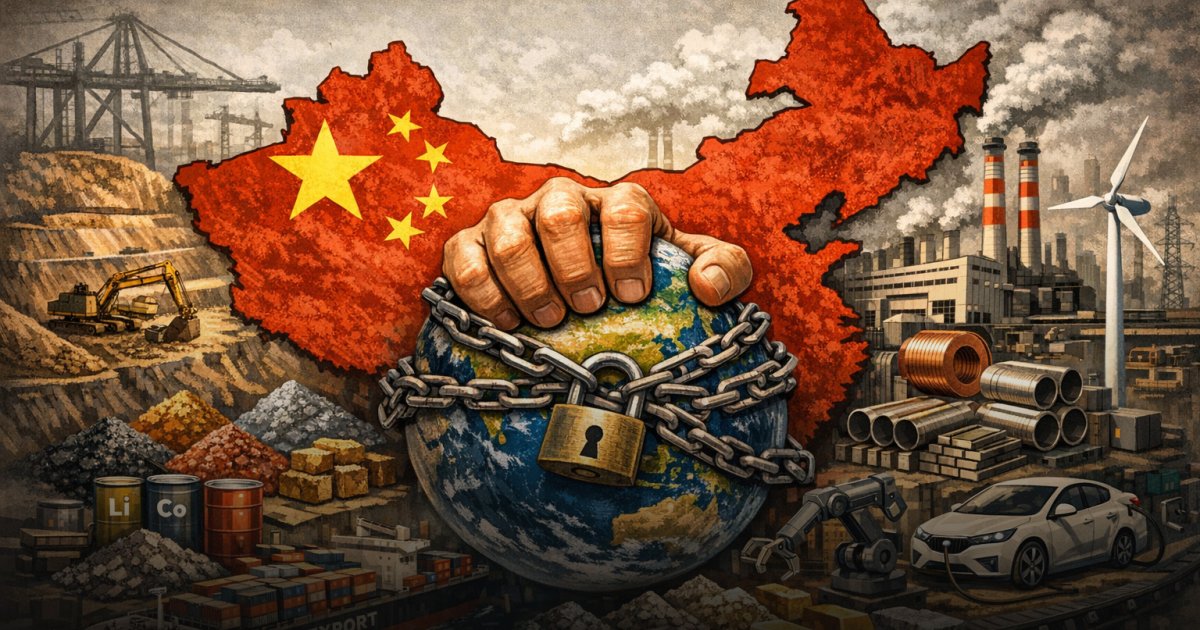
January 30, 2026 – Amid a global race for resources, Financial Sense’s Jim Puplava unpacks the “invisible chokehold” disrupting energy and minerals supply chains in the US and around the world. Cris Sheridan highlights how investments and government action respond to China’s rare earth dominance and advances in nuclear power. Puplava outlines America’s decline in coal and nuclear power, the build-out of new mineral processing hubs, and national security pressures. The conversation covers the challenges of reindustrialization, geopolitical risks, and long-term commodity trends for investors, emphasizing the need to diversify and understand how politics is now a crucial driver of global markets. Have any feedback, questions, or breaking news about today’s show? Click here to send our team a message.
Ways to follow us
Website: Financial Sense Wealth Management
X: Financial Sense (@FinancialSense_) / X
LinkedIn: Financial Sense® Wealth Management: Overview | LinkedIn
YouTube: Financial Sense – YouTube
Apple Podcasts: Financial Sense Newshour – Podcast – Apple Podcasts
Spotify: Financial Sense(R) Newshour | Podcast on Spotify
To speak with any of our advisors or wealth managers, feel free to Contact Us online or give us a call at (888) 486-3939.
Stay ahead of the news! Subscribe to our premium weekday podcast
Summary of key points:
China’s Dominance: China controls the majority share of rare earth processing (up to 90%), as well as critical roles in graphite, lithium, and cobalt refining.
US Response: The US government is ramping up investment and fast-tracking projects to rebuild domestic mineral processing capacity, signaling a strategic shift toward national security and energy dominance.
Nuclear Power Trends: The US has reduced its nuclear fleet from 112 to 94 plants, with almost no new construction, while China is expanding rapidly with 60 reactors and 38 more under construction.
Coal and Natural Gas: US coal plants and capacity are declining, with more closures planned, while natural gas is now the main US power source—particularly crucial for rapidly scaling AI data centers.
Strategic Risks: A major qualifier is that domestic policy and political uncertainty, especially surrounding the 2026 midterms and 2028 presidential election, may stall or reverse industrial and infrastructure gains.
Environmental Improvements: The US aims to build cleaner mineral processing plants using more environmentally friendly technology compared to China’s toxic processes—a competitive and regulatory advantage.
Investor Outlook: Both speakers caution that, while long-term trends may favor commodities and resource investments, significant volatility and political risks can impact returns, highlighting the need for diversification and caution.
Global Resource Competition: The re-industrialization push in the US and allied nations is still at an early stage and will take years; the outcome depends on sustained political will, regulatory reform, and handling competition for global mineral offtakes.
Books and Materials Mentioned
Transcript
Cris Sheridan:
Welcome, everyone, to this week’s Big Picture. Joining us, as always, is our president here at Financial Sense Wealth Management, Jim Puplava. Today, we’re going to discuss an invisible chokehold that we believe all of you should be aware of. One of the big developments: the US government just announced a $1.6 billion investment in another rare earth company. We saw this last November when the US invested $620 million in Vulcan Materials to build and operate a magnet facility. The government has also taken stakes in MP Materials, the country’s largest rare earth miner. We’ve seen a flurry of investment happening following China’s restriction of its rare earth exports last April—not only to the US but also more recently to Japan. So, there is certainly a battle going on for minerals and energy, but, more importantly, a scramble to break China’s monopoly on processing and refining everything that we need in modern society today. So, today’s show is really about the demand for energy, electricity, and the battle— not just for minerals— but for the processing of those minerals critical to everything that we do.
Jim Puplava:
I want to begin with energy, specifically with nuclear power. US nuclear power plants peaked in 1990; we had 112 nuclear plants. We’re still the largest country in the world with the most plants, but we’re down to 94, and there are no new nuclear plants on the drawing board. We’re not building new ones, but we’re trying to reactivate old ones. For example, there’s a nuclear power plant in Michigan that will go active in 2027. Of course, we’ve heard the story about Three Mile Island—the Crane Nuclear Power Plant—which will go active in 2028. Behind that is Microsoft, which needs the power for its large AI center there. We’ve got another one called the Dwayne Arnold restart. So, we’re down to about 95 gigawatts of power now.
What brings this up is this week, the Chancellor of Germany admitted that his country’s decision to abandon nuclear power was a serious strategic mistake. Two decades ago, Germany got about 25% of its power from nuclear. Germany shuttered its last nuclear plant in 2023 and now gets about 59% from renewables—which are more unreliable and more expensive. Ironically, they’re having to reactivate their coal-fired plants. So, you know, we were talking about this for climate change and reduction of carbon emissions. Well, Germany’s back to carbon emissions because they’re reactivating their coal plants now. The US is making the same mistake. We’ve shut down roughly 16% of our nuclear power plants, with more scheduled to be shut down by the end of the decade. They’re going to be replaced by more unreliable renewables.
What’s driving this is that a lot of wealthy billionaires are behind the climate change movement—everybody from Jeff Bezos, Mike Bloomberg, Zuckerberg, Laurene Powell Jobs—they’re all putting billions of dollars in. But recently, Robert Reich just put out a video (we’ll have a link to it) noting these guys have mega-yachts that are emitting more carbon than like 1,500 homes. So, there’s a big push by the super wealthy in this climate change arena and what it’s doing is making our electricity grid in this country more unreliable, which is one of the big issues these AI data centers are facing. If you want to put in a data center like Microsoft, they were looking at California, and they’re pulling out. There just isn’t going to be the power there to run those AI centers. This is a big issue as we discuss the AI buildout in our technology battle with China.
Cris Sheridan:
So, Jim, that’s what we’re seeing in the US and also in Europe. As you mentioned, Germany finally admitted they made a mistake in shutting down all their nuclear reactors. In the US, we’re also not seeing much of a build-out. There’s been a turn in sentiment—of course, via the Trump administration—trying to build nuclear, but it’s going to take some time. At the same time, if we look abroad, whether that’s China, India, or the Middle East, they’re building nuclear reactors hand over fist. Tell us what we’re seeing in China in particular.
Jim Puplava:
Yeah, if you take a look at China, China has 60 nukes with 38 under construction. They will overtake the US by 2030 because we’re still reducing our nuclear plants, and China has now overtaken France to become number two. The key thing: it takes China six years to build a nuclear plant compared to 12 to 15 in the US, and China is way ahead of us in nuclear plant technology. It is the only country in the world with a commercial Generation IV reactor in operation. This makes it inherently safer—it cannot melt down even if all the cooling is lost.
They’re adding roughly 10 new reactors per year with a goal of almost 200 gigawatts of power by 2035. By then, we’ll be down to 95—if that. And it doesn’t end with nuclear.
If you look at coal, the US had 600 coal plants in 1980. Today, we’re down to about 205 due to the “banana green” movement. We’ve gone from 380 gigawatts of coal power to 181. At its peak, coal provided about 50% of US electricity. Today, that’s down to 16%, and we’ve retired roughly 43% of our coal capacity with another 50 gigawatts scheduled for retirement by 2030. So, if you look at what we’re doing, we’re depowering our system: reducing nuclear and coal plants, and replacing them with unreliable wind and solar.
In contrast, China has 1,140 coal-fired plants with roughly 95 currently under construction. Even with coal and nuclear, they’re outperforming us and building more. They have to— they’re the world’s industrial superpower.
The only place we exceed China is in natural gas. We have just over 2,000 natural gas plants—the number one source of US electricity, surpassing coal. We’re adding about 8 to 10 gigawatts, mainly to drive AI data centers. China, by contrast, only has about 3 to 4% nat gas plants. They use natural gas mainly to power heavy industry as the world’s industrial superpower.
So, for China, it’s coal, nuclear, and renewables—they’re using all three. We’re shifting away from reliable power and trying to put everything into renewables. Cris, it’s not going to work.
Cris Sheridan:
So, Jim, if you look at recent data, China has now overtaken every other country in the world in terms of power generation. Why is this such an important development?
Jim Puplava:
Well, we’re in this technology race with China, especially with AI and other areas. If you’re going to be the world’s largest industrial power, you need minerals to make things, and you need electricity to power your plants. That’s why they say, “We don’t want to be dependent on one source of power.” So they use all of them. We used to do the same—we had nukes (we still do), we have nat gas, coal, and renewables. But now, we’re reducing coal, reducing nuclear; the only thing we’re building is nat gas plants and renewables.
The reason we’re building these nat gas plants is, it’s the only thing that works for these AI centers—it’s fast. I think Elon Musk, when he built his giant AI center in Virginia, put in two new natural gas plants within three to six months. You can’t do that with nuclear; maybe a couple of years for coal. So, we are basically de-industrializing but now making a strategic mistake by reducing our reliable power sources, not even building new ones, and relying on something that isn’t predictable.
Cris Sheridan:
Let’s talk about where minerals, rare earths, and some of these other commodities play a crucial role in this developing story.
Jim Puplava:
Yeah, I want to move on to mineral processing because China has been encumbering minerals around the planet—in Africa, South America. That’s also behind what’s going on with the Trump administration: we’re trying to move China out of there, protect our supply in our own backyard. But it’s not just enough to have minerals—you need the processing plants to turn copper into wire, silver into ingots, or rare earths into magnets. China’s dominance in minerals is even more pronounced than in energy. This gives China basically a chokehold on the global supply chain of almost every strategic mineral on the planet. Here are a few examples:
They dominate rare earth processing: 90%.
Graphite: 75%.
Lithium: 70%.
Cobalt: 68%.
Copper: 45%.
Nickel: only 6%.
But here’s what China’s doing: Indonesia dominates nickel production at about 71%, but of that, 80% of their smelters are owned by China. So, it’s not just that China is encumbering minerals, they’re also doing it with smelters. They operate smelters in a “hub” model—four or five smelters in one location. China alone has 50+ large copper smelters, processing almost 10 million tons a year of copper. They have so much capacity that they recently reduced production by 10%.
Compare that to the US: we’re down to only two smelters left—Kennecott Copper in Utah and Freeport-McMoRan in Arizona. Not just copper—if you look at aluminum, China has 80+ smelters; we’re down to five from 30. Once again, we’ve spent almost 40 years de-industrializing and shutting down mining and smelters. The US currently has zero rare earth processing plants, which is key for defense, the auto industry, and electronics.
China doesn’t just process the metals; they make end products like magnets used in EVs, automobiles, even the F-35. And Cris, here’s the key: we’re scrambling now—almost like a Manhattan Project—because we realize the position we’re in. Not just us, but Europe and Japan.
China has spent decades and billions securing offtake agreements, especially in Africa and South America. We’re trying to push them out of our backyard. We just won a court case; Panama is pushing China out of the Panama Canal because a Chinese company was operating it— another chokehold!
So, part of what you see Trump doing in Venezuela and elsewhere is an effort to keep China from encumbering strategic minerals in our own backyard, from copper to silver.
Cris Sheridan:
By the way, for everyone listening, we’re sharing a lot of statistics and research that we compile at Financial Sense Wealth Management, which are part of our investment process—how we select specific mining companies to invest in around these larger investment themes. Give us a call at 888-486-3939 if you’d like to come on board and see how we can assist you.
Jim, let’s go back to the bigger picture here. As you mentioned, it’s not just where the minerals are located. We do have rare earths here in the US; there are some in Greenland, but the problem isn’t just where they’re located, it’s the monopoly China has—up to 90%—in processing these elements. Even if we opened new US mines, we’d still need to ship them to China to be processed. So, that doesn’t solve the problem. We need to open up smelters and refining facilities, which is going to be a longer-term process.
Jim Puplava:
Yeah, Cris, it’ll take about 10 years. Alarm bells have been ringing in the US military because we couldn’t fight a conventional war; we don’t have the production facilities to make munitions at scale like we once did. Today, China is in the position the US was in coming out of World War II. We’re scrambling.
Cris Sheridan:
Tell us a little about what the US is trying to do, and why this is now seen as a national security threat.
Jim Puplava:
Yeah. To address this invisible chokehold China has on mineral processing, the US launched a massive, federally funded wave of construction. US policy under the administration has pivoted from a purely green energy focus to a national security and energy dominance framework. The goal is not just to build EVs but to ensure minerals power everything from AI data centers to F-35s— which we don’t want processed by adversaries.
So, we’ve passed a massive federal de-risking investment program. The President just signed an executive order called Section 232, a proclamation labeling the lack of domestic refining a national security threat. This paves the way for price floors to combat China’s dumping, because China is notorious—they did this in 2010 to Japan, cutting them off from rare earths. We had a rare earth mine operating, and started shipping. China dumped rare earths on the market and drove our mine out of business. So, there need to be price floors to protect these miners because China, as a monopolist, wants to keep its monopoly and will try to drive our companies out of business.
We also have permitting reform—the National Energy Dominance Council, with executive authority to bypass environmental delays for shovel-ready projects. One is Resolution Copper in Arizona, which could meet 25% of our copper demand. That’s being fast-tracked. As of this year, the strategy is to build mine-to-magnet value chains, clustering around refineries near historic mining hubs and strategic defense locations. We’re trying to copy what China has done with its hub centers.
Just to give an update: Tesla is building a lithium hydroxide plant in Texas, operational by January 2026. Oklahoma is building a rare earth processing plant; Louisiana is building another. Oklahoma and Louisiana will be rare earth hubs. In California, MP Materials for light rare earths, and in Montana, we’re starting a gallium and rare earth processing plant.
We’re really going headfirst, because it’s so strategic; technology-wise and on the defense side, we’re pursuing mine-to-magnet value chains, clustering refineries near historical mining hubs or on military bases to get around environmental restrictions.
And here’s the key: we can build cleaner smelters than China. Tesla’s first lithium hydroxide refinery uses an alkaline process that produces a harmless byproduct; in contrast, China uses a highly toxic acid-based leaching process. So, the environmental excuse—”we can’t do it, it’s too dirty”—doesn’t hold; we can actually build cleaner than they do.
For example, in Alexandria, Louisiana, the Strategic Metals Complex focuses on high-temperature magnet minerals for fighter jets and EVs. In Stillwater, Oklahoma, there’s a 310,000-square-foot facility; the US government has invested $1.6 billion there. The US Ex-Im Bank has already deployed more than $3 billion in the last six months to subsidize projects. Cris, it’s almost like every week you pick up The Wall Street Journal and see a new project or company that the government or Defense Department is investing in, because it’s that strategic. Everything we have—technology, military, the green transition—you need silver, copper, all of that to go green.
Cris Sheridan:
So it seems the US is really treating this like a Manhattan Project to fast-track as much as possible to get around processing bottlenecks created over many decades by China. There are national security implications: if a conflict happened, China could restrict resources to us, since we don’t have the ability to process many of them ourselves—and they’re critical for F-35 jets, weapons, all sorts of things. The US sees this and is making attempts to reindustrialize. Given all this, we’ve been talking about this investment theme and why it’s important for investors to understand. What are we doing here at the firm?
Jim Puplava:
Well, if you’ve been listening to this program for the last five or six years, you know we’re invested in precious metals, but recently, over the last year or so, we’ve been moving into base metals. We have large positions in energy, rare earths, and industrials. But these, Cris, are long-term trends we believe will be in place for the rest of this decade, if not the next.
We’ve owned precious metals since 2020. Even with today’s selloff in gold and silver, both are still up quite a bit. Silver started the year at $70, hit $120, and is now back above $90. Gold hit $5,600, even with a big sell off. We believe in precious metals; gold is becoming the world’s reserve currency—especially with China and the BRICs—but we’re also increasing our energy positions, adding copper, and base metals.
If you’re going to industrialize and start making things, you need raw materials. Our resource account for high-net-worth investors owns everything from uranium to precious metals and base metals. Another account I manage is over 30% in key commodities: mining equities, energy, copper, including convertibles and preferred stocks in this sector. So we think, Cris, this is a long-term trend. I’m a firm believer we’re in a commodity supercycle. I think this could be bigger than in the 2000s decade.
Cris Sheridan:
Jim, let’s talk about some of the risks—case in point, what we’re seeing with silver. Silver rose parabolically; you’ve been a bull on silver for years. It recently got above $120 and is now pulling back below $100. So, there’s a lot of volatility in commodities. As a money manager who’s seen the ups and downs for decades, what would you say to investors when positioning in commodities and what are the risks?
Jim Puplava:
Well, I’d scale in. Quite honestly, what happened Friday, I was looking forward to, because I’m building my silver position personally—making it a much larger component of my portfolio. Anytime you see a parabolic rise, in the words of Dave Morgan, when silver takes off it looks like a hockey stick on the charts. I would scale in, especially because it’s very difficult when you’re in a new bull market with patterns you’ve never seen before. Check a 50-year, 20-year, or 30-year chart of silver—you’ll see that hockey stick just in the last year.
So: scale in, diversify. For many people, it’s probably better to go into ETFs if they don’t have the knowledge to analyze these companies. You’re safer in an ETF where you’re diversified across your sector—whether minerals, precious metals, or energy. So that’s what I’d do, Cris: scale in.
Cris Sheridan:
Yeah, that makes sense. Of course, with commodity exposure across accounts, it’ll depend on the objective and suitability for each investor. Again, if you’d like to talk with us about our process or managed portfolios, our number is 888-486-3939. What about political risk? I think this is another risk we’ve touched on. What do you see in terms of political risks moving forward?
Jim Puplava:
I’d say the main risk, Cris, is political. We have the midterms coming up and then the 2028 presidential election. The problem with the midterms is the Democrats have already said they intend to impeach Trump and his cabinet and stop anything he does economically. The Democratic Party is heavily influenced by “banana greens.” For example, after Trump’s first term, on Biden’s first day, he killed the Keystone Pipeline—which Trump had worked on for years.
So, there’s uncertainty for miners or anyone building a smelter or re-industrializing. If the administration changes, they could halt the whole process. The major risk is domestic policy and keeping it on track, rather than canceling projects. If you were building a pipeline under Trump, then the administration changes, and they put a stop to it—it creates too much uncertainty, and it’s why it takes so long to get anything done in this country. I’d say the biggest risk is the political will to follow through between administrations.
What if in the midterms the Republicans lose and Democrats take the House? Or in 2028, if there’s a Democratic president? Right now, California’s own governor is the leading candidate for 2028, but look at what Newsom has done in our state: just last year, we lost two more refiners—they’re pulling out because it’s too hard to do business. We can’t drill, can’t mine; Chevron left for Texas; we shut down our nat gas plants. We had two nuclear plants—San Onofre is shut down, Diablo Canyon is due to be closed by 2030, so we’ll lose 20% of reliable power from nuclear. Cris, there are no new nuclear plants planned—just more wind and solar and maybe nat gas. But you can’t run the grid reliably on wind and solar. Sometimes the sun doesn’t shine, sometimes there’s no wind. We’re making strategic mistakes—I think we’re repeating what Germany did, and it’s sad to see.
Cris Sheridan:
As you pointed out, Germany has acknowledged that was a mistake. Here in California, we are seeing long-term deindustrialization. So, political factors and policy are playing a key role, just as in the “three-legged stool” of how we analyze markets: fundamentals, technicals, and politicals. A lot is at stake with the upcoming midterms and 2028.
Jim Puplava:
Yeah, I don’t think, Cris—and many of our guests have said this—I can remember a time where the “politicals” have played such a huge role in what’s going on in the market: which sectors do well, which are ignored. It’s really dominating things. Look at the debate over the Fed chair—just appointed Warsh; there were worries over Hassett. So much is coming from the politicals, not just here but globally. We’re seeing a reordering of the monetary system worldwide. As we mentioned, gold is now becoming the world’s reserve currency; it’s right up there with central banks, with Treasuries. They are divesting from Treasuries and adding gold. So, gold is becoming money again; we’re reordering the global economic system. The US is waking up to the fact that we’re not the country we were 40 or 50 years ago. At one time, the US military could plan to fight two wars simultaneously and win both. We can’t do that now. That’s why you’re seeing the President pivot to say, “We can’t dominate the globe, but we will dominate our own backyard.” That’s what’s happening now.
Cris Sheridan:
As we say on the show, each country is working to optimize its strategic self-interest: the US, China, Russia, all of them. This is particularly acute with rare earths and the resource wars underway today. Lots of research you’ve shared, Jim, based on many books you’re reading. We’ll have a list of these as part of today’s Big Picture edition of the Financial Sense Newsh our. If you want to read through them yourself to understand the big picture and these investment themes for years ahead, as we believe these are long-term trends, even in the midst of parabolic and exponential moves like we see now with silver, the long-term trend is still in place. If you want to speak with our wealth managers, the number is 888-486-3939 or contact us at financialsensewealth.com.
Jim Puplava:
I just want to mention that we’ll put a list of all the books I’ve read while putting this together, but I want to recommend two—and I hope we can get the author on. One is Resource Wars: The New Landscape of Global Conflict, by Michael Klare, K-L-A-R-E. He’s Director of the Five College Program in Peace and World Security Studies at Hampshire College in Amherst, Massachusetts. The other is his latest book, The Race for What’s Left: The Global Scramble for the World’s Last Resources (2012). There are so many good books if you want to follow this theme; I think it will dominate for the balance of this and well into the next decade. In the meantime, on behalf of Cris Sheridan and myself, thank you for joining us here on the Financial Sense NewsHour. Until we talk again, we hope you have a pleasant weekend.
Music (Invisible Chokehold)
Switch flipped on, dead of night,
City’s hummin’, but the power’s tight.
Everything we build, everything we need,
From AI dreams to factory steam—
It all hangs by a wire you can’t see.
Minerals moving on invisible rails,
Shipped to the East when the West unveils,
Smelters silent, maps redrawn,
We’re running short and something’s wrong.
It’s an invisible chokehold,
Squeezin’ on the land,
Copper in the circuit,
But the world is in one hand.
Rare earth on the ocean,
Nuclear winding down,
It’s an invisible chokehold—
And we’re just finding out.
China’s lighting coal, we’re closing ours down,
Talk of going green but the grid’s gone brown.
Shadows in the headlines, money in the ground,
Factories waiting but the wires won’t sound.
America once made what it needed to survive,
Now we scramble to restart, just to keep the dream alive.
Ghosts of steel and copper towns,
Empty decks where hope ran out,
Politicians argue, billionaires buy,
The workers wonder why.
It’s an invisible chokehold,
Tightening every day,
Processing the power
Half a world away.
Lithium and graphite,
Silver, gold, and steel,
Invisible chokehold—
What’s fantasy, what’s real?
The rarest earth is not the hardest to find,
But the hardest to refine,
If your furnace is overseas,
Security’s a thin line.
We talk about the future,
But the present’s getting sold,
Wasn’t it a lesson
From the stories our fathers told?
Now the rush is on,
To build what we forgot,
From Arizona mines
To Louisiana docks.
Fast-track the permits, race against the clock,
Hope we break the grip
Before the whole thing stops.
Every war is silent now,
Fought with wires, fought with trade,
The new Manhattan Project
Is built on price and shade.
It’s an invisible chokehold,
Drawn across the sky,
Tell me who will cut the wire—
Or will we let it lie?
Invisible chokehold—
Feels tighter every night,
Can we break it open
And bring the dawn to light?
To learn more about Financial Sense® Wealth Management, give us a call at (888) 486-3939 or click here to contact us.
The views and opinions expressed in this interview are solely those of the interviewee(s) and do not necessarily reflect the views, policies, or positions of Financial Sense Wealth Management.
Content is for informational purposes only and does not constitute financial, investment, legal, or other advice.
Investing involves risk, including the loss of principal. Past performance is not indicative of future results.
Forward-looking statements are based on assumptions that may not materialize and are subject to risks and uncertainties.
Any mention of specific securities or investment strategies is not an endorsement or recommendation.
Advisory services offered through Financial Sense® Advisors, Inc., a registered investment adviser. Securities offered through Financial Sense® Securities, Inc., Member FINRA/SIPC. DBA Financial Sense® Wealth Management.